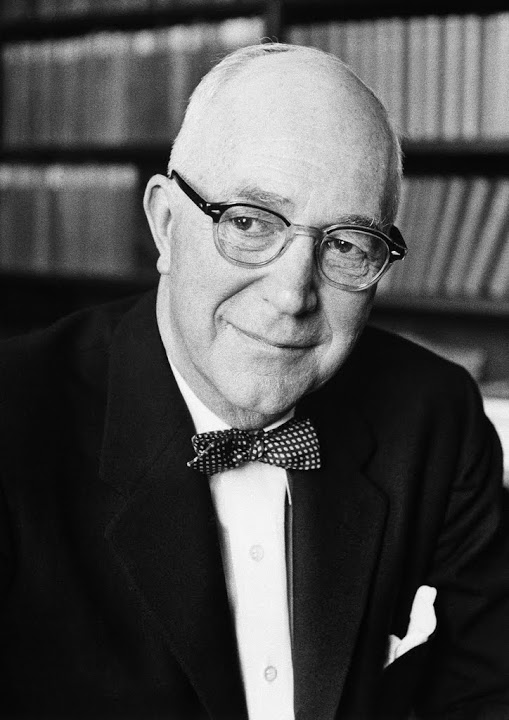
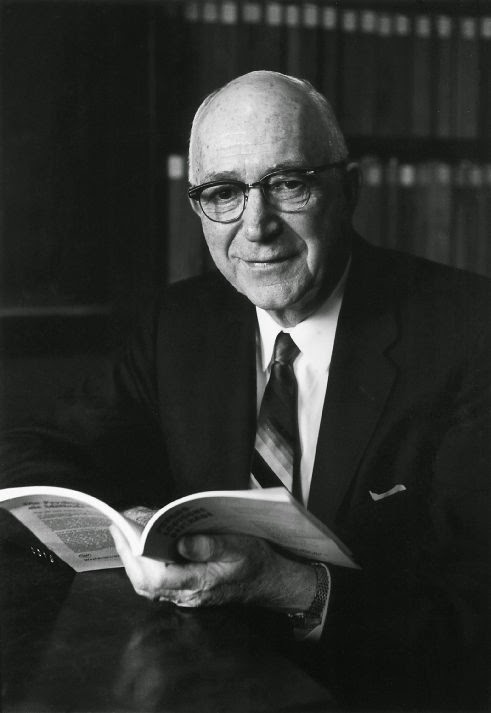
"Gordon Allport's landmark book, The nature of prejudice, defined the field of intergroup relations for social psychologists as the study of prejudice and its effects on group interactions. He organized existing knowledge about societal, group and personality determinants of prejudice acquisition and persistence in a way that suggested new directions for research. Moreover, he brought the subject of ethnic stereotyping into the mainstream of behavioral science by treating this phenomenon as a special case of ordinary cognitive functioning. (...) Allport was impressed by the apparent nonreversability of ethnic stereotypes; his pessimism about the prospects for immediate prejudice reduction in the United States remains a prevalent point of view among investigators."
Irwin Katz, 1991

Excerpts:
The proverb
familiarity breeds contempt contains considerably less than a half-truth. While we sometimes do become bored with our daily routine of living and with some of our customary companions, yet the very values that sustain our lives depend for their force upon their familiarity. What is more, what is familiar tends to
become a value. We come to like the style of cooking, the customs, the people, we have grown up with.
Psychologically, the crux of the matter is that the familiar provides the indispensable basis of our existence. Since existence is good, its accompanying groundwork seems good and desirable. A child's parents, neighborhood, region, nation are given to him - so too his religion, race, and social traditions. To him all these affiliations are taken for granted. Since he is part of them, and they are part of him, they are
good.
The in-group of sex makes an interesting case study. A child of two normally makes no distinction in his companionships: a little girl or a little boy is all the same to him. Even in the first grade the awareness of sex-groups is relatively slight. Asked whom they would choose to play with, first-grade children on the average choose opposite-sexed children at least a quarter of the time. By the time the fourth grade is reached these cross-sexed choices virtually disappear: only two percent of the children want to play with someone of the opposite sex. (...)
For some people - misogynists among them - the sex-grouping remains important throughout their lives. Women are viewed as a wholly different species from men, usually an inferior species.
If a person is capable of rectifying his erroneous judgments in the light of new evidence he is not prejudiced. Prejudgments become prejudices only if they are reversible when exposed to new knowledge. A prejudice, unlike a simple misconception, is actively resistant to all evidence that would unseat it. We tend to grow emotional when a prejudice is threatened with contradiction. Thus the difference between ordinary prejudgments and prejudice is that one can discuss and rectify a prejudgment without emotional resistance.
 "We ar e now in a position to understand and appreciate a major theory of prejudice. It holds that all groups develop a way of living with characteristic codes and beliefs, standards and "enemies" to suit their own adaptive needs."
Gordon W. Allport
"We ar e now in a position to understand and appreciate a major theory of prejudice. It holds that all groups develop a way of living with characteristic codes and beliefs, standards and "enemies" to suit their own adaptive needs."
Gordon W. Allport
"Dogmatism makes for scientific anemia."
Gordon W. Allport
"Many studies have discovered a close link between prejudice and "patriotism" ... Extreme bigots are almost always super-patriots."
Gordon W. Allport
- - - - - - - - - - - - -
- Allport, G. W. (1954) The Nature of Prejudice. Unabridged. 25th anniversary edition. Reading et al.: Addison-Wesley Publishing Company
- Katz, I. (1991) Gordon Allport's
The Nature of Prejudice.
Political Psychology, 12(1), 125-157
- photographs of Gordon Willard Allport (1897-1967)
via and
via