Showing posts with label Michael Rougier. Show all posts

Tuesday, 25 September 2018

"Dear applicant, we regret to inform you...". Rejection letters and politeness strategies in Japan and the U.S.

An analysis of Japanese and US-American rejection letters sent to applicants came to the conclusion that politeness strategies differ. While US-American letters tend to look personal - e.g. by addressing letters personally, often by forename - Japanese letters openly show that all rejected applicants receive the same letter and don't use forenames as not preserving a certain distance would be considered as disrespectful. US-Americans attempt to look positive and communicate concern while Japanese feel less uncomfortable when they are rejected as "one of many" (Baresova, 2008).


"To counterbalance the negativity of refusal and inadequacy with something positive, the Americans frequently added praise for the candidate’s “excellent qualifications”, which, although very personal in appearance, lacked any specifics and were, upon closer comparison, remarkably similar, even between letters addressed to the candidate with many years of experience and the new graduate with no qualifications at all."
Baresova, 2008:108

"It could be argued that the Americans only seem to be more personal than the Japanese, because the Americans also send virtually the same letter to all applicants, but this would be to ignore the more significant fact. Of course neither the Americans nor the Japanese are going to write individualized letters. The difference is that the Americans want to seem personal."
Baresova, 2008:109


"Each culture has a different perception of what is polite, and each language has various devices for expressing politeness. Some situations call for more politeness than others. The importance of politeness increases with the degree of potential offense to the hearer. Rejection is, by its very nature, one of the most offensive speech acts, and if not done politely it is quite likely to negatively impact the hearer’s self-image. Therefore, various politeness strategies are employed to minimize its negative impact. To perform a rejection is not easy, even if both parties have a complete understanding of the language and rituals concerning politeness in that culture. To reject someone from another culture without causing offense or misunderstanding is even more challenging."
Baresova, 2008:11


- Baresova, I. (2008). Politeness Strategies in Cross-Cultural Perspective. Study of American and Japanese Employment Rejection Letters. Olomoue: Palacky University.
- photographs by Micheal Rougier (1964) via and via and via and via

Monday, 1 June 2015

The Tokyo Beatles, Culture, Odd and Even Numbers

While Westerners show a tendency to prefer even numbers, Japanese prefer odd numbers - with few exceptions such as "eight" ("increasing property) and "nine" ("suffering"). In the Seven-Five-Three Festival, for instance, boys and girls at the age of three, boys at the age of five and girls at the age seven celebrate their growth at shrines. According to a custom, festivals are held on odd numbered days in odd-numbered months. At weddings, there is the tradition to give gifts of 10.000, 30.000 or 50.000 yen, never 20.000 or 40.000 yen.


Even numbers, on the other hand, generally do not have positive associations. "Two" means separating, "four" is associated with death and "six" means "good-for-nothing". At funerals, condolence payments are entirely in odd numbers. Hospital sickrooms avoid the number "four" as it sounds like the pronunciation of the word meaning "death".


The clear roles of odd and even numbers can be traced back to the Chinese philosophy of yin and yang (Nishiyama, 2004) - literally meaning dark and bright - which describes the complementary, interconnected and interdependent character of apparently opposite or contrary forces (via).


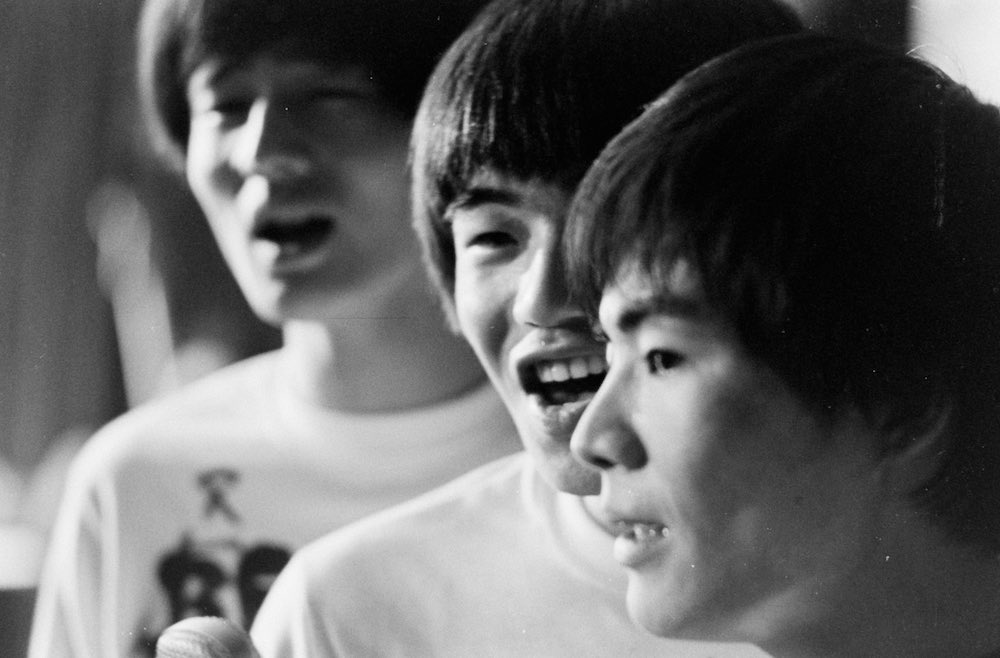
The Tokyo Beatles were a Japanese cover band, "a group of skinny, mop-topped Japanese rock and rollers" that drove their fans wild borrowing their name of "a group of skinny, mop-topped British rock and rollers". The band was most popular for some time and had "highly energized fans" but broke up after seven years in the 1960s "without too many people noticing they were gone" (via).

::: "I want to hold your hand" in Japanese: Dakishimetai 


Michael Rougier (1925-2012) was a LiFE Magazine staff photographer for 24 years (via) and an accomplished sculptor. He was recognised as a "stellar photojournalist" and won the "Magazine Photographer of the Year" award from the National Press Photographers Association in 1954 (via). In 1964, he was on assignment in Japan where he did not only take photographs of the Tokyo Beatles and their fans but "an astonishingly intimate, frequently unsettling portrait of teenagers hurtling willfully toward oblivion" (via).


- Nishiyama, Y. (2004). The Cultural History of Numbers. Studies in Economic History, 8, 146-174.
- photographs by LIFE photographer Michael Rougier (1964) via and via and via and via and via and via and via and via and via and via and via and via and via and via