The
"right of citizens of the United States to vote shall not be denied or abridged by the United States or by any state on account of race, color, or previous condition of servitude."
15th Amendment to the Constitution, ratified on 3 February 1870
 "The Fifteenth Amendment does not confer the right of suffrage upon any one. It prevents the States, or the United States, however, from giving preference, in this particular, to one citizen of the United States over another on account of race, color, or previous condition of servitude. Before its adoption, this could be done. It was as much within the power of a State to exclude citizens of the United States from voting on account of race, &c., as it was on account of age, property, or education. Now it is not. If citizens of one race having certain qualifications are permitted by law to vote, those of another having the same qualifications must be. Previous to this amendment, there was no constitutional guaranty against this discrimination: now there is. It follows that the amendment has invested the citizens of the United States with a new constitutional right which is within the protecting power of Congress. That right is exemption from discrimination in the exercise of the elective franchise on account of race, color, or previous condition of servitude."
The Court, 1876

The Fifteenth Amendment was ratified in 1870 (with a clear limitation: the Court had held that the judiciary did not have the power to force states to register minorities to vote,
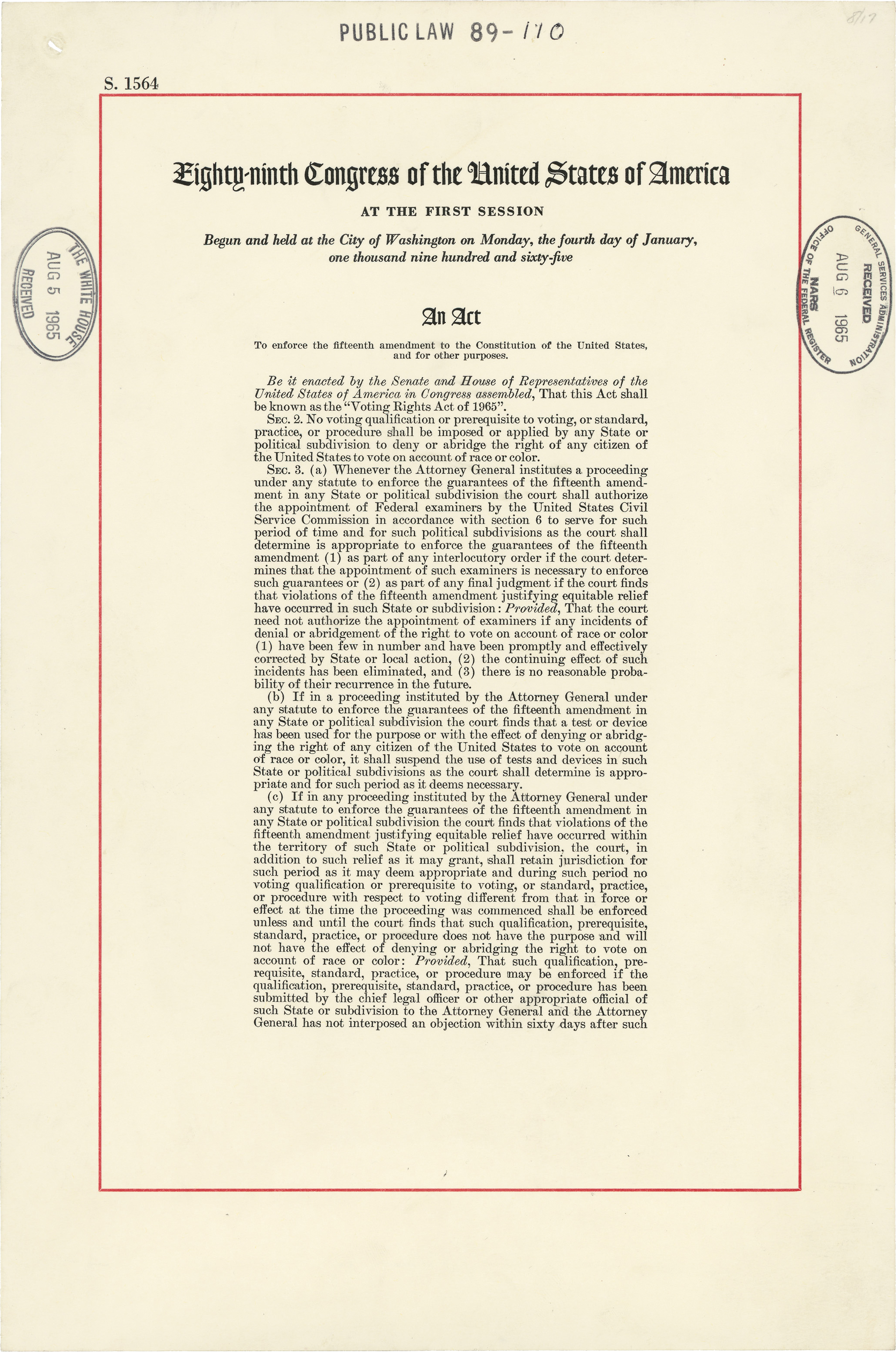
via). Black US-Americans and other minorities, however, had to fight almost another 100 years for their right to vote which was officially gained with the Voting Rights Act of 1965 (
via). Voting started with the registration process which again started with an application form that was four pages long. Registering in the courthouse, which was open only every other Monday for a few hours, meant taking a day off. Taking a day off meant asking the employer for permission. And if white employers gave black employees permission to take a day off to register they were driven out of business (
via). In 1963, for instance, 32 black school teachers applied to register as voters. All of them were immediately fired by the all-white school board (
via). The few hours the registration office was open, the board arrived late and took long lunches (
via).


In addition, tactics such as physical intimidation, i.e., violence organised by the Ku Klux Klan, poll taxes, the grandfather's clause and literacy tests kept voting "a white thing". The tax had to be paid in order to vote while the grandfather's clause allowed adult men
"whose father or grandfather had voted in a specific year prior to the abolition of slavery to vote without paying the tax" (
via). In other words, those whose ancestors had been allowed to vote before the Civil War had the right to vote - practically no black person. In fact, the grandfather's clause was a very effective tool to prevent poor and illiterate black US-Americans from voting without denying poor and illiterate white US-Americans the right to vote (
via). Many counties had a "voucher system" which meant that black persons needed a registered voter who vouched under oath that they met the qualifications. White persons did not dare vouch for black persons and black persons did not have the possibility (
via). At the time protesters were marching through Lowndes County during the Selma to Montgomery Movement in March 1965, 81% of the county's population was black, 19% was white. Not a single black person was registered to vote at that time (
via).

Between August 1964 and July 1965 there were about 100 different so-called literacy tests in order to make sure that applicants could not study for them (
via). Last year, Harvard students took the 1964 Louisiana Literacy Test (30 questions in 10 minutes) black voters had to pass before being allowed to vote. Not one of the "bright Ivy League minds" passed the test. According to their tutor Miller,
"Louisiana’s literacy test was designed to be failed. Just like all the other literacy tests issued in the South at the time, this test was not about testing literacy at all. It was a legitimate sounding, but devious measure that the State of Louisiana used to disenfranchise people that had the wrong skin tone or belonged to the wrong social class." The test was designed in a manner that every question could be interpreted as wrong (
via).
- Here is the Louisiana Literacy Test:
link
- Here is the test used by voting rights pioneer Rufus A. Lewis:
link


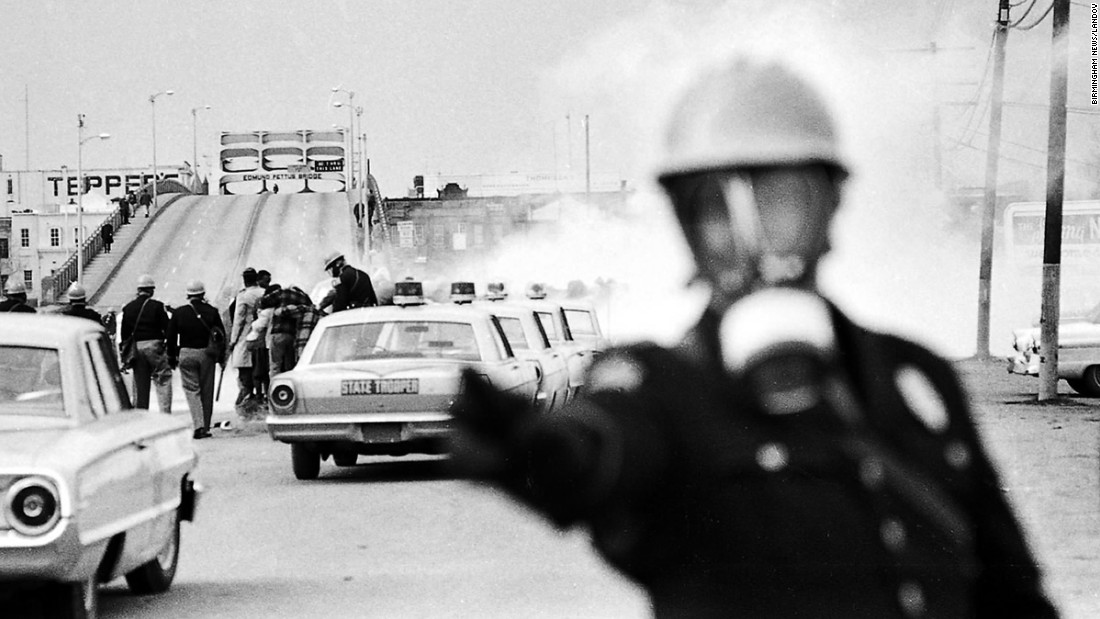
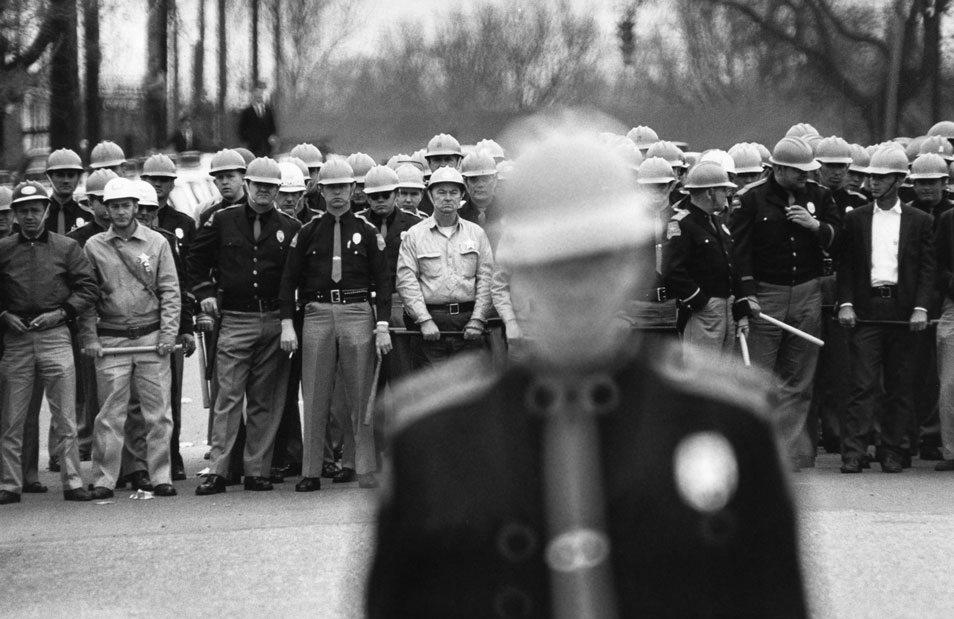
On 7 March 1965, the day that made history as "Bloody Sunday", about 600 protesters gathered in the little town of Selma, Alabama, to march 87 km / 54 miles to the state capital in Montgomery. The County Sheriff had ordered all white males in Dallas County over the age of 21 to report to the courthouse to be deputised. The protest "went according to the plan until the marchers crossed the Edmund Pettus Bridge (...) where they found a wall of state troopers and county posse waiting for them on the other side" (
via). Edmund Pettus Bridge has, by the way, become a symbol, "a landmark that holds so much significance for the civil rights movement" that civil rights activists believe it is time to change the name of the bridge into "Freedom Bridge" or "Bridge to Hope" and therefore started a petition which is, by the way, not far away from its 150.000 signature goal. The reason why is that Edmund Pettus was a Grand Dragon of Alabama's Ku Klux Klan (
via).
Update (March 2017): 189.490 persons signed the petition on change.org, the bridge has kept its name (
via).
 Photograph: Singing "We Shall Overcome" in front of Brown Chapel in Selma (James H. Barker/Steven Kasher Gallery, via)
On 9 March, Martin Luther King, Jr. led a second march to Edmund Pettus Bridge, the place where the first one had ended with police and troopers brutality (dogs, fire hoses, bullwhips, tear gas, batons, and rubber tubing wrapped in barbed wire) (v
ia). This second march is also referred to as "Turnaround Tuesday" because the marchers turned back after crossing the Edmund Pettus Bridge.
After a nationwide call for supporters, on 21 March, the third and final march started with about 8000 people assembling at Brown Chapel (v
ia). Protesters marched through chilling rain and camped overnight. On 24 March, a "Stars for Freedom" rally was held, with Harry Belafonte, Sammy Davis, Jr., Joan Baez, Tony Bennett, Nina Simone, Frankie Laine, Odetta and Pete Seeger, Johnny Mathis, Anthony Perkins, Mike Nichols, Elaine May, Shelley Winters, Ruby Dee, Nipsey Russell, George Kirby, and Peter, Paul and Mary (
via and
via). Among the ones who had completed the entire walk and helped other volunteers to erect and break down the tents for camping were
Pernell Elvin Roberts (Bonanza) and Gary Merrill (All About Eve) (
via). The march ended five days later at the Alabama State Capitol in Montgomery with a petition for Governor Wallace. More than 25.000 people were there (v
ia).

 "Let us march on ballot boxes until race-baiters disappear from the political arena. Let us march on ballot boxes until the salient misdeeds of bloodthirsty mobs will be transformed into the calculated deeds of orderly citizens. Let us march until the Wallaces of our nation tremble away in silence."
Martin Luther King
"Let us march on ballot boxes until race-baiters disappear from the political arena. Let us march on ballot boxes until the salient misdeeds of bloodthirsty mobs will be transformed into the calculated deeds of orderly citizens. Let us march until the Wallaces of our nation tremble away in silence."
Martin Luther King

There had been a great many attempts to gain voting rights before the Selma Voting Rights Movement. Many lost their lives, many were arrested.
The Selma to Montgomery Marches led to the
Voting Rights Act of 1965, signed into law by President Lyndon B. Johnson. on 6 August. This time, to really enforce the voting rights of minorities.
"Even if we pass this bill, the battle will not be over. What happened in Selma is part of a far larger movement which reaches into every section and state of America. It is the effort of American Negroes to secure for themselves the full blessings of American life. Their cause must be our cause, too, because it is not just Negroes but really it is all of us who must overcome the crippling legacy of bigotry and injustice. And we shall overcome." President Lyndon Baines Johnson, speech in front of Congress
::: Selma to Montgomery March, film (17 minutes) by Stefan Sharff:
WATCH
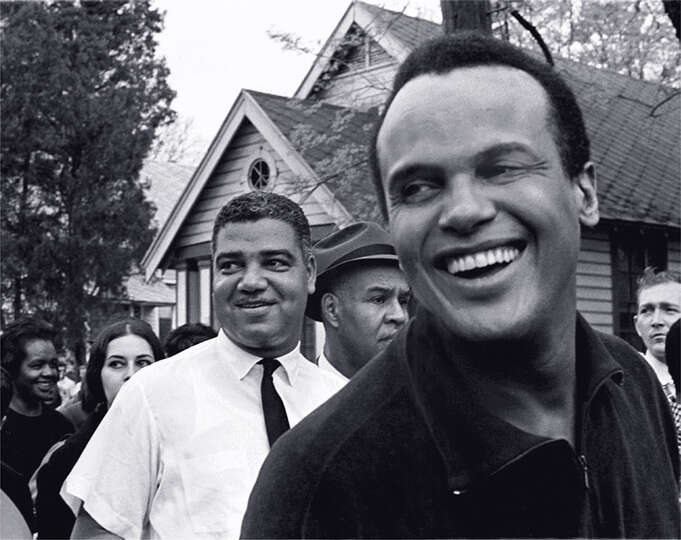
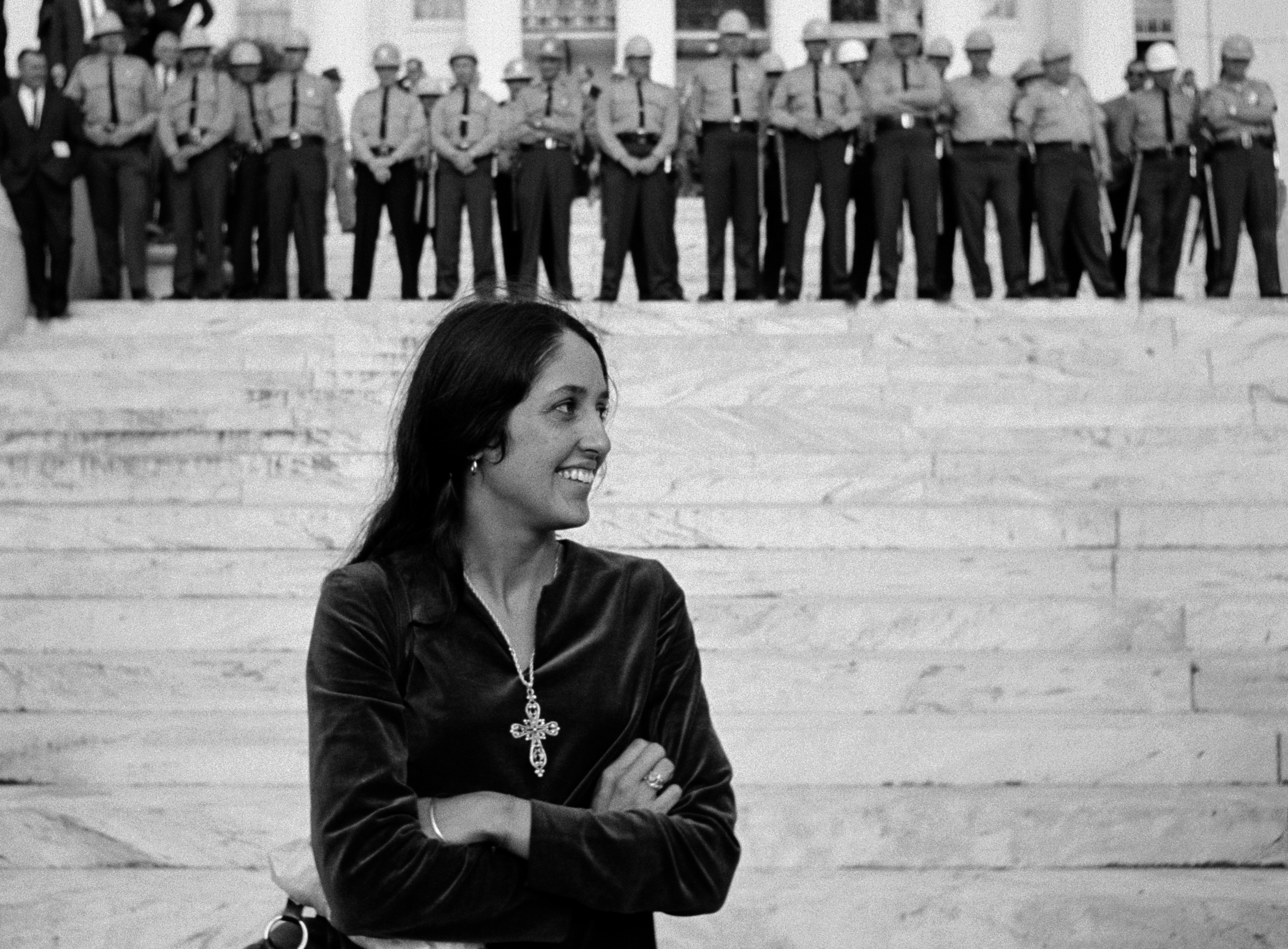
 - photographs: first two ones by James Karales (1930-2002) via and via and Joan Baez with line of state police by Stephen Somerstein via and "Folk singers performing in front of 25,000 Selma to Montgomery civil rights marchers in front of the Alabama State House. Harry Belafonte, Leon Bibb, Joan Baez and Oscar Brand. On March 25, 1965 in Montgomery, Alabama. (descr. via)" via and "The actor and civil rights ativist Harry Belafonte smiles broadly while marching with National Urban League director Whitney Young (1921 - 1971) and NAACP executive secretary Roy Wilkins (1901 - 1981), from Selma to the state capital of Montgomery, Alabama, March 1965. The actress Ina Balin is partly visible over Young's right shoulder (descr. via)" via and "Artist sketching Selma to Montgomery civil rights marchers at City of St. Jude school grounds. On March 25, 1965 in Montgomery, Alabama." via and "Martin Luther King with others via and via and Martin Luther King from the rear speaking in front of 25.000 civil rights marchers at the conclusion of the Selma to Montgomery march in front of Alabama state capital building on 25 March 1965 in Montgomery" by Stephen Somerstein via and "Demonstrators, including Dr. Martin Luther King Jr., stream over an Alabama River bridge at the city limits of Selma, Ala., on March 10, 1965, during a voter rights march (descr. via)" via and "Marchers cross the Alabama River on the Edmund Pettus Bridge in Selma on March 21, 1965" via and Bloody Sunday via and of police line by Flip Schulke via; all copyrights by their respective owners
- Alabama Voter Literacy Test, Parts B and C: link
- photographs: first two ones by James Karales (1930-2002) via and via and Joan Baez with line of state police by Stephen Somerstein via and "Folk singers performing in front of 25,000 Selma to Montgomery civil rights marchers in front of the Alabama State House. Harry Belafonte, Leon Bibb, Joan Baez and Oscar Brand. On March 25, 1965 in Montgomery, Alabama. (descr. via)" via and "The actor and civil rights ativist Harry Belafonte smiles broadly while marching with National Urban League director Whitney Young (1921 - 1971) and NAACP executive secretary Roy Wilkins (1901 - 1981), from Selma to the state capital of Montgomery, Alabama, March 1965. The actress Ina Balin is partly visible over Young's right shoulder (descr. via)" via and "Artist sketching Selma to Montgomery civil rights marchers at City of St. Jude school grounds. On March 25, 1965 in Montgomery, Alabama." via and "Martin Luther King with others via and via and Martin Luther King from the rear speaking in front of 25.000 civil rights marchers at the conclusion of the Selma to Montgomery march in front of Alabama state capital building on 25 March 1965 in Montgomery" by Stephen Somerstein via and "Demonstrators, including Dr. Martin Luther King Jr., stream over an Alabama River bridge at the city limits of Selma, Ala., on March 10, 1965, during a voter rights march (descr. via)" via and "Marchers cross the Alabama River on the Edmund Pettus Bridge in Selma on March 21, 1965" via and Bloody Sunday via and of police line by Flip Schulke via; all copyrights by their respective owners
- Alabama Voter Literacy Test, Parts B and C: link


.jpg)


.jpg)
.jpg)

.jpg)

.jpg)
.jpg)











a_72dpi-L.jpg)