Showing posts with label STEM. Show all posts

Thursday, 12 December 2019

Women Wearing Swimsuits and Performing in Math

Fredrickson et al. (1998) tested the hypothesis that self-objectification diminishes math performance (n = 82 undergraduate students at the University of Michigan, 42 women and 40 men). Students completed the Self-Objectification Questionnaire, their tendency to body shame was measured, as well as their feelings associated with trying on swimwear; they were given a challenging math test, as well as sweets.


Female participants were randomly assigned to two experimental conditions: trying on a one-piece swimsuit or a V-neck jumper, male participants either wore a swim trunk or a crew neck jumper. In all cases, they did so alone in a dressing rom where they were asked to look at themselves in the full-length mirror and afterwards complete all questionnaires mentioned before. Then, they were given sweets and told to eat as much as they wanted and fill out another questionnaire.


Results show that only in the case of women trying on a swimsuit (i.e. manipulating the state of self-objectification) produced more body shame than trying on a jumper. Self-objectification, again, led to body shame in women. And most interestingly, women performed worse on the math test when wearing a swimsuit than when wearing a jumper (Fredrickson et al., 1998).
In 2004, Hebl, King and Lin replicated the study with 400 undergraduate students (with a focus on gender and ethnicity) and supported the findings that "sellf-objectification serves as a mechanism through which the experience of wearing a swimsuit affected psychological and behavioral outcomes", that women had lower self-esteem and body image than men. However, they added: "All individuals can be vulnerable to the consequences of self-objectification."


- Fredrickson, B. L., Noll, S. M., Roberts, T.-A., Quinn, D. M. & Twenge, J. M. (1998). That Swimsuit Becomes You: Sex Differences in Self-Objectification, Restrained Eating, and Math Performance. Journal of Personality and Social Psychology, 75(1), 269-284.
- Hebl, M., King, E. B. & Lin, J. (2004). The Swimsuit Becomes Us All: Ethnicity, Gender and Vulnerability to Self-Objetcification. Personality and Social Psychology Bulletin, 30(10), link
- images of Alain Delon and Romy Schneider (La Piscine, 1969) via and via and via

Friday, 29 November 2019

STEM, Gender, and Stereotypes

"Women have been found to be under-represented in fields where it is believed that innate talent is the main requirement for success and where women are stereotyped as not possessing this talent."
UNESCO (2017:43)


Various reasons are considered when discussing gender inequalities in STEM (Science, Technology, Engineering, Mathematics). Self-selection bias is seen as the major reason for girls not considering STEM professions since they believe they would be incompatible with their gender. Girls encounter explicit and implicit STEM-related gender stereotypes throughout the socialisation process; two stereotypes prevail: Boys are better at maths and science and engineering careers are masculine domains. These stereotypes are internalised but even if not, having people around them who hold such beliefs can undermine the girls'confidence, performance, and intention to pursue a STEM career. Often, parents (particularly mothers) can reinforce negative stereotypes about girls in STEM and discourage their daughters. Similarly, (female) peers who see STEM subjects as inappropriate for women have a discouraging effect. Teachers play a crucial role, too. In one study, they were found to be "the only significant predictor of girls' interest and confidence in science". 
(UNESCO, 2017)

Related posting:
::: Women, Maths & Stereotype Threat: LINK

- - - - - - - - - -
- UNESCO (2017). Cracking the code: Girls' and Women's Education in Science, Technology, Engineering and Mathematics (STEM). LINK
- photograph of Iranian women before the Islamic Revolution by A. Abbas/Magnum Photos via

Tuesday, 27 September 2016

In the year 2069

According to Deloitte's recent analysis, the gender pay gap in the UK is incrementally closing. But: Real pay parity between men and women is  - at the current rate of convergence - not forecast to be achieved until 2069, i.e. 99 years after the 1970 Equal Pay Act (via and via).

::: The full report: Women in STEM. Technology, career pathways and the gender pay gap: DOWNLOAD


"BE IT ENACTED by the Queen's most Excellent Majesty, by and with the advice and consent of the Lords Spiritual and Temporal, and Commons, in this present Parliament assembled, and by the authority of the same, as follows:-
1.-(l) The provisions of this section shall have effect with a Requirement view to securing that employers give equal treatment as regards of equal terms and conditions of employment to men and to women (...)"
Equal Pay Act 1970

- - - - - - - - - -
Photograph via

Sunday, 28 June 2015

Born this day ... Maria Goeppert-Mayer

"Some [schools] even condescended to give her work, though they refused to pay her, and the topics were typically 'feminine', such as figuring out what causes colors … the University of Chicago finally took her seriously enough to make her a professor of physics. Although she got her own office, the department still didn't pay her … When the Swedish academy announced in 1963 that she had won her profession's highest honor, a local San Diego newspaper greeted her big day with the headline 'S.D. Mother Wins Nobel Prize'." (via)


"Do girls only have to learn how to read just to study cook books?"
Maria Goeppert Mayer

"'Don't grow up to be a woman', and what he meant was, a housewife ... without interests ... Did I think it strange for him to say such a thing to me? ... No, I felt flattered and decided I wasn't going to be just a woman."
Maria Goeppert Mayer (cited in Hargittai, 2015)

Maria Goeppert-Mayer was born on 28 June 1906 in the city of Kattowitz (then in Germany, now Katowice in Poland). Her father, who she found more interesting than her mother because "He was after all a scientist", told her "she should not grow up to be a woman, meaning a housewife". And that was exactly what she did not become. Although there was no public high school offering education to girls to make them eligible to enroll at a university, she passed university entrance, studied mathematics and got more and more interested in physics. With her husband, the US-American physicist Joseph Mayer, she moved to the U.S. and continued the family tradition of becoming professors (she was the seventh straight generation of university professors on her father's side) and took up appointments at e.g. Johns Hopkins University and Columbia University (Sachs, 1979). Later, her son mentioned that running a home was "not her forte" and that her husband suggested to hire support (Hargittai, 2015).
"My father's response to my mother's helplessness was, 'As expensive as maids are in the United States, I promise to hire one ... as long as you remain a scientist!'" Peter Mayer (their son)
For her work on the nuclear shell structure, she received the Nobel Prize in Physics in 1963 (Sachs, 1979) which she shared with Eugene Wigner and Hans Jensen. She was the fourth woman Nobel laureate and the second one in physics (Sachs, 1979). Maria Goeppert-Mayer passed away in San Diego on 20 February 1972.


- Hargittai, M. (2015) Women Scientists. Reflections, Challenges, and Breaking Boundaries. Oxford University Press
- Sachs, R. G. (1979) Maria Geoppert Mayer. 1906-1972. A Biographical Memoir by Robert G. Sachs. National Academy of Sciences Washington D.C.
- photographs via and via and via

Saturday, 16 May 2015

Women, Maths & Stereotype Threat

Do stereotypes – such as women having inferior mathematics skills - have an effect on calculus performance? In order to answer that question, 102 female undergraduates majoring in STEM (science, technology, engineering, mathematics) fields were randomly assigned to three groups: 1) stereotype threat (women were told that there were gender differences and that men performed better than women), 2) gender equivalence (subtle cues: women were told that there were no gender differences and that men and women performed equally), and 3) no mention of gender.


According to Stelle (1997), "stereotype threat should have its greatest effect on the better, more confident students in stereotyped groups, those who have not internalized the group stereotype to the point of doubting their own ability and have thus remained identified with the domain - those who are in the academic vanguard of their group."


The results: Women performed the worst in the stereotype threat condition, intermediate in the gender equivalence condition and best in the no mention condition. In addition, the effect of stereotype threat on performance was greatest for women with higher skills (Steinberg et al., 2012). Stereotypes do matter.


- Steinberg, J. R., Okun, M. A. & Aiken, L. S. (2012). Calculus GPA and Math Identification as Moderators of Stereotype Threat in Highly Persistent Women. Basic and Applied Social Psychology, 34, 534-543
- photographs "NASA before Powerpoint" by J. R. Wharton Eyerman (1961) via and via and via

This posting was originally published on Science on Google+ on 6th of December 2014

Friday, 7 November 2014

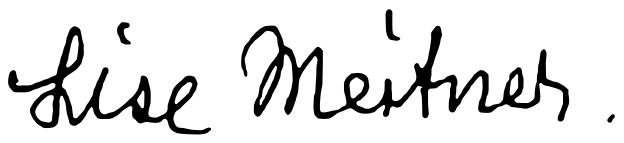
Born this day ... Lise Meitner

"I will have nothing to do with a bomb!"

"Surely Hahn fully deserved the Nobel Prize for chemistry. There is really no doubt about it. But I believe that Otto Robert Frisch and I contributed something not insignificant to the clarification of the process of uranium fission - how it originates and that it produces so much energy and that was something very remote to Hahn."


Lise Meitner (1878-1968) was born on 7th of November 1878 in Vienna. The physicist was the "Mother of the Atomic Bomb" and a pacifist, a female scientist at a time women were not yet permitted at Prussian universities, and an Austrian of Jewish descent living in the 1930s (via). First she suffered because she was a woman, then she suffered because she was Jewish (via) and fled to Sweden.
In 1905/06, Meitner became the second woman to earn a doctoral degree at the University of Vienna. She went to Berlin to study with Max Planck (via) who - until then - had rejected any women wanting to attend his lectures, later became his assistant and then the first woman in Germany to assume the post of full professor in physics (via). In Berlin, she met Otto Hahn who became her research partner for the following 30 years (via). At that time, working in Berlin as a female scientist meant entering the Kaiser-Wilhelm-Institut (now Max Planck Institut) through the backdoor (via) and making experiments in the cellar since women had no access to "real" laboratories (via).
Otto Hahn (1879-1968) received the Nobel Prize in Chemistry for 1944, Meitner - part of the team that discovered the nuclear fission - was overlooked. And not just once. From 1939 to 1945 she was nominated nine times, each time a male candidate received the prize (via). Meitner is probably "one of the most glaring examples of women's scientific achievement overlooked by the Nobel committee." (via).

images via and via