"Just because a man lacks the use of his eyes doesn't mean he lacks vision."
Stevie Wonder
"Sometimes, I feel I am really blessed to be blind because I probably would not last a minute if I were able to see things."
Stevie Wonder
🚧The photo is currently unavailable.
"Clearly, love is love, between a man and a woman, a woman and a man, a woman and a woman and a man and a man. What I'm not confused about is the world needing much more love, no hate, no prejudice, no bigotry and more unity, peace and understanding. Period."
Stevie Wonder
"I am all for anything that is going to better equip a person who is physically challenged in any way, to have an opportunity to be able to do what they are able to do."
Stevie Wonder
"I am not a normal man."
Stevie Wonder
"Do you know, it's funny, but I never thought of being blind as a disadvantage, and I never thought of being black as a disadvantage."
Stevie Wonder
"When I was a child, kids used to make fun of me because I was blind. But I just became more curious, 'How can I climb this tree and get an apple for this girl?' That's what mattered to me."
Stevie Wonder
- - - - - - - -
Stevie Wonder on YouTube:
::: Superstition: LISTEN/WATCH
::: For Once in My Life: LISTEN/WATCH
::: I'm Gonna Make You Love Me: LISTEN/WATCH
::: The Shadow of Your Smile: LISTEN/WATCH
::: Yester-Me, Yester-You, Yesterdy: LISTEN/WATCH
- - - - - - - -
photograph of Stevie Wonder via

Selection of categories
 Age |
 Disability |
 Ethnicity |
 Queer |
 Religion |
 Gender |
 Stereotypes |
 -isms |
 Quotes |
 World days |
 Music |
 Space |
 Sports |
 Health |
 Marketing |
 Urban planning |
 Narrative images |
 Birthday |
 Language |
 Segregation |
 School |
Saturday, 30 September 2017


Friday, 29 September 2017
Beauty Warriors
"To be successful, you must be perfect and look perfect—these are our society’s rules, which we all follow without even realizing how ridiculous the standards are. We often forget about the importance of inner beauty."
Evija Laivina


"The series “Beauty Warriors” is (sic) collection of photographs featuring strange and unusual-looking beauty products. All the products were bought on Ebay, and most items were made in China. These products promise instant cures to almost all beauty problems; they fight “problem zones” and promise to cure problems without surgical intervention. Each item visually appeals to me and I tried to show the relationship between beauty product and model."
Evija Laivina


Evija Laivina is an HND Contemporary Art Practice student at Inverness College UHI (via). Her “Beauty Warriors” received the LensCulture Portrait Awards 2017 Student Spotlight Award.


"In today’s world, success is closely tied to perceived perfection. Appropriating the style of traditional portraiture, this series questions the use of products that promise to augment our physical appearance."
Evija Laiviņa


photographs via, copyright by the artist
Evija Laivina


"The series “Beauty Warriors” is (sic) collection of photographs featuring strange and unusual-looking beauty products. All the products were bought on Ebay, and most items were made in China. These products promise instant cures to almost all beauty problems; they fight “problem zones” and promise to cure problems without surgical intervention. Each item visually appeals to me and I tried to show the relationship between beauty product and model."
Evija Laivina


Evija Laivina is an HND Contemporary Art Practice student at Inverness College UHI (via). Her “Beauty Warriors” received the LensCulture Portrait Awards 2017 Student Spotlight Award.


"In today’s world, success is closely tied to perceived perfection. Appropriating the style of traditional portraiture, this series questions the use of products that promise to augment our physical appearance."
Evija Laiviņa


photographs via, copyright by the artist
Friday, 22 September 2017
Time to forget
"It's time to forget
To forget about your age
Forget about your race
Your social standing
Your ideological view...
Forget about everything that keeps us apart"
September is World Alzheimer's Month, November is National Alzheimer's Disease Awareness Month in the U.S., and June is Alzheimer' & Brain Awareness Month. These initiatives all aim at raising awareness and changing the circumstances of those directly and indirectly affected. According to the World Health Organisation, members of civil society "can play a key role in improving the lives of people with dementia, their carers and families" by enhancing dementia research, by supporting people with dementia, their carers and families, by fostering improvement in health and social care delivery, by raising public awareness, and by influencing government policy-making. More: LINK
To forget about your age
Forget about your race
Your social standing
Your ideological view...
Forget about everything that keeps us apart"
September is World Alzheimer's Month, November is National Alzheimer's Disease Awareness Month in the U.S., and June is Alzheimer' & Brain Awareness Month. These initiatives all aim at raising awareness and changing the circumstances of those directly and indirectly affected. According to the World Health Organisation, members of civil society "can play a key role in improving the lives of people with dementia, their carers and families" by enhancing dementia research, by supporting people with dementia, their carers and families, by fostering improvement in health and social care delivery, by raising public awareness, and by influencing government policy-making. More: LINK
Thursday, 21 September 2017
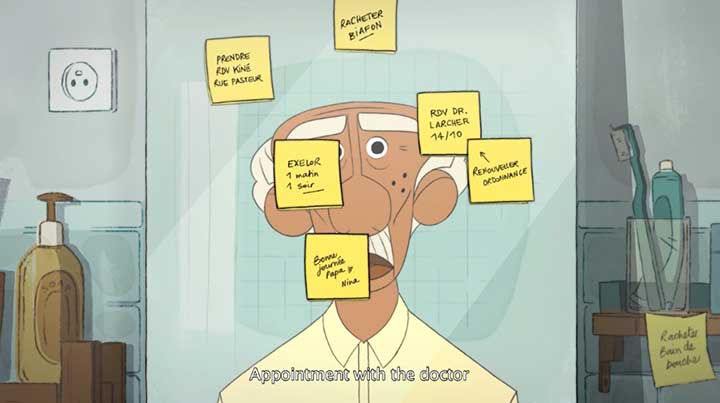
Mémo
Louis has a protective daughter, Alzheimer's and a strong will to carry on despite the difficulties. This beautiful animated short film was produced by the award winning animation school Gobelins.

Today is World Alzheimer's Day, a day that is dedicated to raising awareness about persons with Alzheimer's and its impact on their families. Alzheimer's is a family disease as family members often develop chronic stress when they helplessly watch their parent's, partner's, sibling's, ... cognitive decline and see how the symptoms worsen (via).
image via

Today is World Alzheimer's Day, a day that is dedicated to raising awareness about persons with Alzheimer's and its impact on their families. Alzheimer's is a family disease as family members often develop chronic stress when they helplessly watch their parent's, partner's, sibling's, ... cognitive decline and see how the symptoms worsen (via).
image via
Wednesday, 20 September 2017
Born this day ... Lee Lorch
"Because he believed in the principles of decency and justice, and the equality of men under God, Lee Lorch and his family have been hounded through four states from the North to the South like refugees in displaced camps. And in the process of punishing Lee Lorch for his views, three proud institutions of learning have been made to grovel in the dust and bow the knee to bigotry."
Ethel Payne

Lee Lorch (1915-2014) was a mathematician and civil rights activist. He obtained his PhD in mathematics from the University in Cincinnati in 1941.
After World War II, Lorch started teaching at the City College of New York "but was soon fired because of his civil rights work on behalf of African-Americans." Shortly after taking up his job at the City College of New York, he moved into Stuyvesant Town, a private residential development on the east side of Manhattan, owned by the Metropolitan Life Insurance. Blacks were barred from living there as, according to the president of Metropolitan Life, "negroes and whites do not mix" and apart from that "it would be to the detriment of the city, too, because it would depress all surrounding property." Lee Lorch had all the credentials to move in, i.e., a "steady job, college, teacher and all that. And, not black." The lawsuit against Metropolitan that had been brought in by several people and organisations in 1947 had failed in the state courts as the insurance company was free to select tenants based on absurd criteria. Lorch was aware of the discrimination other faced and became a vice-chair of the tenants' committe that was founded to eliminate the housing discrimination. He also invited a black family (art student Hardine and Raphael Hendrix and their 6-year-old son Hardine Jr.) to live in his own flat where he was living with his wife (a longtime activist herself) and his young daughter.

Lorch did not pay the price for his activism only once. In 1949, he was forced to leave City College since he was "unquestionably a fine scholar and a promising teacher" but "an irritant and a potential troublemaker". The N.A.A.C.P. protested the decision ... but Lorch had to leave.
Lorch started teaching at Pennsylvania State University. When he arrived at the campus, he was immediately taken to the university's acting president whom he had to explain what had happened at Stuyvesant Town as the university had received phone calls from wealthy alumni who wanted to know why Lorch had been hired. He was denied reappointment because he had accommodated a black family which was "extreme, illegal and immoral, and damaging to the public relations of the college." Students, the American Association of University Professors, the American Mathematical Society, The New York Times, The Daily Worker, and Albert Einstein protested ... but Lorch had to leave.
In 1950, Lorch became one of two white professors at historically black Fisk University. He continued his activism, tried to enroll his daughter in an all-black school, refused to answer questions before the House Un-American Activities Committee ... in 1955, Lorch had to leave Fisk University.
When the Little Rock Nine enrolled in Little Rock Central High School in 1957, Lee Lorch - at that time an official with the Arkansas chapter of the N.A.A.C.P. and chair of the Mathematics Department at Philander Smith College in Little Rock - was working behind the scenes and accompanying the students to school and tutoring them. He was told his best contribution would be to terminate his affiliation with the Little Rock Branch of the N.A.A.C.P. Whites abused him for his desegregation activism, blacks kept their distance because of the "un-American" stance he was accused of. After threats and the school's funding at risk, Lorch resigned.
By 1959 it was official that no US-American college would have him, Lorch was blacklisted. The family moved to Canada where he taught at the University of Alberta and then at York University until he retired.
In 2010, Lee Lorch was asked if he would do anything differently. His reply: "More and better of the same."
- - - - - - - - - -
- Fox, A. (2010). Battle in Black and White. In Rosenblum, C. (ed.) More New York Stories. The Best of the City Section of The New York Times, New York & London: New York University Press, 246-253
- photographs via and via
Ethel Payne

Lee Lorch (1915-2014) was a mathematician and civil rights activist. He obtained his PhD in mathematics from the University in Cincinnati in 1941.
After World War II, Lorch started teaching at the City College of New York "but was soon fired because of his civil rights work on behalf of African-Americans." Shortly after taking up his job at the City College of New York, he moved into Stuyvesant Town, a private residential development on the east side of Manhattan, owned by the Metropolitan Life Insurance. Blacks were barred from living there as, according to the president of Metropolitan Life, "negroes and whites do not mix" and apart from that "it would be to the detriment of the city, too, because it would depress all surrounding property." Lee Lorch had all the credentials to move in, i.e., a "steady job, college, teacher and all that. And, not black." The lawsuit against Metropolitan that had been brought in by several people and organisations in 1947 had failed in the state courts as the insurance company was free to select tenants based on absurd criteria. Lorch was aware of the discrimination other faced and became a vice-chair of the tenants' committe that was founded to eliminate the housing discrimination. He also invited a black family (art student Hardine and Raphael Hendrix and their 6-year-old son Hardine Jr.) to live in his own flat where he was living with his wife (a longtime activist herself) and his young daughter.
"The Stuyvesant Town tenants committee, with 1,800 members, was made up of the families of veterans who believed that after fighting a war for justice overseas, they could not ignore injustice at home. "The courage and sharpshooting of a Negro machine gunner saved my life with a dozen other white G.I.'s (...). Can any one of us say he can't be my neighbor? I can't." Surveys of residents conducted by the tenants committee showed that two-thirds of Stuyvesant Town's 25,000 tenants opposed MetLife's exclusionary policy." (Fox, 2010)
"I had become very aware of racism through the war; not just anti-Semitism, but the way the American army treated black soldiers. On the troop transport overseas, it was always the black company on board that had to clean the ship and do the dirty work, and I felt very uncomfortable with that." Lee Lorch, 2007Metropolitan Life refused to accept the Lorches' rent check and started searching for ways to get them out. But Lorch had decided not to go quietly, that he would resist and that they had to throw him out by force.
"Nineteen of the families decided to fight to keep their apartments. (...) The city marshal ordered the targeted tenants to be out of their apartments by 9 o'clock on the morning of Jan. 17, 1952, and hired a moving company to drag their furniture onto the street. In response, the families barricaded their doors. They sent their children to stay with relatives and passed baskets of food from window to window with ropes." (Fox, 2010)In 1950, Metropolitan Life admitted three token black families but did not change its tenant housing policy. In 1959, only 47 black tenants lived in Stuyvesant Town.

Lorch did not pay the price for his activism only once. In 1949, he was forced to leave City College since he was "unquestionably a fine scholar and a promising teacher" but "an irritant and a potential troublemaker". The N.A.A.C.P. protested the decision ... but Lorch had to leave.
Lorch started teaching at Pennsylvania State University. When he arrived at the campus, he was immediately taken to the university's acting president whom he had to explain what had happened at Stuyvesant Town as the university had received phone calls from wealthy alumni who wanted to know why Lorch had been hired. He was denied reappointment because he had accommodated a black family which was "extreme, illegal and immoral, and damaging to the public relations of the college." Students, the American Association of University Professors, the American Mathematical Society, The New York Times, The Daily Worker, and Albert Einstein protested ... but Lorch had to leave.
In 1950, Lorch became one of two white professors at historically black Fisk University. He continued his activism, tried to enroll his daughter in an all-black school, refused to answer questions before the House Un-American Activities Committee ... in 1955, Lorch had to leave Fisk University.
When the Little Rock Nine enrolled in Little Rock Central High School in 1957, Lee Lorch - at that time an official with the Arkansas chapter of the N.A.A.C.P. and chair of the Mathematics Department at Philander Smith College in Little Rock - was working behind the scenes and accompanying the students to school and tutoring them. He was told his best contribution would be to terminate his affiliation with the Little Rock Branch of the N.A.A.C.P. Whites abused him for his desegregation activism, blacks kept their distance because of the "un-American" stance he was accused of. After threats and the school's funding at risk, Lorch resigned.
By 1959 it was official that no US-American college would have him, Lorch was blacklisted. The family moved to Canada where he taught at the University of Alberta and then at York University until he retired.
In 2010, Lee Lorch was asked if he would do anything differently. His reply: "More and better of the same."
"It's hard to imagine now, but there was no civil rights legislation back then. You could be fired without explanation. But how could you do anything else, in all good conscience?" Lee LorchDecades later, several colleges - among them two that had fired him - and associations gave Lee Lorch honorary degrees and other awards (via and via).
- - - - - - - - - -
- Fox, A. (2010). Battle in Black and White. In Rosenblum, C. (ed.) More New York Stories. The Best of the City Section of The New York Times, New York & London: New York University Press, 246-253
- photographs via and via


Tuesday, 19 September 2017
Superman and the Undocumented Workers
In Actions Comics #987 - "The Oz Effect" - Superman protects undocumented immigrants from an angry white man who wants to shoot them for taking his job. Superman, once an undocumented immigrant himself, has always stood up for justice. The issue was released a few days ago, at a time Superman's protection is very much needed again.

image via

image via

Thursday, 14 September 2017
"Equality should have no boundaries." Nike.
Nike's campaign from February 2017 (Black History Month) speaks up for equality. Part of the campaign is a clip that features "Nike athletes", a film narrated by Michael B. Jordan (via).

"Equality is about Nike raising its voice and using the power of sport to stand up for the value of equality and to inspire people to take action in their communities."
Nike
"Together with our athletes, employees and communities, we are encouraging people to take the respect and fairness they see on the field and translate it off the field. We can help advance the conversation and create lasting change."
Nike
Behind the scenes:WATCH
- - - - -
image via

"Equality is about Nike raising its voice and using the power of sport to stand up for the value of equality and to inspire people to take action in their communities."
Nike
"Together with our athletes, employees and communities, we are encouraging people to take the respect and fairness they see on the field and translate it off the field. We can help advance the conversation and create lasting change."
Nike
Behind the scenes:WATCH
- - - - -
image via

Tuesday, 12 September 2017
The Role of the Behavioral Scientist in the Civil Rights Movement, by Martin Luther King, Jr. (1967)
"On 1 September 1967, the Nobel Prize-winning civil rights leader Martin Luther King Jr. delivered a speech entitled 'The role of the behavioral scientist in the civil rights movement' to the American Psychological Association (APA, 1999; King, 1968). With eloquence and passion, Martin Luther King championed the civil rights struggle and spoke to the interests of his audience. He stressed how behavioural scientists could and should support the civil rights movement. King's eloquent and passionate speech is still relevant today - explaining how psychologists and other mental health professionals could help address today's pressing social issues."
Kinderman

Some excerpts:
(...) In the preface to their book, 'Applied Sociology' (1965), S. M. Miller and Alvin Gouldner state: 'It is the historic mission of the social sciences to enable mankind to take possession of society.' It follows that for Negroes who substantially are excluded from society this science is needed even more desperately than for any other group in the population.
For social scientists, the opportunity to serve in a life-giving purpose is a humanist challenge of rare distinction. Negroes too are eager for a rendezvous with truth and discovery. We are aware that social scientists, unlike some of their colleagues in the physical sciences, have been spared the grim feelings of guilt that attended the invention of nuclear weapons of destruction. Social scientists, in the main, are fortunate to be able to extirpate evil, not to invent it.
If the Negro needs social sciences for direction and for self-understanding, the white society is in even more urgent need. White America needs to understand that it is poisoned to its soul by racism and the understanding needs to be carefully documented and consequently more difficult to reject. The present crisis arises because although it is historically imperative that our society take the next step to equality, we find ourselves psychologically and socially imprisoned. All too many white Americans are horrified not with conditions of Negro life but with the product of these conditions-the Negro himself.
(...) Now there are many roles for social scientists in meeting these problems. Kenneth Clark has said that Negroes are moved by a suicide instinct in riots and Negroes know there is a tragic truth in this observation. Social scientists should also disclose the suicide instinct that governs the administration and Congress in their total failure to respond constructively. What other areas are there for social scientists to assist the civil rights movement? There are many, but I would like to suggest three because they have an urgent quality.
Social science may be able to search out some answers to the problem of Negro leadership. E. Franklin Frazier, in his profound work, Black Bourgeoisie, laid painfully bare the tendency of the upwardly mobile Negro to separate from his community, divorce himself from responsibility to it, while failing to gain acceptance in the white community. There has been significant improvements from the days Frazier researched, but anyone knowledgeable about Negro life knows its middle class is not yet bearing its weight. Every riot has carried strong overtone of hostility of lower class Negroes toward the affluent Negro and vice versa. No contemporary study of scientific depth has totally studied this problem. Social science should be able to suggest mechanisms to create a wholesome black unity and a sense of peoplehood while the process of integration proceeds.
As one example of this gap in research, there are no studies, to my knowledge, to explain adequately the absence of Negro trade union leadership. Eight-five percent of Negroes are working people. Some two million are in trade unions but in 50 years we have produced only one national leader-A. Philip Randolph.
Discrimination explains a great deal, but not everything. The picture is so dark even a few rays of light may signal a useful direction.
(...) I have not lost hope. I must confess that these have been very difficult days for me personally. And these have been difficult days for every civil rights leader, for every lover of justice and peace.
Full text: American Psychological Association

photographs via and via
Kinderman

Some excerpts:
(...) In the preface to their book, 'Applied Sociology' (1965), S. M. Miller and Alvin Gouldner state: 'It is the historic mission of the social sciences to enable mankind to take possession of society.' It follows that for Negroes who substantially are excluded from society this science is needed even more desperately than for any other group in the population.
For social scientists, the opportunity to serve in a life-giving purpose is a humanist challenge of rare distinction. Negroes too are eager for a rendezvous with truth and discovery. We are aware that social scientists, unlike some of their colleagues in the physical sciences, have been spared the grim feelings of guilt that attended the invention of nuclear weapons of destruction. Social scientists, in the main, are fortunate to be able to extirpate evil, not to invent it.
If the Negro needs social sciences for direction and for self-understanding, the white society is in even more urgent need. White America needs to understand that it is poisoned to its soul by racism and the understanding needs to be carefully documented and consequently more difficult to reject. The present crisis arises because although it is historically imperative that our society take the next step to equality, we find ourselves psychologically and socially imprisoned. All too many white Americans are horrified not with conditions of Negro life but with the product of these conditions-the Negro himself.
(...) Now there are many roles for social scientists in meeting these problems. Kenneth Clark has said that Negroes are moved by a suicide instinct in riots and Negroes know there is a tragic truth in this observation. Social scientists should also disclose the suicide instinct that governs the administration and Congress in their total failure to respond constructively. What other areas are there for social scientists to assist the civil rights movement? There are many, but I would like to suggest three because they have an urgent quality.
Social science may be able to search out some answers to the problem of Negro leadership. E. Franklin Frazier, in his profound work, Black Bourgeoisie, laid painfully bare the tendency of the upwardly mobile Negro to separate from his community, divorce himself from responsibility to it, while failing to gain acceptance in the white community. There has been significant improvements from the days Frazier researched, but anyone knowledgeable about Negro life knows its middle class is not yet bearing its weight. Every riot has carried strong overtone of hostility of lower class Negroes toward the affluent Negro and vice versa. No contemporary study of scientific depth has totally studied this problem. Social science should be able to suggest mechanisms to create a wholesome black unity and a sense of peoplehood while the process of integration proceeds.
As one example of this gap in research, there are no studies, to my knowledge, to explain adequately the absence of Negro trade union leadership. Eight-five percent of Negroes are working people. Some two million are in trade unions but in 50 years we have produced only one national leader-A. Philip Randolph.
Discrimination explains a great deal, but not everything. The picture is so dark even a few rays of light may signal a useful direction.
(...) I have not lost hope. I must confess that these have been very difficult days for me personally. And these have been difficult days for every civil rights leader, for every lover of justice and peace.
Full text: American Psychological Association

photographs via and via


Friday, 8 September 2017
Captain Kathryn Janeway
"It took balls for these guys to hire me in this capacity. It’s a bold choice, and an appropriate one for 400 years in the future."
Kate Mulgrew
"I'm not even remotely surprised at how much attention the fact that the show had a female captain attracted. This is the human condition. It's novelty."
Kate Mulgrew cited in Altman & Gross (2016)

The decision to have a female captain was "a landmark moment" (Knight, 2010) and one the creators never made a grand point about. There was a female captain. Naturally (via). Because it "seemed like the logical thing to do" (via).

Before Kate Mulgrew, there was Geneviève Bujold. Bujold was supposed to play Captain Janeway in Voyager but left after three days because she could not adjust to the work schedule TV series have (via). Kate Mulgrew was the next choice:

"The beauty of ‘Star Trek’ is that Roddenberry was very far-seeing. Gender regarding the Captain’s seat was a unilateral thing. It transcended all of those classifications. I think that I played Janeway as I would play her today."
Kate Mulgrew
"I watched this with great curiosity because I love to see how men deal with their deepest anxieties ... about will this franchise succeed or will it not, with this woman at the helm.... They changed it (her hairstyle) five times in the first season, two, three times in the second. You know, my message to Patrick Stewart is, 'You lucky devil.' I mean, it was just constantly a source of anxiety for them, and of course it had nothing to do with the reality."
Kate Mulgrew, cited in Relke (2006)
"I played Captain Janeway in the era that had not resolved the conflicts surrounding mothers and work.
It’s slow-going. I’m not gonna be foolish about it. It’s still a boy’s club. But this must change, out of necessity."
Kate Mulgrew
"A female captain has a lot of leeway that a male captain wouldn’t have."
"Women have an emotional accessibility that our culture not only accepts but embraces. We have a tactility, a compassion, a maternity-and all these things can be revealed within the character of a very authoritative person."
Kate Mulgrew
"Kate has a lot of pressure on her. There’s really no precedent for her situation. Except maybe Joan of Arc. And she had the anointing of God."
Robert Beltran (Chakotay)
- - - - - - - - - -
- Altman, M. A. & Gross, E. (2016). The Fifty-Year Mission. The Complete, Uncensored, Unauthorized Oral History of Star Trek. New York: St. Martin's Press
- Garcia, F. & Phillips, M. (2009). Science Fiction Television Series, 1990-2004. Histories, Casts and Credits for 58 Shows. Jefferson & London: McFarland & Company
- Knight, G. L. (2010). Female Action Heroes. A Guide to Women in Comics, Video Games, Film, and Television. Santa Barbara et al.: Greenwood
- Relke, D. M. A. (2006). Drones, Clones, and Alpha Babes. Retrofitting Star Trek's Humanism, Post-9/11. Calgary: University of Calgary Press
- images via and via and via
Kate Mulgrew
"I'm not even remotely surprised at how much attention the fact that the show had a female captain attracted. This is the human condition. It's novelty."
Kate Mulgrew cited in Altman & Gross (2016)

The decision to have a female captain was "a landmark moment" (Knight, 2010) and one the creators never made a grand point about. There was a female captain. Naturally (via). Because it "seemed like the logical thing to do" (via).
"I told them, ‘I want to do this with a woman,’ and they were very supportive. They just said, ‘Let’s not close the door to men. Look at men as well.’ But being opposed to hiring a woman — that’s nonsense. They just weren’t 100 percent sure we would find the right woman." Rick BermanCaptain Kathryn Janeway was strong-willed, fearless, strong. In terms of behaviour, she was a second-wave feminist's ideal power woman: equal of any man. Janeway was dressed in the Star Fleet unisex uniform that conceiled her feminine figure (Knight, 2010). Kate Mulgrew, in fact, refused to sexualise Captain Janeway (via). The solution to this "problem" was to bring in a "physically overdeveloped" cyborg in a catsuit ("Seven of Nine" played by Jeri Ryan) who "took the pressure off the Captain to satisfy the sexual voyeurism of which male science fiction audiences were widely suspected" (Relke, 2006). The cyborg's purpose was "to cater to the snickering demographic of young male viewers and it worked" (Garcia & Phillips, 2009). It may be added that Seven of Nine replaced Kes, a character that was surely not the most exciting one, that the scripts were popular, that the cyborg was intelligent and had a sense of humour and that her interaction with other crew members was at times rather amusing. These facts could have contributed to the success - there is hope it was not the catsuit alone.
"That moment stands out for me when Jeri Ryan arrived. That was an interesting moment because – there’s been a lot of controversy about it generated by me – again unfortunate.""When you’re the first female captain you hope against hope that that’s going to be sufficient until the day it wasn’t.""I said, ‘I’m not going to sleep with Chakotay, it’s not going to happen. I said you’re just going to have to go somewhere else for it, so they got this very beautiful girl to come in. She played a wonderful character. And yes, I was unsettled by it because I had hoped – as I’m sure Hillary Clinton hoped. We all hope." Kate Mulgrew

Before Kate Mulgrew, there was Geneviève Bujold. Bujold was supposed to play Captain Janeway in Voyager but left after three days because she could not adjust to the work schedule TV series have (via). Kate Mulgrew was the next choice:
"Something in me rose up at the very thought that after Miss Bujold defected, that I would fail and then they would bring back another man. I thought, ‘No, no, no we can’t have this. We simply cannot, we must go forward.’ And so we did. And guess who had me to the White House after the end of the first season? A woman by the name of Hillary Clinton." Kate Mulgrew

"The beauty of ‘Star Trek’ is that Roddenberry was very far-seeing. Gender regarding the Captain’s seat was a unilateral thing. It transcended all of those classifications. I think that I played Janeway as I would play her today."
Kate Mulgrew
"I watched this with great curiosity because I love to see how men deal with their deepest anxieties ... about will this franchise succeed or will it not, with this woman at the helm.... They changed it (her hairstyle) five times in the first season, two, three times in the second. You know, my message to Patrick Stewart is, 'You lucky devil.' I mean, it was just constantly a source of anxiety for them, and of course it had nothing to do with the reality."
Kate Mulgrew, cited in Relke (2006)
"I played Captain Janeway in the era that had not resolved the conflicts surrounding mothers and work.
It’s slow-going. I’m not gonna be foolish about it. It’s still a boy’s club. But this must change, out of necessity."
Kate Mulgrew
"A female captain has a lot of leeway that a male captain wouldn’t have."
"Women have an emotional accessibility that our culture not only accepts but embraces. We have a tactility, a compassion, a maternity-and all these things can be revealed within the character of a very authoritative person."
Kate Mulgrew
"Kate has a lot of pressure on her. There’s really no precedent for her situation. Except maybe Joan of Arc. And she had the anointing of God."
Robert Beltran (Chakotay)
- - - - - - - - - -
- Altman, M. A. & Gross, E. (2016). The Fifty-Year Mission. The Complete, Uncensored, Unauthorized Oral History of Star Trek. New York: St. Martin's Press
- Garcia, F. & Phillips, M. (2009). Science Fiction Television Series, 1990-2004. Histories, Casts and Credits for 58 Shows. Jefferson & London: McFarland & Company
- Knight, G. L. (2010). Female Action Heroes. A Guide to Women in Comics, Video Games, Film, and Television. Santa Barbara et al.: Greenwood
- Relke, D. M. A. (2006). Drones, Clones, and Alpha Babes. Retrofitting Star Trek's Humanism, Post-9/11. Calgary: University of Calgary Press
- images via and via and via


Wednesday, 6 September 2017
Tuvok, the Black Vulcan
"Star Trek: Voyager", the fifth incarnation of Star Trek was produced from 1995 to 2001 (via). When it premiered in 1995 with female Captain Kathryn Janeway and black Vulcan Tuvok (played by Tim Russ), a sexist and racist discourse started. As Russ points out "it's part of the fabric of this country" but at the same time it "seems counter to the typical Trek fan who tend to be above all that." (via)

For others, Tuvok was an inspiration. In an interview, Clayton Woullard, for instance, thanks Tim Russ:
"I’m black, and growing up, Tuvok was such a role model for me — to see a strong, black character, keeping it together and saving people, and having adventures, so thanks."
Tim Russ's reply:
"There you go. You’re firsthand feeling the impact of what I’ve done on a show, you’re a perfect example of the impact this character has had on people. When I’m doing it, I don’t think about that until later on after the fact. But yes, true to Rodenberry’s creation, he always strived to portray the future as it would make sense to portray it: so that you have a female captain, you have minorities on the bridge as bridge officers, in powerful, strong dramatic roles…and those are still not as common, I think. So it’s very cool to have the opportunity to be part of that legacy. It’s his vision." (via)

images via and via

For others, Tuvok was an inspiration. In an interview, Clayton Woullard, for instance, thanks Tim Russ:
"I’m black, and growing up, Tuvok was such a role model for me — to see a strong, black character, keeping it together and saving people, and having adventures, so thanks."
Tim Russ's reply:
"There you go. You’re firsthand feeling the impact of what I’ve done on a show, you’re a perfect example of the impact this character has had on people. When I’m doing it, I don’t think about that until later on after the fact. But yes, true to Rodenberry’s creation, he always strived to portray the future as it would make sense to portray it: so that you have a female captain, you have minorities on the bridge as bridge officers, in powerful, strong dramatic roles…and those are still not as common, I think. So it’s very cool to have the opportunity to be part of that legacy. It’s his vision." (via)

images via and via


Subscribe to:
Posts (Atom)