
Selection of categories
 Age |
 Disability |
 Ethnicity |
 Queer |
 Religion |
 Gender |
 Stereotypes |
 -isms |
 Quotes |
 World days |
 Music |
 Space |
 Sports |
 Health |
 Marketing |
 Urban planning |
 Narrative images |
 Birthday |
 Language |
 Segregation |
 School |
Tuesday, 25 August 2020
Universal law...
“It's an universal law -- intolerance is the first sign of an inadequate education. An ill-educated person behaves with arrogant impatience, whereas truly profound education breeds humility.”


Monday, 17 August 2020
Professor Rogelio Lasso describes his experience as a part-black college student in Texas in 1969
I lived with a family friend from Panama. Roberto was blond,
blue-eyed and had lived in the United States for years, so he
spoke English without an accent. Soon after I arrived, Roberto
asked me to join him and two of his white friends for dinner.
At the restaurant, the waiter asked me where I was from. I
answered, "Panama." He politely told me that although the
restaurant was not integrated, he could serve me because I was
not an American. He explained that the restaurant did not
serve "Negroes or Mexicans," but since I was neither, I was
"OK." I pointed out that I was part Black and Native
American. "But you are a Panamanian," he patiently
explained. "You are welcome to eat and drink here..

Exceptionalism:
(cited in Green, 2008:409)

Exceptionalism:
It has long been understood that when people encounter a person who differs from a previously held stereotype, they tend not to change the stereotype, but to create a new subtype to accommodate the exception.(Green, 2008:407)
- - - - - - - - -
- Green, T. (2008). Discomfort at work: Workplace assimilation demands and the Contact Hypothesis. North Carolina Law Review, 86(2), 379-440.
- photograph via
- photograph via
Friday, 14 August 2020
Quoting Dolly Parton
"And of course black lives matter. Do we think our little white asses are the only ones that matter? No!"

photograph via

photograph via
Saturday, 8 August 2020
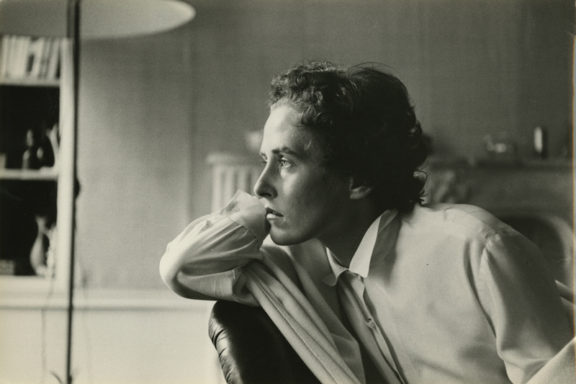
Inge Morath + Her Male Pseudonym
"A bold and determined woman, she managed to establish herself in a then male-dominated filed, and even had to sell her first shots to a number of publishers under the male pseudonym Egni Tharom. The first woman to ever join the renowned Magnum Photos agency, first as an editor and later, in 1955, as a full photographer, Inge Morath helped breaking down many prejudices with her talent."
Inge Morath exhibition, Museo Diocesano, Milan 2020

photograph of Inge Morath via
Friday, 31 July 2020
Charlie Phillips: Photographing the Lives of Black Londoners
"His most iconic photograph of the period depicts a mixed-race Notting Hill Couple, taken almost a decade after the violent attacks. The intimate picture of a young pair conveys warmth, love and defiance. When understood in the racialised political context of the time, the image takes on a more complex meaning, especially since the Notting Hill riots had started with an assault on a Swedish woman who married to a Caribbean man — attacked for being in a mixed-race relationship." (via)

In 1956, Charlie Phillips was a teenager when he moved to London with his family from Jamaica. The British government had asked people from former colonies to rebuild the so-called mother country after the Second World War. Many of them - including Charlie's family - settled in North Kensington, Notting Hill, and Ladbroke Grove (via).

"I remember I came in late August. I found I couldn't walk barefoot. I couldn't go out in the garden."
During a time of changes and adjustment, Charlie Phillips got his first camera, a Kodak Brownie, which was given to him by a US-American serviceman stationed in the U.K. Overlooked for a long time in which his work was hardly noticed and he struggled to publish his pictures, his photographs are now "celebrated for sensitively and insightfully documenting the cultural landscape of black Britain in the post-war period: a time when the struggle for civil rights, justice, and equality was particularly hard-fought. Phillips continued hoping to pass down this document to his children (via).
photographs via

In 1956, Charlie Phillips was a teenager when he moved to London with his family from Jamaica. The British government had asked people from former colonies to rebuild the so-called mother country after the Second World War. Many of them - including Charlie's family - settled in North Kensington, Notting Hill, and Ladbroke Grove (via).

"I remember I came in late August. I found I couldn't walk barefoot. I couldn't go out in the garden."
During a time of changes and adjustment, Charlie Phillips got his first camera, a Kodak Brownie, which was given to him by a US-American serviceman stationed in the U.K. Overlooked for a long time in which his work was hardly noticed and he struggled to publish his pictures, his photographs are now "celebrated for sensitively and insightfully documenting the cultural landscape of black Britain in the post-war period: a time when the struggle for civil rights, justice, and equality was particularly hard-fought. Phillips continued hoping to pass down this document to his children (via).
The borough of North Kensington, where Phillips spent much of his youth, had high rates of poverty, crime and violence in the 1950s. People had been attracted from the West Indies by the promise of good jobs and homes, but the post-war period saw London plunged into a housing and employment crisis. Large numbers of Afro-Caribbean Londoners struggled to make a living and were forced to live in crammed, slum-like conditions. This situation was made worse by structural racism: British society upheld an unofficial ‘Colour Bar’, a systematic exclusion of black people from certain public and private spaces.- - - - - - - -
Despite the fact that those who had arrived from the colonies had British passports and enjoyed the same legal rights as their white counterparts, black British citizens faced everyday racism, social injustices and widespread patterns of discrimination. (...)
Captivated by his surroundings and profoundly influenced by the Notting Hill "riots", Phillips spent the best part of the 1960s and 1970s photographing the experience of transatlantic migration in North Kensington. “I attended demonstrations and continued to show solidarity with different struggles,” Phillips recalls. “The 60s and 70s were very challenging. People had begun to ask questions. It was an era where you had to decide who you sympathised with.” (via)
photographs via
Monday, 27 July 2020
Stereotype Threat and Women's Athletic Performance
Female and male tennis and basketball college student athletes performed two athletic tasks relevant to their sport: a difficult concentration task and an easier speed task. Participants were told beforehand that (1) there was a gender difference on the tasks (to induce stereotype threat) or (2) there was no gender difference (to remove any preexisting stereotype threat).

On the difficult task, women performed worse than men only when stereotype threat was induced. Performance on the easier speed task was unaffected by the stereotype information. Interestingly, women's beliefs regarding women's and men's general athleticism were also affected by the manipulation.
We concluded that one minor comment regarding a very specific athletic task may sometimes impair task performance and alter gender stereotypes of athleticism among women. (literally via)
- - - - - -
- Hively, K. & El-Alayli, A. (2014). “You throw like a girl:” The effect of stereotype threat on women's athletic performance and gender stereotypes. Psychology of Sport and Exercise, 15(1), 48-55
- photograph via

On the difficult task, women performed worse than men only when stereotype threat was induced. Performance on the easier speed task was unaffected by the stereotype information. Interestingly, women's beliefs regarding women's and men's general athleticism were also affected by the manipulation.
We concluded that one minor comment regarding a very specific athletic task may sometimes impair task performance and alter gender stereotypes of athleticism among women. (literally via)
- - - - - -
- Hively, K. & El-Alayli, A. (2014). “You throw like a girl:” The effect of stereotype threat on women's athletic performance and gender stereotypes. Psychology of Sport and Exercise, 15(1), 48-55
- photograph via
Friday, 24 July 2020
Intergroup Contact Theory
According to Allport (1954), four conditions are essential to enhance positive effects of intergroup contact: equal status, common goals, intergroup cooperation, and support of authorities.

Equal status
Equal status needs to be perceived by both groups within the situation. Research findings vary and range from a) contact with outgroup members of lower status showing negative effects to b) being insignificant and equal status within the situation being the key factor.
Common goals
An active, goal-oriented effort (as given in athletic teams) means that teams need each member to achieve their goal.
Intergroup cooperation
Intergroup competition is seen as a barrier to enhancing a positive intergroup contact; cooperation should be the way how common goals are reached.
Support of authorities, law, or custom
Explicit social sanction fosters the acceptance of intergroup contact since norms of acceptance are established by authorities.
- - - - - - - -
- Pettigrew, T. F. Intergroup Contact Theory. Annual Review of Psychology, 49, 65-85.
- photograph by the magnificent Vivian Maier via

Equal status
Equal status needs to be perceived by both groups within the situation. Research findings vary and range from a) contact with outgroup members of lower status showing negative effects to b) being insignificant and equal status within the situation being the key factor.
Common goals
An active, goal-oriented effort (as given in athletic teams) means that teams need each member to achieve their goal.
Intergroup cooperation
Intergroup competition is seen as a barrier to enhancing a positive intergroup contact; cooperation should be the way how common goals are reached.
Support of authorities, law, or custom
Explicit social sanction fosters the acceptance of intergroup contact since norms of acceptance are established by authorities.
- - - - - - - -
- Pettigrew, T. F. Intergroup Contact Theory. Annual Review of Psychology, 49, 65-85.
- photograph by the magnificent Vivian Maier via
Sunday, 19 July 2020
Hispanics. Better Have a Lighter Skin Tone.
According to a survey carried out by the Pew Research Center in the United States last year, 58% of Hispanic adults report having experienced discrimination because of their ethnicity. Experiences, however, vary by skin tone: 50% of Hispanics with lighter skin colours versus 64% of Hispanics with darker skin colours. The differences even hold after controlling variables such as gender, age, education and country of birth (U.S. vs abroad).

More Hispanics with darker skin tone (55%) than with lighter skin tone (36%) say that people tend to react as if they were not smart and are more often subject to slurs or jokes (53% vs 34%) (via).
- - - - - - - - -
photograph of Benicio del Toro via

More Hispanics with darker skin tone (55%) than with lighter skin tone (36%) say that people tend to react as if they were not smart and are more often subject to slurs or jokes (53% vs 34%) (via).
- - - - - - - - -
photograph of Benicio del Toro via
Friday, 17 July 2020
Using Design to Redefine an Empathetic Mental Health Assessment
The Mindnosis Kit is a set of exercises that "help understand emotional distress and how to feel about it" and to reach out for help when necessary. The first tool, for instance, consists of six colourful triangles which represent areas that may be have an impact on the user's wellbeing. Once the right one has been chosen, it can be pasted into the journal with thoughts and reflections. Another tool is made of activity tools (mindfulness, cognitive behaviour therapy techniques, tips from peers) (via).

"When I was 17 I became unwell for a year. Accessing and using mental health services was a very traumatic experience which I buried and felt ashamed of for a long time. Years after I discovered many people had had similar experiences and we all shared the same thoughts. That is why I decided to use design to redefine what an empathetic mental health assessment can look like, as done by people who had gone through it."
Sarah Lopez Ibanez
- - - - - - -
photograph via

"When I was 17 I became unwell for a year. Accessing and using mental health services was a very traumatic experience which I buried and felt ashamed of for a long time. Years after I discovered many people had had similar experiences and we all shared the same thoughts. That is why I decided to use design to redefine what an empathetic mental health assessment can look like, as done by people who had gone through it."
Sarah Lopez Ibanez
- - - - - - -
photograph via
Thursday, 16 July 2020
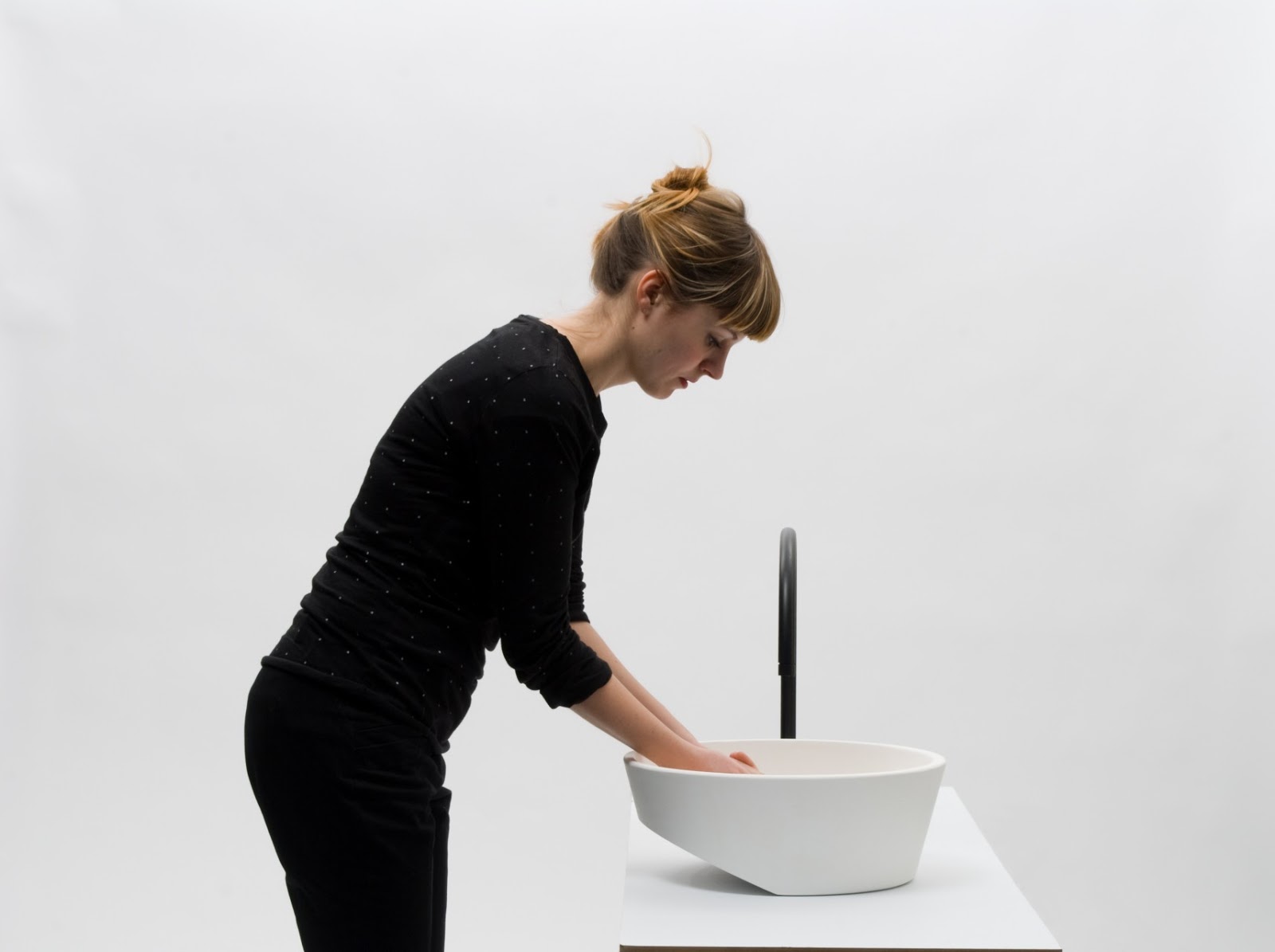
The Tilting Sink by Gwenolé Gasnier
« tilting sink », is a sink that can adapt to everyone. The common basin has been re-imagined with a simple alteration to accommodate all walks of life – a cut along the body of the piece to allow it to tilt according to the user’s height. By rocking around an axis, the design can be positioned to cater for a standing and seated adult or children. A locking system and a large overflow makes it secure in the two positions of use. (literally via)


photographs via

photographs via
Subscribe to:
Posts (Atom)