Wednesday, 31 May 2017

We don't make a "woman's car"

"Women only drive automatic transmissions."


Some car manufacturers actually believe women buy cars for different reasons than men do.
So they build "a woman's car." Oversized, hopelessly automatic and dull.
At Honda we designed just one thing. A lean, spunky economy car with so much pizzazz it handles like a sports car.
If you're bored with cars designed only to get you from point A to point B, without responding to you the driver, maybe you ought to take the Honda Civic for a spin.
We've got a stick shift with an astonishing amount of zip. Enough to surprise you. We promise.
Or, if you prefer, Hondamatic. It's a semi-automatic transmission that gives you convenience, but doesn't rob you of involvment.
Neither one is a woman's car.
Honda Civic.
We don't make "a woman's car".

- - - - - - - - - -
image (1974) via

Tuesday, 30 May 2017

Women are soft and gentle, but they hit things.

Sooner or later, your wife will drive home one of the best reasons for owning a Volkswagen.


Women are soft and gentle, but they hit things.
If your wife hits something in a Volkswagen, it doesn't hurt you very much.
VW parts are easy to replace. And cheap. A fender comes of without dismantling half the car. A new one goes on with just ten bol. For $ 24.95*, plus labor.
And a VW dealer always has the kind of fender you need. Because that's the one kind he has.
Most other VW parts are interchangeable too. Inside and out. Which means your wife isn't limited to fender smashing.
She can jab the hood. Graze the door. Or bump off the bumper.
It may make you furious, but it won't make you poor.
So when your wife goes window-shopping in a Volkswagen, don't worry.
You can conveniently replace anything she uses to stop the car.
Even the brakes.

- - - - - -
image (1964) via

Monday, 29 May 2017

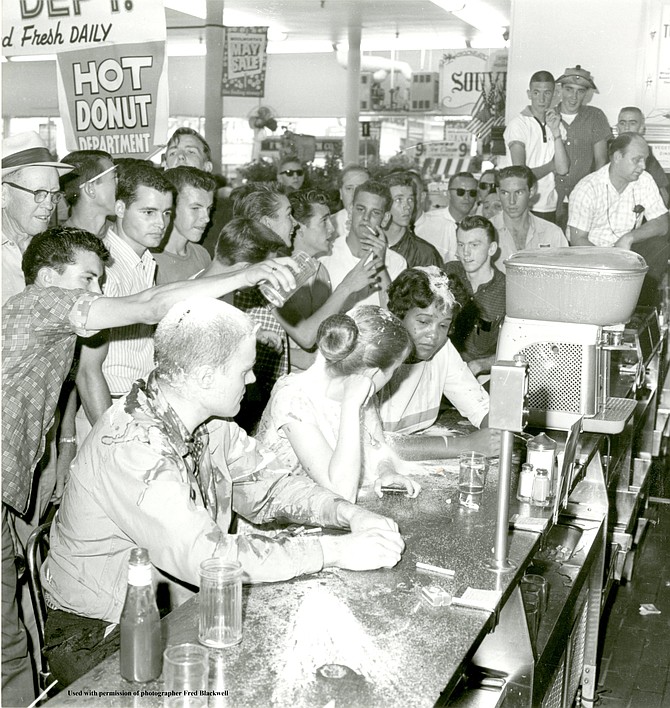
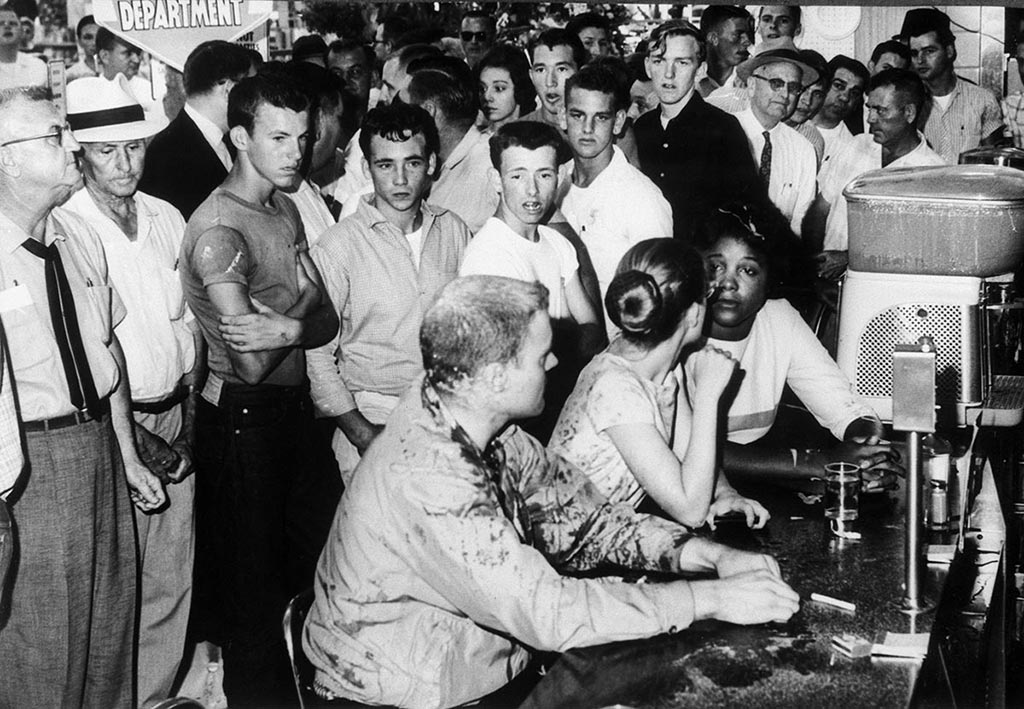
Narrative images: Lunch at the Woolworth Counter in May 1963

"We didn’t allow fear. We had accepted we could die. Panic-attack fear immobilizes you, it doesn’t keep you alive. Stay cool. At that Woolworth counter, people were beaten. It was a total out-of-body experience for me — the kind you hear soldiers have in battle."
Joan Trumpauer Mulholland


The Greensboro (North Carolina) sit-ins in 1960, the most well-known sit-ins of the Civil Rights Movement, led to the Woolworth department store chain removing its racist policy of segregation in the South. It was a long way and it took a great many sit-ins. Today, the Woolworth store in Greensboro is the International Civil Rights Center and Museum (via). These photographs were taken on 28 May 1963. In the centre of the picture above are Anne Moody and Joan Trumpauer, seated on the left is Hunter Gray (via). They sat there after others had been pulled away, kicked and smeared with ketchup, mustard, sugar - anything that was on the counter (via).

"They cut my face with sharp brass knuckles, someone cut the back of my head with the jagged edge of a broken sugar container. There was a good deal of blood.
They dumped slop on us. I was burned with cigarettes, hit and had pepper thrown in my eyes. The women weren't struck, but had their hair pulled. All the air was filled with obscenities, the n-word - it was a lavish display of unbridled hatred. (...)
I saw the photo the next morning in the Jackson Daily News. Friends across the county called to say they had seen it, and we got letters from people from all over the world.
Now in textbooks, this picture reinforces my feeling that change came because of the great courage and determination of grass-roots people. I remember sitting at that counter, thinking about the indoctrination of these young people: white councils issuing special curriculums for white schools. And more sinister warnings such as: “Race mixers are communist and traitors.” The kids had been brainwashed with this poisonous stuff all their lives. I saw no free will in that mob, and I couldn’t blame the kids personally.
Fifty years on I continue to feel sorry for them. If I met any of them today, I’d say: “Let’s go have lunch.
"
Hunter Gray


"They wanted the "n*ggers" - both white and black - to leave."
Trip Burns


photographs via and via and via

Friday, 26 May 2017

Joan Trumpauer Mulholland & Thomas Jefferson

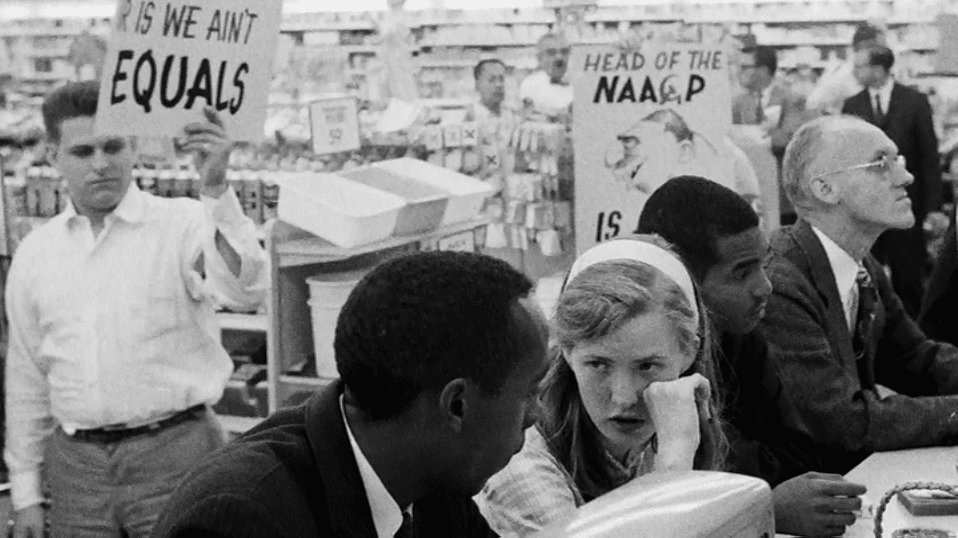
"We hold these truths to be self-evident: that all men are created equal; that they are endowed by their Creator with certain unalienable rights; that among these are life, liberty, and the pursuit of happiness."
Thomas Jefferson (1776)


Photographs: Joan Trumpauer Mulholland holds a picket signs in North Carolina (1960)


Related postings:
::: Quoting Charlton Heston (who quotes Thomas Jefferson)
::: Joan Trumpauer Mulholland: White, Southern and Civil Rights Activist

- - - - - - - - - - - - -
photographs (holding a picket sign in North Carolina) via and (demonstrating in North Carolina, 1960) via

Wednesday, 24 May 2017

Joan Trumpauer Mulholland: White, Southern and Civil Rights Activist

"No matter how bad things are, at least ya aren't black."
Joan's mother

"My mother’s side of the family was your stereotypical Georgia redneck, that’s the only way I can put it, Pentecostal. I think that exposed me to a lot of the rural Deep South, hearing them express their attitudes and religious fervor. My father’s side of the family was more college-bred Iowa. My folks had met in Washington, D.C. during the Depression. Though my closest identification was with the Georgia branch, I also had this relationship with the other side of the family. My Iowa family cancelled out my Georgia family."
Joan Trumpauer Mulholland


Joan Trumpauer Mulholland grew up with a racist mother but rebelled, took part in a civil rights protest at Duke University in 1960, then joined the Freedom Riders. In 1963, she took part in the sit-in at the segregated Woolworth lunch counter in Mississippi. She was arrested several times and disowned by her family (via), hunted down by the Klu Klux Klan and imprisoned on death row (via). When she spent two weeks in prison in Mississippi, prison ward Fred Jones wrote a letter to Joan's mother:
What I cannot understand is why as a mother you permitted a minor white girl to gang up with a bunch of negro bucks and white hoodlums to ramble over this country with the express purpose of violating the laws of certain states and attempting to incite acts of violence.
Fred Jones
Joan received letters, too. Here is one hate mail that was written to her:
Nothing you can do will integrate me. I do not choose to associate with black African slaves who were dragged here like animals + have remained almost the same. All we owe them is a return trip to Africa.
I M White
Joan was the first white student to enroll in the all-black Tougaloo College in Jackson where she met Medgar Wiley Evers (1925-1963), a civil rights activist who was killed by a white supremacist and Klansman (via). Joan Trumpauer Mulholland was active in the 1960s, took part in the Cherrydale Drug Fair counter in 1960, a protest that led to the desegregation of area drug stores, helped to integrate a college in Jackson (via) and is still active today.


Photographs of Joan Trumpauer Mulholland at a sit-in in Northern Virginia


"When I was 10 years old and down at my grandma’s and my friend Mary and I dared each other to go into the Black area and the poverty there was so much worse than in the dirt poor White area. And then I saw the school – no paint, I remember – one outhouse and one pump or well – and such a contrast, I just knew that this was wrong and when I had the chance, to do something. I wanted to make the South the best that it could be for all of its people."
Joan Trumpauer Mullholland

"My great grandmother was a suffragette and chained herself to the Iowa State Capital Building. I grew up on these stories and I think that was part of me – it was in the DNA. My father had no sympathy for segregation but was a good government bureaucrat who believed you change the law at the top. My dad didn’t like the tactics but worried most that his first-born was going to be killed."
Joan Trumpauer Mulholland

"My involvement came about from my religious conviction, and the contradiction between life in America with what was being taught in Sunday school."
Joan Trumpauer Mulholland

"What we did in the ’60s changed the law, but not the inherent racism that made those laws. The Bible says we were all created in God’s image — nowhere is that image described as black or white, straight or gay."
Joan Trumpauer Mulholland

- - - - - - - - - - - - - - - - -
photographs via and via and via

Monday, 22 May 2017

What would Jesus say?

Markus Dröge is the bishop of the Evangelical Church Berlin-Brandenburg-Silesian Upper Lusatia and ambassador for the House of One in Berlin. He openly discusses what it means to be truly Christian and points out that being Christian is not about defending traditions but about having a social mission. Dröge is convinced that the church has to actively react to right-wing populism that is on the rise - he refers to Trump and the German far-right party "Alternative for Germany" (AfD) and what they have in common.


The church, according to Dröge, does not tell people who to vote for but communicates Christian values and sees itself as a sort of sparring partner. From all political parties that there are in Germany, he chooses the AfD to talk about. And there is a reason why. The AfD is the defender of "western Christianity". But their political agenda, according to Dröge, is not Christian when they reject homosexuality, when they only accept a conservative family image, when they aggressively protect unborn life without being able to differentiate, when they promote the so-called German Leitkultur (often a rather nationalist and monocultural vision of German society that tends to solve any problem with cultural assimilation), or when they reject Islam.
Last year, the AfD published a paper saying that the party had to be politically incorrect, that the party in fact needed to provoke. Dröge explains the mechanism: After the provocation, the party denies that it has ever provoked and says that it was only one member's opinion. By doing so, the party makes sure that it is always present in the media. Apart from that, the misanthropic ideas that are constantly repeated start being normalised after a while. Society gets used to them and finally a great many people do not realise that they find inhumane remarks normal.
Dröge asks the question what Jesus would say. Altruism, Christian love or Christian charity do not mean loving your own national traditions, your own family, your own native country, and people who share your religion. Christian love crosses cultural and religious borders. Dröge comes to the conclusion that the values of the church and the values of the AfD are incompatible.

Content from Markus Dröge's speech "Was haben wir Christen, was hat die Evangelische Kirche, dem wachsenden Rechtspopulismus entgegenzusetzen?, 25 March 2017, via

- - - - - - - - -
photograph via

Sunday, 21 May 2017

"The I Hate to Cook Book" (1960)

"Some women, it is said, like to cook. This book is not for them."
Peg Bracken

Ruth Eleanor "Peg" Bracken (1918-2007) was the US-American author of books such as "The I Hate to Cook Book" (1960). "The I Hate to  Housekeep Book" (1962) and "The Appendix to the I Hate to Cook Book". Her recipes had unusual names and sardonic comments. She offered quick-witted recipes that were founded on the principle that her "standard position in regard to cooking is on the sofa with my feet up". Bracken understood "the silent tyranny of cooking", the demands, the social pressures, and the need to ease the 1960s' housewife's tasks. Male editors did not agree. The first half-dozen editors - all men - she approached, thought US-American women were not unhappy with their lot and did not want to publish her manuscript. Things changed when she finally found a woman editor at Harcourt Brace; more than three million copies of the book were sold (via), various editions were published (via).


"Male editors were afraid of it because they were convinced that women regarded anything that had to do with cooking very seriously and would not stand for an attitude that was the least bit flippant."
Peg Bracken

Her book aimed to make cooking easier by using common, convenient ingredients (e.g. crushed cornflakes instead of breadcrumbs). She also used plenty of alcohol or suggested taking a shortcut and just drinking it. It was about saving time as her books was meant to appeal to "those of us who want to fold our big dishwater hands around a dry Martini instead of a wet flounder" (via).
"When the sun has set and the party starts to bounce, you want to be in there bouncing too, not stuck all by yourself out in the kitchen, deep-fat frying small objects or wrapping oysters in bacon strips." Peg Bracken
"We don’t get our creative kicks from adding an egg, we get them from painting pictures or bathrooms, or potting geraniums or babies, or writing stories or amendments, or, possibly, engaging in some interesting type of psycho-neuro-chemical research like seeing if, perhaps, we can replace colloids with sulphates. And we simply love ready-mixes." 
Peg Bracken
Skid Road Stroganoff (literally via)
Start cooking those noodles, first dropping a bouillon cube into the noodle water. Brown the garlic, onion and crumbled beef in the oil. Add the flour, salt, paprika and mushrooms, stir, and let it cook five minutes while you light a cigarette and stare sullenly at the sink.

Trivia: Before becoming famous, Bracken worked as an advertising copywriter along with Homer Groening, father of the great Matt Groening (via).

- - - - -
image via

Monday, 15 May 2017

Franco Basaglia, Democratic Psychiatry & the Closure of Psychiatric Hospitals in Italy

"Many were seduced by Basaglia’s intellect and his personality (including those who had never met him). He was charismatic and charming, and he inspired love and admiration, but also fear, jealousy and sometimes hatred. He became a hero to many, but also an anti-hero for those who were opposed to the movements linked to 1968 (as well as for some who were key figures in ‘1968’ itself). In 1968, he became a symbol for a whole epoch overnight, a household name. A key law was later named after him, a rare honour in Italy, especially for a non-politician."
John Foot (2014)


Franco Basaglia (1924-1980) - "the most influential Italian psychiatrist of the 20th century" - studied medicine and surgery at the prestigious university of Padua and spent the years after his graduation studying the philosophical ideas of Sartre, Husserl, Heidegger, and Jaspers, as well as critics of psychiatric institutions such as Michel Foucault and Erving Goffman. He worked at university and specialised in the field of "nervous and mental diseases", then left university as he was "too sharp, too unorthodox, too original, not servile enough" to progress within the university system. Basaglia left and became the director of the provincial asylum of Gorizia which had about 500 patients (after this position he became the director of asylums in other cities). When he arrived at the Lunatic Asylum of Gorizia in 1961, he was "revolted by what he observed": locked doors, straits jackets, ice packs, bed ties and insulin-coma shock therapies in response to human suffering. Basaglia refused to bind patients to their beds and abolished isolation methods. He introduced democracy within the asylum: doctors did not wear white coats and mingled with patients, locked wards were opened, bars and strait-jackets were removed.
Thanks to his initiative, a debate started all over Italy that finally resulted in a paradigm shift seeing recovery as participation and citizenship, a shift that led to the gradual closure of mental hospitals. The so-called "Basaglia Law" (Law 180, Italian Mental Health Act) was passed in 1978 which restructured mental health care and closed all psychiatric hospitals in Italy.

Basaglia's main criticism was that psychiatry's approach was to oppress persons instead of curing and liberating them. He was convinced that  the entire asylum system was morally bankrupt and reducing inmates to "non-persons" or "hollow men" (via and via and via and via).
"We want to change the pattern that makes the patient a dead body and strive to transform the dead mental patient in the asylum into a living person, responsible for his own health." Franco Basaglia, cited in Roberto Mezzina
For Basaglia, stereotypes of madness were consequences of institutional conditions. In other words, some eccentric behaviour patterns were exacerbated or even created by the institutions themselves. Inmates were "the excluded", a "deviant majority" that was interned against their will and broken down by this very system. Psychiatric hospitals were prison-like, oppressive institutions. Both architecturally and functionally they were similar to prisons. Basaglia himself, by the way, had spent six months in prison after being arrested for being an anti-fascist activist  (via and via).
This was a collective ‘no’. And this ‘no’ changed the world. It was not acceptable to treat people in that way – without rights, without autonomy, without knives and forks, without hair, without any control over their own treatment. It was wrong to electrocute these people, cut out bits of their brains or tie them up for years on end. This movement was a struggle for liberation, for democracy and for equality. These 100,000 inmates of mental asylums had disappeared from history.
They needed to re-emerge – to be given back their own identity and dignity. This generation of politicians and psychiatrists was a post-war, anti-fascist generation. There was something profoundly anti-fascist about the anti-asylum movement. It was a movement about human rights. The people inside the asylums were people.
John Foot (2014)


"Democratic Psychiatry", created by Franco Basaglia, was never "antipsychiatric" but a movement to liberate the ill from segregation in mental hospitals (via). Its implementation was and is not easy and it is debated to what extent the reform has made changes in the general picture of psychiatric care (Palermo, 1991). Literature on Basaglia either tends towards idealisation or demonisation portraying him as a secular saint or an irresponsible radical (via). Basaglia was not a saint but he surely "helped to transform the way we see mental illness" and it was his work that "saved countless people from a miserable existence". His "legacy persists, as an object lesson in the struggle against the brutality and ignorance that the establishment peddles to the public as common sense" (John Foot, 2015).
The history, biography and practice of Franco Basaglia and the psichiatria democratica (democratic psychiatry) movement he partly led and inspired has, with a few exceptions, been consistently misinterpreted in the English-speaking world (and in particular in the UK, although one exception is Ramon, 1988). Let us take, for example, the judgements of two of the leading historians of ‘madness’ and ‘asylums’. In 2002, Roy Porter wrote: ‘In Italy, leadership of the movement was assumed by the psychiatrist Franco Basaglia, who helped engineer the rapid closure of institutions (chaos resulted)’ (Porter, 2002: 210). In 1994, Porter referred to Basaglia as ‘Enrico Basaglia’ and labeled him as a ‘boisterous anti-psychiatrist’ (Porter and Micale, 1994: 20). Andrew Scull’s judgement on Basaglia was similarly brief, in 2011: ‘In Italy, led by the charismatic Franco Bassaglia [sic], the political left led the charge’ (Scull, 2011: 113). A more balanced and well-informed account (although with some errors) can be found in Burns (2013: xlvi, 148–9, 183). However, even here, Basaglia is described as a ‘Gramscian Marxist’.
The origins of these snap and inaccurate judgements lie in a series of areas. First, Basaglia’s work was not translated into English, including (and most importantly) L’istituzione negata (Basaglia, 1968). This book was, however, quickly translated with success into numerous other languages.
John Foot (2014)
“Tomorrow morning, at visiting time, when without any lexicon you try to communicate with these men, you will be able to remember and recognise that, in comparison with them, you are superior in only one way: force.”
Franco Basaglia

- - - - - - - - - - - - - -
photographs via and via

Monday, 8 May 2017

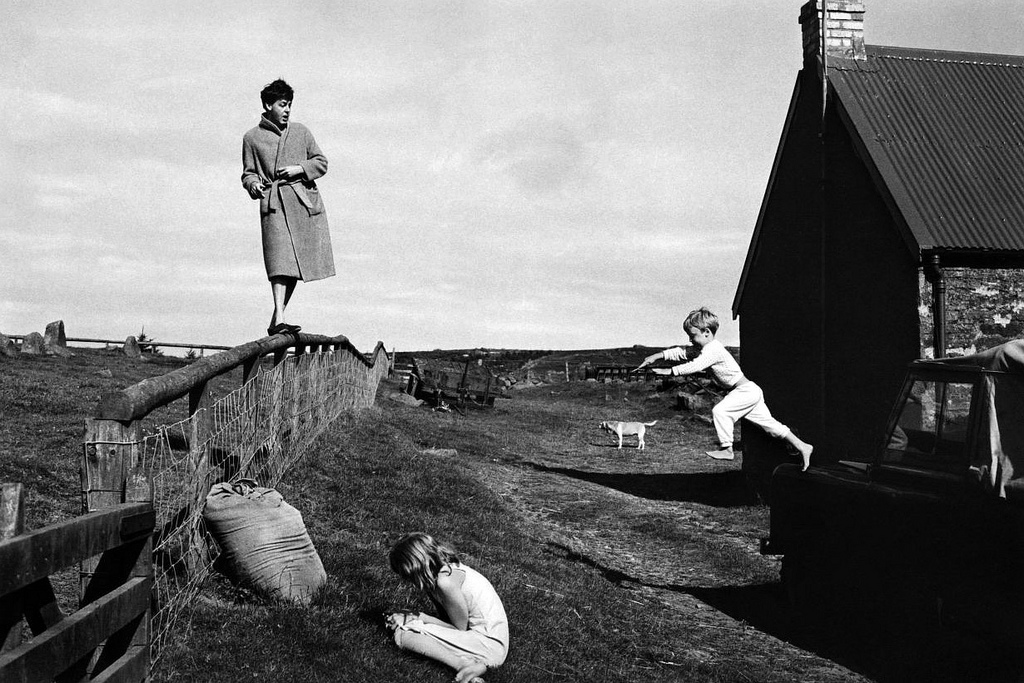
Quoting Paul McCartney (II)

"I used to think that anyone doing anything weird was weird. I suddenly realized that anyone doing anything weird wasn't weird at all and it was the people saying they were weird that were weird." 
Paul McCartney


Related posting: Quoting Paul McCartney

- - - - - - - - - - - - -
photograph of Paul McCartney by Linda McCartney via