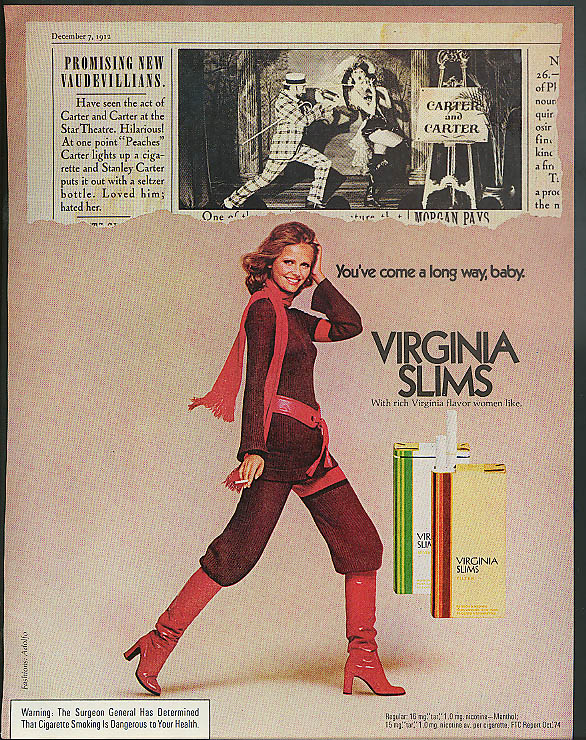
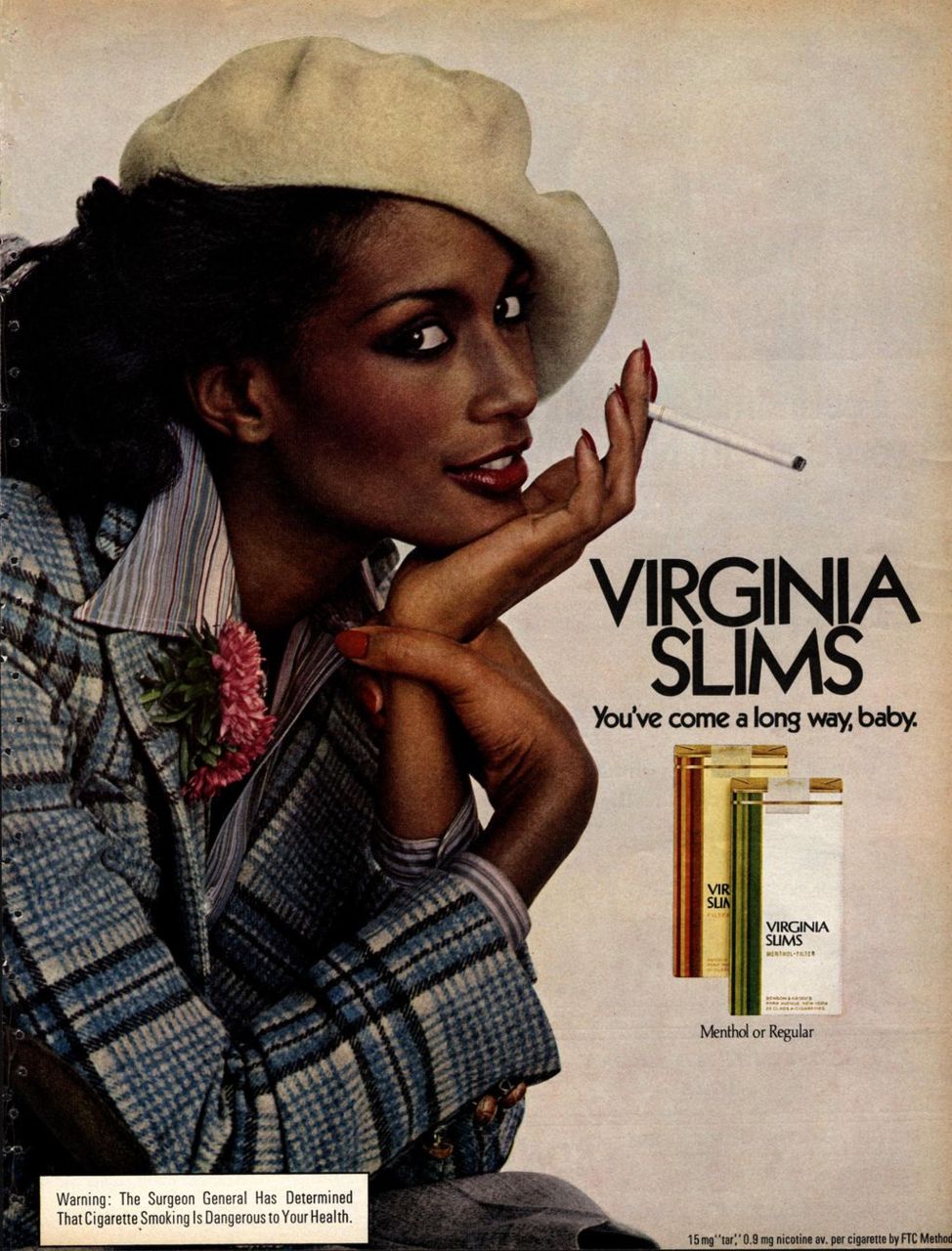
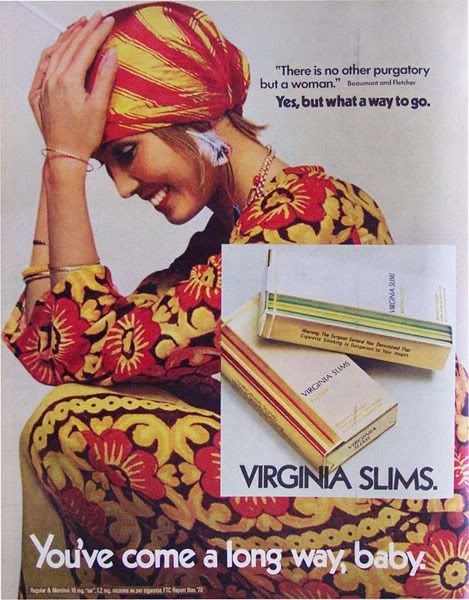
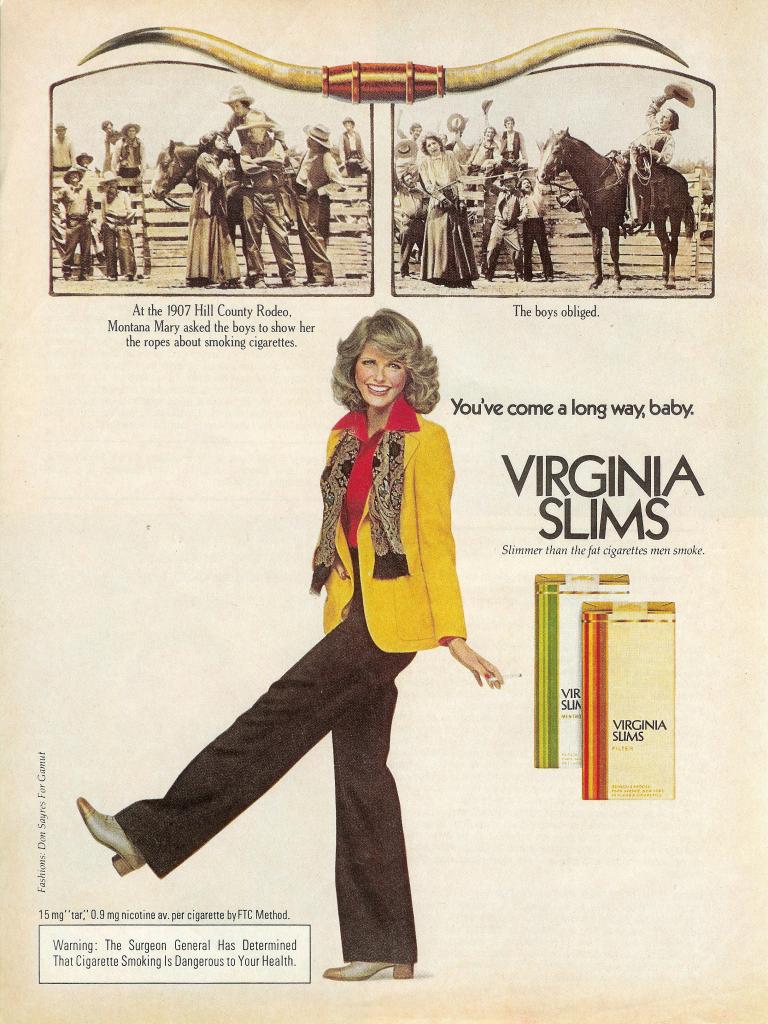
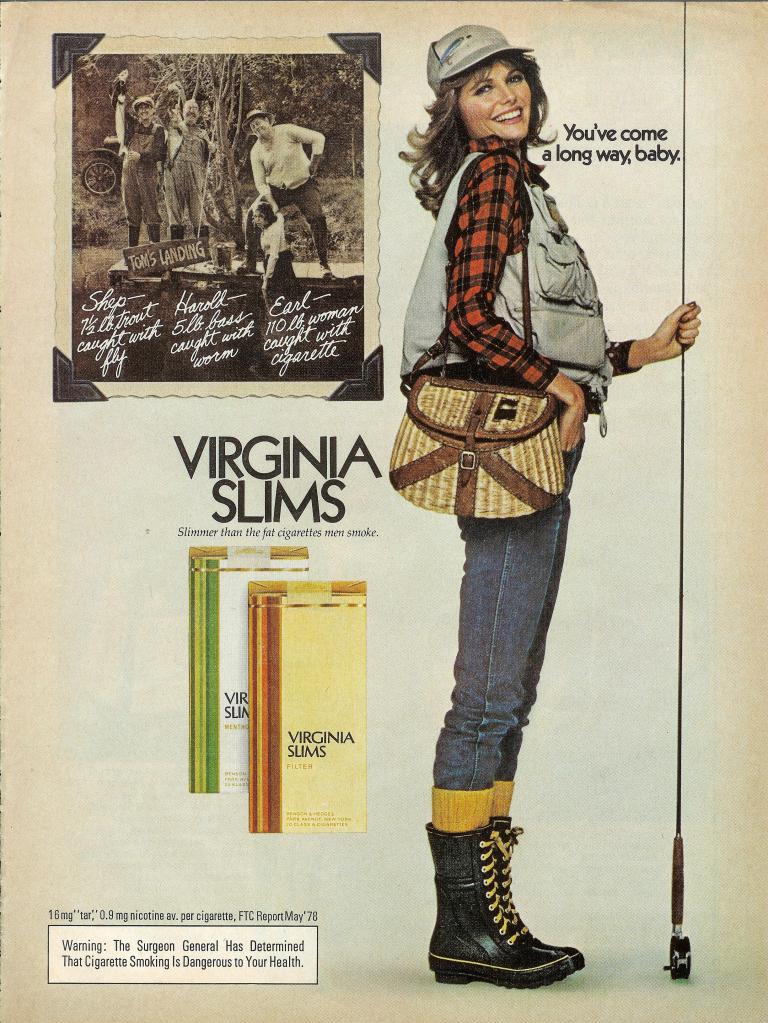
"You've come a long way, baby
To get where you've got to today
You've got your own cigarette now, baby
You've come a long, long way"
"We make Virginia Slims expecially for women because they are biologically superior to men", 1971, via

Virginia Slims were introduced by Philip Morris in 1968 and "marketed as a female-oriented spinoff to their Benson and Hedges brand". The slogans "You've come a long way" and later "It's a woman thing" and "Find your voice" were supposed to link smoking with
"women's freedom, emancipation, and empowerment" (
via). It was not the first product to speak to women
"in the language of liberation" but it was the first one that interpreted feminism as something that could sell (Zeisler, 2008).
"Rosemary for president. Someday. Meanwhile you've got Virginia Slims. The taste for today's woman.", via; 1968, via


Philip Morris continued this strategy and in 2008 launched a campaign targeting women and girls. The "purse pack" - repackaged, compact, pink Virginia Slims - implies that smoking is both feminine and fashionable. "Super slim" communicates the association between smoking and weight loss (
via). John T. Landry, former Philip Morris marketing chief:
"I knew thinness was a quality worth talking about. It's an American obsession." (
via).
Images via, via, via and via


This gender marketing strategy changed statistics encouraging girls to start smoking.
"Six years after the introduction of Virginia Slims, the rate of smoking initiation for 12-year-old girls had increased 110 percent." (
via). In fact, apart from social factors, marketing strategies are considered to be one reason for the rise of smoking among women. Smoking as a symbol of emancipation was the core of the campaign. In 1991, an internal industry document describes the strategy targeting only women as follows:
"To convince fashionable, modern, independent and self-confident women aged 20-34 that by smoking VSLM, they are making better/more complete expression of their independence." (Hitchman & Fong, 2011). The market share grew from 0.24% bo 3.16% (Toll & Ling, 2005).
LIFE, 13 August, 1971, via

In the 1980s, the number of cigarettes sold declined dramatically. Women were "a saving grace" who just had to be convinced that a woman
"needs her very own cigarette as absolutely as she needs ther own underwear" (
via). To women, smoking Virginia Slims meant "independence, slimness, glamour, and liberation". Despite the equality progresses the commercials showed since the early twentieth century, "the only equality this campaign ended up supporting involved lung cancer. Today, women and men die at similar rates from the diseases." (
via).
Images via, via, via, via, via, via, via, via and via


The campaign was developed by the Leo Burnett Agency and was launched on 22 July 1968. It was a huge success and the slogan more or less became "a national catch-phrase". According to a 1986 corporate study, the so-called brand personality was the key to its success (
via).
Images via, via, via, via, 15 November,1968, via; 30 June, 1972, via


Slogan, catch-phrase and song:
- Virginia Slims commercial from 1970s
watch
In 1978, the US-American country music singer-songwriter Loretta Lynn was in the charts with the song "We've come a long way, baby". "The title song was a top ten hit for Lynn, playing on the famous Virginia Slims slogan of the day,
You've Come a Long Way Baby" (
via).
- Loretta Lynn
We've come a long way, baby watch
Images via


Hitchman, S. C. & Fong, T. G. (2011) Gender empowerment and female-to-male smoking prevalence ratios. Bulletin of the World Health Organization;
via
New York Times (1986) Why They Stretched The Slims
via
Toll, B. A. & Ling, P. M. (2005) The Virginia Slims identity crisis: an inside look at tobacco industry marketing to women. Tobacco Control, 14, 172-180
Zeislere, A. (2008) Feminism and Pop Culture. Berkeley: Seal Press


.jpg)