Showing posts with label smoking. Show all posts

Friday, 28 June 2024

Women and Smoking Stigma in South Korea

Generally speaking, fewer women smoke than men. There are however, cultural and regional variations and greater gender differences are found in South Korea, Indonesia, and China, compared to Europe and the United States. South Korea, for instance, has the highest male smoking rate and the lowest female smoking rate of all (OECD) countries (Park et al., 2014). The World Health Organization (2017) estimates that 40% to 50% of men and 4% to 8% of women in Korea smoke; according to the OECD (2015) it is 31.3& of males and 3.4% of females (Gunter et al., 2020). Gender is a factor.

Women may encounter negative social attitudes toward women's smoking. This stigma can have an impact on their smoking cessation motivation and concealment (David et al., 2024). Korean women, for instance, underreport their smoking activity because of the stigmatisation. This stigma may prevent many Korean woman from smoking (Woo, 2018). Using biological indicators (urinary cotitine concentration), others come to the conclusion that the "actual female smoking rate is significantly highere than official records state" and that the social desirability bias produces results that underestimate the number of female smokers (Park et al., 2014).

This study shows that the actual female smoking rate is significantly higher than that reported officially, but also that the gap is decreasing steadily. Females exhibited a higher rate of false responses, which resulted in an underestimation of the female smoking rate. (Park et al., 2014)

Concealment is not really surprising given harsh reactions might be possible as the following two anecdotes imply:

"I was a bit tipsy and felt like a puff. After I lit the cigarette, a random middle-aged man came up to me and started shouting as if I had done something very bad. He said, ‘I will slap your face if you don't throw your cigarette away right now.' He called me ‘dirty little woman.'" (Kim, 26)

"When I was smoking outside, an old man shouted at me how dare I, a female, smoke there. People say the social atmosphere about female smoking has changed but this kind of thing still happens. Men cannot understand how scared women get in those situations." (Lee, 33)

In South Korea, women use heated tobacco products for different reasons than men do, i.e., to avoid the stimga associated with female smoking while men use them to avoid family members putting pressure on them to stop smoking (Kwanwook et al., 2020)

As has been well-established by previous studies, the smell of cigarettes was the main reason for using HTP for both male and female users. Nevertheless, there was a gender difference in the cause for concern about the smell of cigarettes, especially regarding the person(s) to whom participants thought the smell was an issue. Males tended to identify smell as a problem when it came to their familial responsibilities with their wives and children. Many participants felt guilty for using cigarettes due to their harmfulness to health and exposing their family members to secondhand smoke. For these participants, these feelings, usually recognised, and revived by the very smell of tobacco, could be reduced through the use of HTPs with a relatively low odour. Therefore, males were more concerned with the ‘physical’ characteristics of the cigarette smell as a reminder of the harmfulness of tobacco. 

‘When I got married, my wife knew that I was a smoker and did not care too much. But when she got pregnant, she kept telling me, “Your body smells of cigarettes. Don’t come near, it’s bad for a child”. She told me a lot to stop smoking. So, I thought about various ways, and finally bought IQOS which was easily available. I think it would be better to choose one that doesn’t smell to my family.’ (Male, 39 years) 

Unlike the male participants, female participants were more interested in the ‘socio-cultural’ rather than physical characteristics of the tobacco smell. In other words, women were conscious that their tobacco smell would expose their smoking habit in a patriarchal society where female smoking is still a highly stigmatised activity, particularly in the workplace. Therefore, unlike men, they were reluctant to disclose their smoking habit. In particular, women with children were extremely vigilant about concealing such socially unacceptable behaviour as smoking, when among other parents and their children’s teachers, because of the perception that they should be a morally upright ‘agi-eomma’ (a baby’s mother). For these reasons, women chose HTPs to maintain their social status as a righteous working woman or mother.  

‘I should not let my colleagues in the company notice the smell from my smoking. Since my sister introduced me to “lil”, I have used it while working and smoked CCs at home.’ (Female, 22 years)  

‘For me, [the] IQOS has solved every interpersonal problem caused by the smelly cigarette. Now I have been able to avoid uncomfortable gazes, [I am] liberated from the smell, and [I have] improved interpersonal relationships with my children’s teachers or other parents. I used to be unable to smoke openly because I was given kind of a name tag called “agi-eomma” (a baby’s mother).’ (Female, 42 years) (Kwanwook et al., 2020)

- - - - - - - - - - - - - - - - - -

- David, J.-C., Fonte, D., Sutter-Dallary, A.-L., Auriacombe, M., Serre, F., Rascle, N. & Loyal, D. (2024). The stigma of smoking among women: A systematic review. Social Sciene & Medicine, 340, 116-491. Korean Journal of Family Medicine, 41(3)
- Gunter, R., Szeto, E., Jeong, S.-H., Suh, S. & Waters, A. J. (2020). Cigarette Smoking in South Korea: A Narrative Review. 
-  Kwanwook Kim, Jinyoung Kim, Hong-Jun Cho (2020). Gendered factors for heated tobacco product use: Focus group interviews with Korean adults. Tobacco Induced Diseases, 18(43), link
- Myung Bae Park, Chun-Bae Kim,corresponding author Eun Woo Nam & Kyeong Soo Hong (2014). Does South Korea have hidden female smokers: discrepancies in smoking rates between self-reports and urinary cotinine level. BMC Womens Health, 14(156), link
- Woo, C. (2018). Gendered Stigma Management among Young Adult Women Smokers in South Korea. Sociological Perspectives, 61(3), link
- photograph by Nina Ahn via

Friday, 6 November 2015

"We reserve the right to smoke for the young, the poor, the black and stupid."

“We don’t smoke that s***. We just sell it. We reserve the right to smoke for the young, the poor, the black and stupid.” 
R.J. Reynolds Tobacco Company Executive

"Smoking is a plague on all Americans, but it hits African-Americans especially hard. The tobacco companies target African-Americans with the intensity of fanatical hunters on the trail of very special game."
New York Times, 1993


"To say that the black community has been overrun with tobacco advertising is an understatement." (via)

At the end of World War II, tobacco companies decided to expand to so-called "new" markets in order to keep growing, discovered black Americans and started targeting them in their campaigns. After WWII, there was more "minor advertising" in weekly African American newspapers.


The sudden interest developed because of post-war changes: urban migration and increasing incomes of black Americans in the 1940s. Between 1920 and 1943, their annual income increased threefold, i.e., from $3 billion to more than $10 billion ... an income that made black Americans attractive for the tobacco industry.


Advertising and marketing magazines called the "emerging Negro market" profitable and published a great many articles. One of them, published in 1944, was titled "The American Negro-An 'Export' Market at Home". And the plan worked out: From 1920 to 1943, the amount of money black Americans spent on tobacco products increased six-fold.


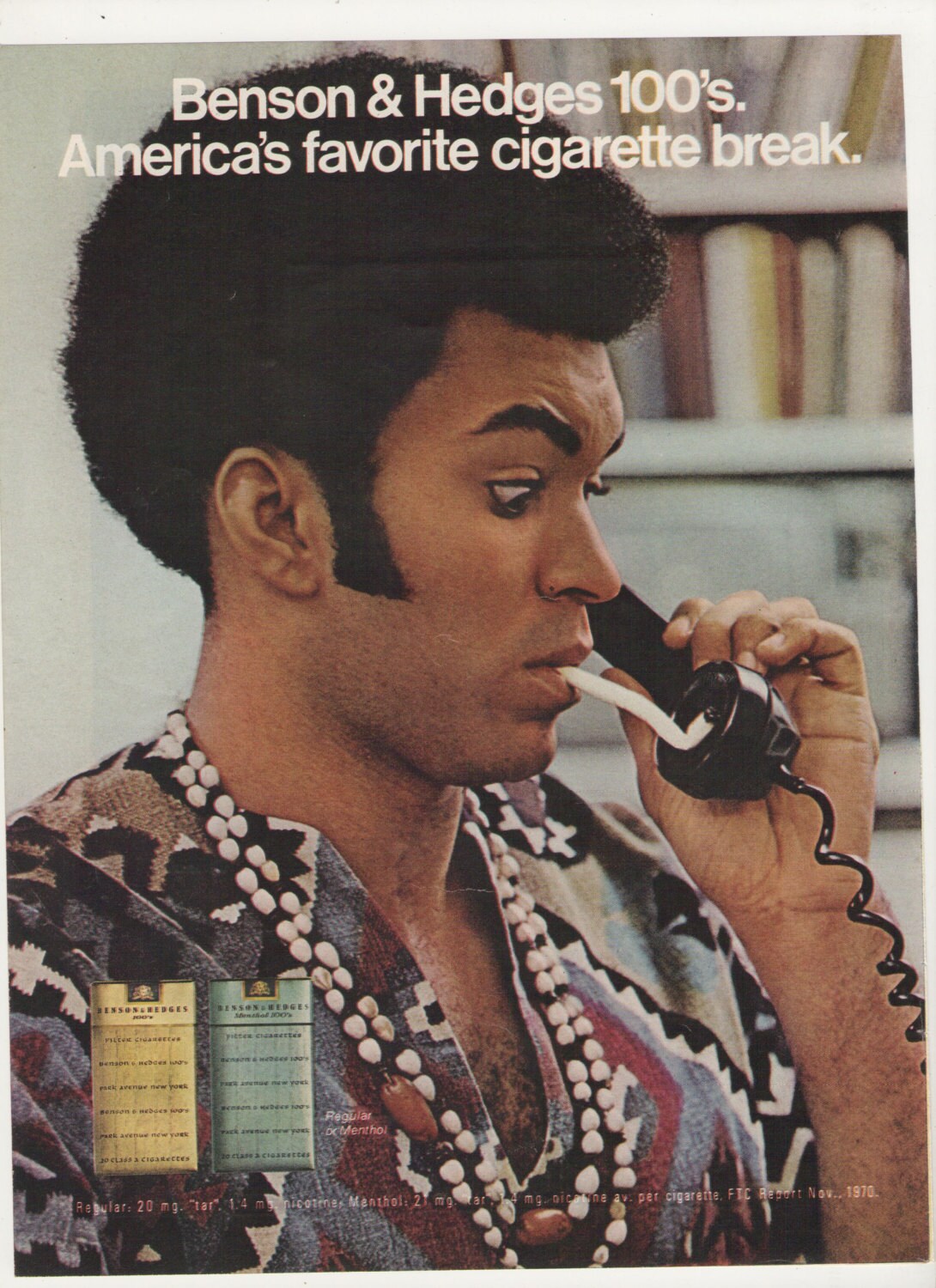
Another development that helped the tobacco industry was that during the 1940s, glossy monthly magazines targeting African Americans were introduced (e.g. Negro Digest, Ebony, and Negro Achievements). They were more attractive to advertisers than the pre-war African American daily newspapers as they had glossy pages and a much larger national distribution. In addition, advertisers could feature black models "away from the eyes of white consumers" (via Stanford School of Medicine). They were, however, not the only medium advertisers used. Inducements to smoke were present on billboards, buses, underground trains; sports and cultural events were sponsored. A disproportionate amount of tobacco companies' promotional budget was spent on attracting black smokers (via).


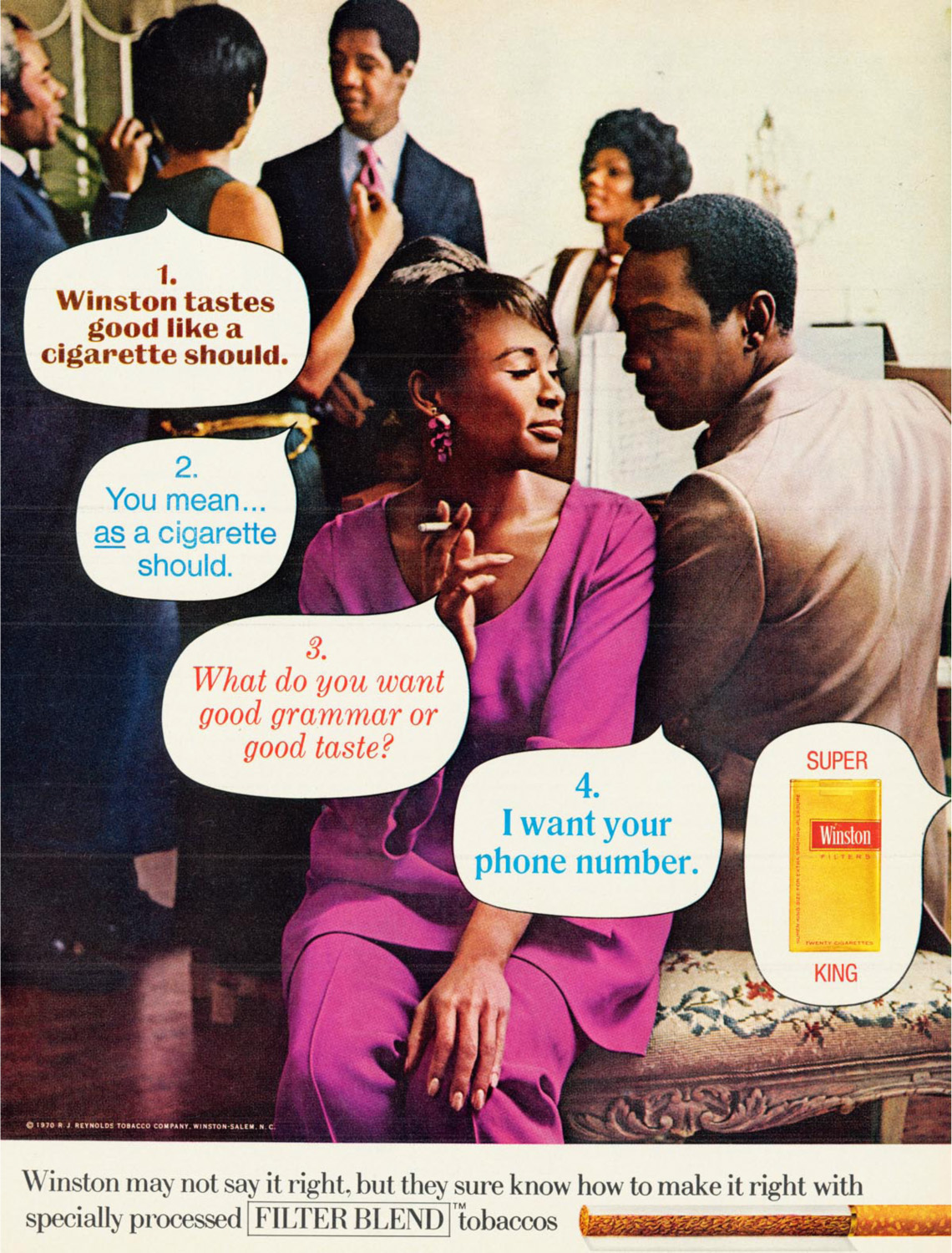
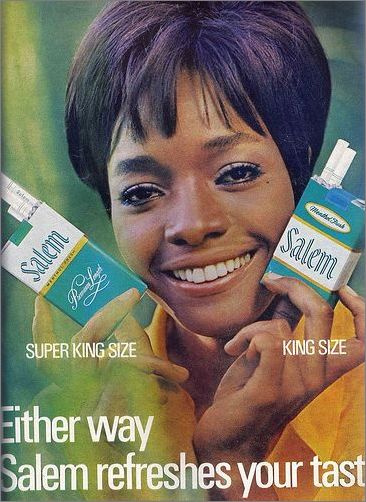
Winston, owned by Imperial Tobacco Company and Japan Tobacco and originally introduced by R. J. Reynolds Tobacco Company in 1954, is one of the top selling cigarette brands. In fact, it became the number one cigarette sold worlwide by 1966 - a position it held until 1972 (via). It was not the only brand that discovered black Americans. In 1995, Menthol X was introduced (and was soon pulled off the shelves after protests), in 1997, R. J. Reynolds introduced a mentholed version of Camel denying that the company was targeting black consumers (and had to withdraw after protests) - just to name a few.
“Marlboro would probably have a very difficult time getting anywhere in the young black market. The odds against it there are heavy. Young blacks have found their thing, and it's menthol in general and Kool in particular.” Philip Morris


"Since younger adult Blacks overwhelmingly prefer menthol cigarettes, continued emphasis on Salem within the Black market is recommended. Salem is already positioned against younger adults. With emphasis on the younger adult Black market, Salem may be able to provide an alternative to Newport* and capitalize on Kool’s decline."
R. J. Reynolds

*Newport is a brand of menthol cigarettes owned by R. J. Reynolds Tobacco Company, introduced in 1957. According to a 2005 survey, about 50% of all cigarette sales to black Americans were Newport cigarettes (via).


Potential black consumers were discovered after WWII and still seem to be defined as "the" target group. According to studies carried out in the 1980s, there are twice as many billboards in black neighbourhoods of St. Louis as white, about 60% of them advertising cigarettes and alcohol. In Philadelphia, out of 73 billboards along 19 blocks in a black neighbourhood, 60 advertised cigarettes or alcohol; in Baltimore 70% of the 2.015 billboards. Three fourth of the billboards were found in predominantly poor black neighbourhoods. Marketing to win the "lungs of Blacks . . . [by] playing on the image of success, upward mobility, stokes fantasies of wealth and power. . . . They design socially conscious ads in Black publications that tout Black leaders and celebrities, praise Black historical figures, scientists, artists and events and promote their sponsorship of scholarship, business and equal opportunity promotional programs for Blacks. . . ." (via). And things have not changed. According to a 2013 study of tobacco retail outlets in St. Louis, for instance, there is more tobacco advertising (including more menthol advertising) in areas with a higher rate of black American residents. A study carried out in California shows: The more black high school students in a neighbourhood, the more menthol advertising. When it comes to menthol cigarette brands, disparities in advertising are particularly evident (via).


Related posting: You've come a long way, baby (Philip Morris targeting women)

Winston images via Stanford School of Medicine, inspired by Flashbak; other images via and via and via and via and via and via and via and via and via

Tuesday, 15 April 2014

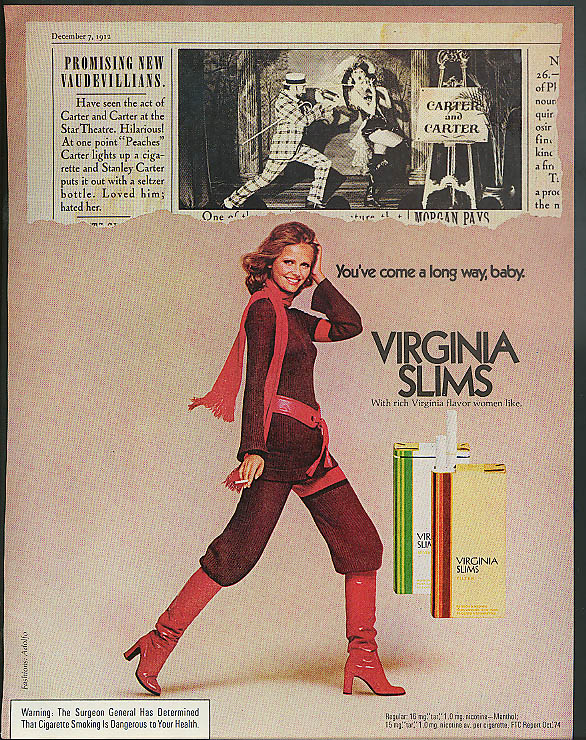
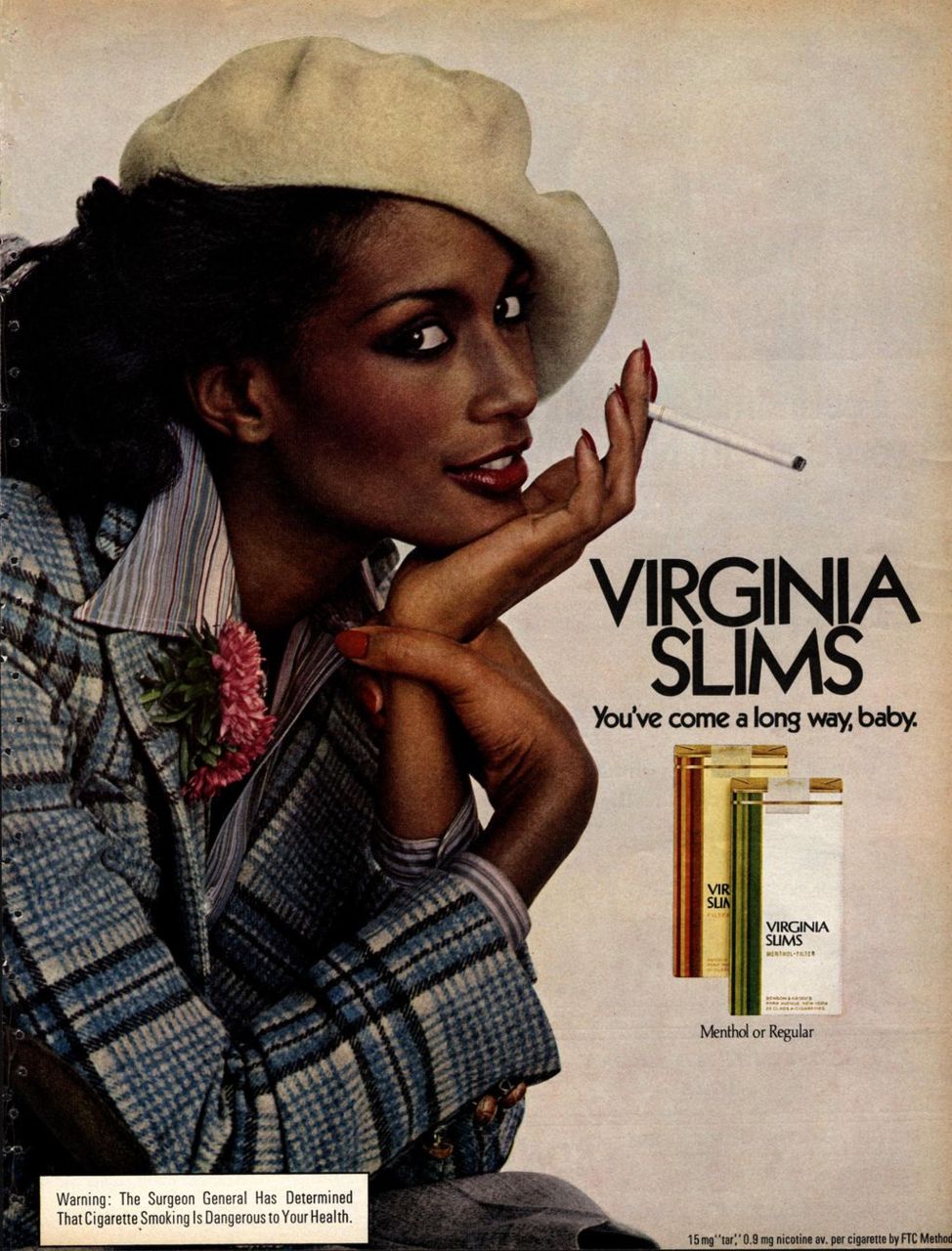
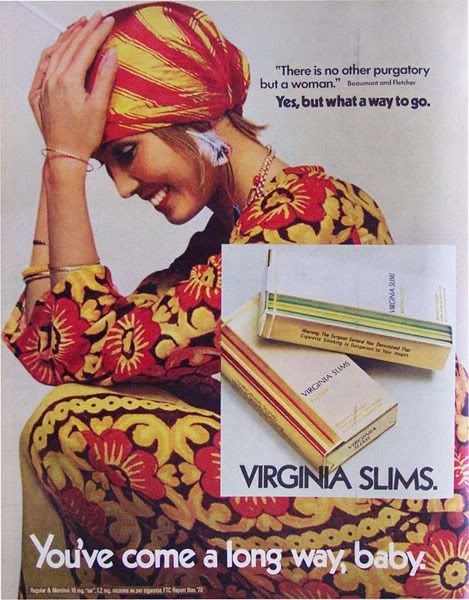
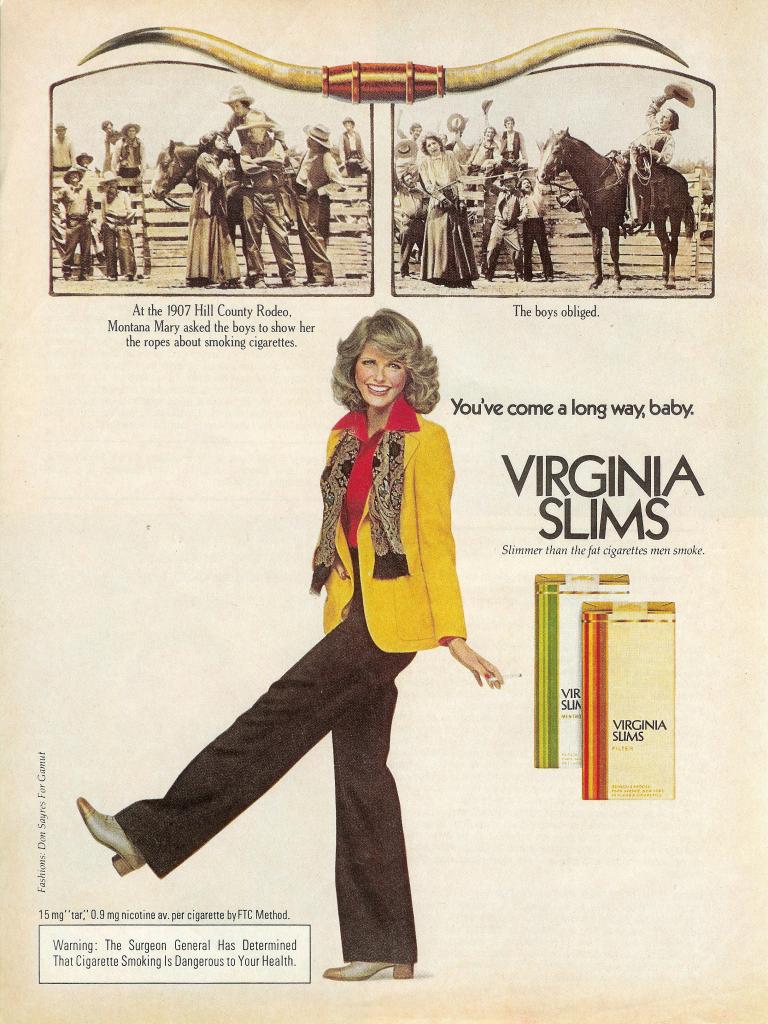
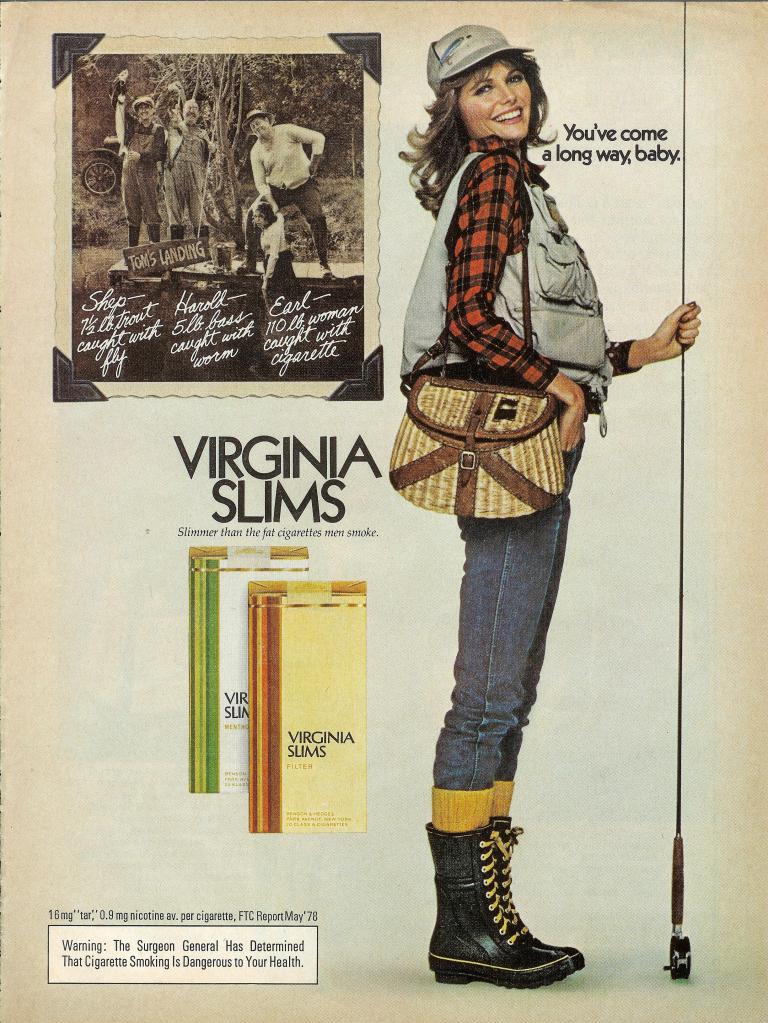
You've come a long way, baby

"You've come a long way, baby 
To get where you've got to today 
You've got your own cigarette now, baby 
You've come a long, long way"

"We make Virginia Slims expecially for women because they are biologically superior to men", 1971, via


Virginia Slims were introduced by Philip Morris in 1968 and "marketed as a female-oriented spinoff to their Benson and Hedges brand". The slogans "You've come a long way" and later "It's a woman thing" and "Find your voice" were supposed to link smoking with "women's freedom, emancipation, and empowerment" (via). It was not the first product to speak to women "in the language of liberation" but it was the first one that interpreted feminism as something that could sell (Zeisler, 2008).

"Rosemary for president. Someday. Meanwhile you've got Virginia Slims. The taste for today's woman.", via; 1968, via


Philip Morris continued this strategy and in 2008 launched a campaign targeting women and girls. The "purse pack" - repackaged, compact, pink Virginia Slims - implies that smoking is both feminine and fashionable. "Super slim" communicates the association between smoking and weight loss (via). John T. Landry, former Philip Morris marketing chief: "I knew thinness was a quality worth talking about. It's an American obsession." (via).

Images via, via, via and via


This gender marketing strategy changed statistics encouraging girls to start smoking. "Six years after the introduction of Virginia Slims, the rate of smoking initiation for 12-year-old girls had increased 110 percent." (via). In fact, apart from social factors, marketing strategies are considered to be one reason for the rise of smoking among women. Smoking as a symbol of emancipation was the core of the campaign. In 1991, an internal industry document describes the strategy targeting only women as follows: "To convince fashionable, modern, independent and self-confident women aged 20-34 that by smoking VSLM, they are making better/more complete expression of their independence." (Hitchman & Fong, 2011). The market share grew from 0.24% bo 3.16% (Toll & Ling, 2005).

LIFE, 13 August, 1971, via


In the 1980s, the number of cigarettes sold declined dramatically. Women were "a saving grace" who just had to be convinced that a woman "needs her very own cigarette as absolutely as she needs ther own underwear" (via). To women, smoking Virginia Slims meant "independence, slimness, glamour, and liberation". Despite the equality progresses the commercials showed since the early twentieth century, "the only equality this campaign ended up supporting involved lung cancer. Today, women and men die at similar rates from the diseases." (via).

Images via, via, via, via, via, via, via, via and via


The campaign was developed by the Leo Burnett Agency and was launched on 22 July 1968. It was a huge success and the slogan more or less became "a national catch-phrase". According to a 1986 corporate study, the so-called brand personality was the key to its success (via).

Images via, via, via, via, 15 November,1968, via; 30 June, 1972, via


Slogan, catch-phrase and song:

- Virginia Slims commercial from 1970s watch

In 1978, the US-American country music singer-songwriter Loretta Lynn was in the charts with the song "We've come a long way, baby". "The title song was a top ten hit for Lynn, playing on the famous Virginia Slims slogan of the day, You've Come a Long Way Baby" (via).
- Loretta Lynn We've come a long way, baby watch

Images via


Hitchman, S. C. & Fong, T. G. (2011) Gender empowerment and female-to-male smoking prevalence ratios. Bulletin of the World Health Organization; via
New York Times (1986) Why They Stretched The Slims via
Toll, B. A. & Ling, P. M. (2005) The Virginia Slims identity crisis: an inside look at tobacco industry marketing to women. Tobacco Control, 14, 172-180
Zeislere, A. (2008) Feminism and Pop Culture. Berkeley: Seal Press