Showing posts with label NASA. Show all posts

Monday, 8 April 2019

The Future of Women Astronauts Seen from 1962

"When I was about 13, I wrote to NASA and asked what I needed to do to try to be an astronaut. And of course, there weren't any women astronauts and NASA wrote me back and said there would not be any women astronauts. And I was just crestfallen."
Hillary Clinton


In February 1962, long before Women@NASA, a woman  from Connecticut applied at NASA and received the following reply (via):

Dear Miss Kelly:
This is in response to your letter of February 20, 1962.
Your offer to go on a space mission is commendable and we are very grateful.
This is to advise that we have no existing program concerning women astronauts nor do we contemplate any such plan.
We appreciate your interest and support of the nations's space program.
Sincerely,
O.B. Lloyd, Jr.
Director
Public Information

- - - - - - -
selfie of Buzz Aldrin in 1966 on the Gemini 12 mission via

Thursday, 26 May 2016

Born this day: Sally Kristen Ride

"On June 18, 1983, NASA astronaut Sally Ride broke through the ultimate glass ceiling, blasting into orbit on the shuttle Challenger as part of the crew of mission STS-7. Since her history-making flight, 39 female NASA astronauts have followed her into space, including shuttle commanders and an International Space Station commander."
NASA


Astronaut and astrophysicist Sally Kristen Ride (1951-2012) was born on 26th of May 1951 in California. She became the first US-American woman to fly in space in 1983 (aboard the space shuttle Challenger) and flew on the space shuttle again in 1984. She was scheduled for a third trip which was cancelled after the Challenger accident in 1986 (via and via).
"For whatever reason, I didn't succumb to the stereotype that science wasn't for girls. I got encouragement from my parents. I never ran into a teacher or a counselor who told me that science was for boys. A lot of my friends did." Sally Ride
"For a long time, society put obstacles in the way of women who wanted to enter the sciences." Sally Ride
"Yes, I did feel a special responsibility to be the first American woman in space." Sally Ride
"There are aspects of being the first woman in space that I'm not going to enjoy." Sally Ride

"I think it's important for little girls growing up, and young women, to have one in every walk of life. So from that point of view, I'm proud to be a role model!" Sally Ride
"The fact that I was going to be the first American woman to go into space carried huge expectations along with it." Sally Ride
After leaving NASA, Ride became the director of the California Space Institute at the University of California and a professor of physics. In 2001, she started her own company with the focus on educational programmes and products ("Sally Ride Science"). Her main motivation was to help students in general and inspire girls and young women in particular, girls who wanted to study science and mathematics, wrote science books for students and teachers and came up with the idea of for NASA's EarthKAM project - EarthKAM lets middle school students take pictures of Earth using a camera on the International Space Station.
Sally Ride received many honours and was inducted into the National Women's hall of Fame and the Astronaut Hall of Fame. She passed away at the age of 61 but will always be remembered as "a pioneering astronaut who went where no other American woman had gone before" (via and via).

"The astronauts who came in with me in my astronaut class - my class had 29 men and 6 women - those men were all very used to working with women."
Sally Ride

"The women's movement had already paved the way, I think, for my coming."
Sally Ride

"I wish that there had been another woman on my flight. I think it would have been a lot easier."
Sally Ride talking to Gloria Steinem: LISTEN/WATCH


photographs via and via and via

Thursday, 9 April 2015

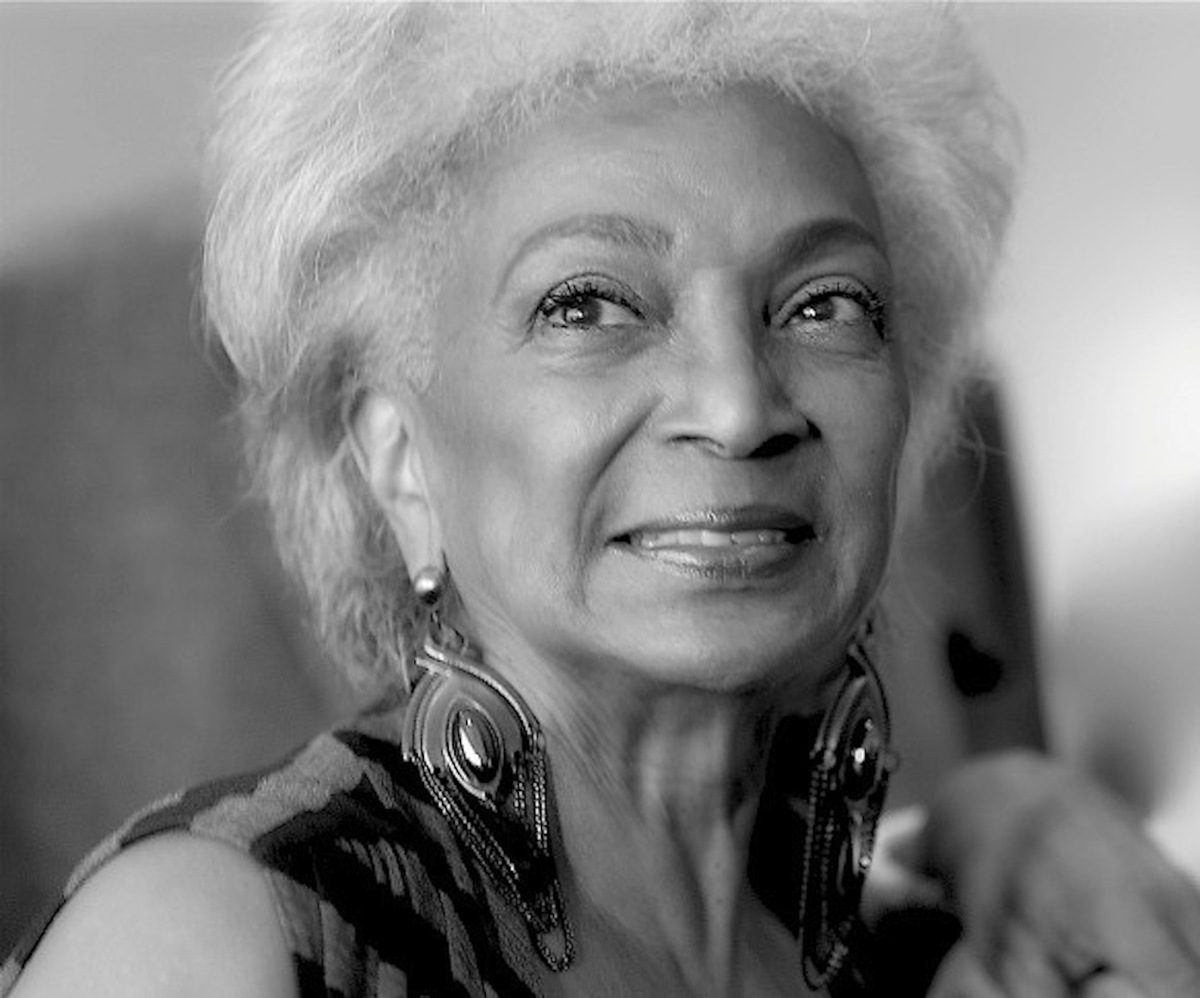
The Nonstereotypical Role of Lieutenant Uhura

"It didn't hit me at the time until somebody told me. I splashed onto the TV screen at a propitious historical moment. Black people were marching all over the South. Dr. King was leading people to freedom, and here I was, in the 23rd century, fourth in command of the Enterprise." (via)


"Oh, man, there were parts of the South that wouldn't show 'Star Trek' because this was an African American woman in a powerful position, and she wasn't a maid or tap dancer." (via)
Nichelle Nichols, born Grace Dell Nichols, portrayed Communications Officer Lieutenant Nyota Uhura aboard the USS Enterprise in the Star Trek series, "one of the first non-stereotypical roles assigned to an African-American actress" (via). When Whoopie Goldberg first watched Star Trek in 1966, she yelled out: "Momma! There's a black lady on TV, and she ain't no maid!" (via). As Levine writes on NASA's website, Nichols has warped to many worlds as Lt. Uhura but her real-life adventures have taken her to where no one has gone before. She inspired and encouraged women and black US-Americans to become astronaut candidates, among them Ronald Ervin McNair and Mae Jemison, the first black woman in space (via) who, by the way, called Nichols her childhood idol and made a cameo appearance on Star Trek: The Next Generation in 1993 (Evans, 2014).

Not everybody was amused about seeing a black woman as a lieutenant on Starship Enterprise. The 1960s were dominated by segregation and while her colleagues did not discriminate against her, other parts of the studio and the show photographer did.
"That's right. There were instances where I was turned away from entering the studio at the walk-on gate, and I had to go all the way around to the front gate, sign-in and come back. A guard on the set told me I had no right being there -- that they had replaced a blue-eyed blonde with me." (via)
"I went through crap, man. Racism was alive and rampant there. Some people said I wasn't good enough, saying things like, 'I don't know how you got this role.' And they kept waiting for me to complain and raise hell about it, but I decided to ignore it. I never went to Gene [Roddenberry] about it." (via)
"There are more pictures of me behind somebody where you can barely see me, but they also had to take pictures of me singularly." (via)

"It had been OK'ed, script-wise, and we went into production for that episode. After the first take, the director yelled 'CUT!' and came over, saying, 'Bill, what are you doing? You actually kissed her!' And Bill said, 'Yeah, I can't get her to let me do it any other way except that it was written in the script. So, what's the problem?' And the director said, 'The South -- they'll kill us.'" (via)
In the third season, Star Trek's progressive attitude made television history. The episode "Plato's Stepchildren", which aired in November 1968, became famous for "the kiss". "White" Captain Kirk kissing "black" Lt. Uhura was a clear message. Segregation meant that on TV, blacks and whites had absolutely no physical contact. The same year, NBC had expressed concern because British actress and singer Petula Clark had touched Harry Belafonte's arm in a muscial sequence singing "On the Path of Glory" (via). The sponsor insisted the touch be cut out of the programme, producer/director Steve Binder refused (via). Variety ended its review with the words: "... the touching bit which caused such a stir ... could only disturb the spiritually sick" (via). "Plato's Stepchildren" received a huge and mostly positive response:
"We received one of the largest batches of fan mail ever, all of it very positive, with many addressed to me from girls wondering how it felt to kiss Captain Kirk, and many to him from guys wondering the same thing about me. However, almost no one found the kiss offensive" except from a single mildly negative letter from one white Southerner who wrote: "I am totally opposed to the mixing of the races. However, any time a red-blooded American boy like Captain Kirk gets a beautiful dame in his arms that looks like Uhura, he ain't gonna fight it." (via)
In the episode's original script, Uhura and Spock were supposed to kiss each other. According to Nichelle Nichols the scene changed when Shatner took a look at it:
"My understanding is Bill Shatner took one look at the scene and said, 'No you will not! If anyone's going to be part of the first interracial kiss in television history, it's going to be me!' So they rewrote it." (via)

"Star Trek was one of the only shows that [King] and his wife Coretta would allow their little children to watch. And I thanked him and I told him I was leaving the show. All the smile came off his face. And he said, don't you understand for the first time, we're seen as we should be seen. You don't have a black role. You have an equal role." (via)
In 1967, Nichelle Nichols wanted to leave the series to return to Broadway but changed her mind after Martin Luther King's words to her. "You are our image of where we're going, you're 300 years from now, and that means that's where we are and it takes place now. Keep doing what you're doing, you are our inspiration." (via).
"When I turned around, I was looking into the face of Dr. Martin Luther King, walking toward me with a big smile on his face." "He said, 'Don't you realize how important your presence, your character is? This is not a black role or a female role. You have the first nonstereotypical role on television. You have broken ground.'" "He added, 'Here we are marching, and there you are projecting where we're going. You cannot leave [the show]. Don't you understand what you mean?' I told him that when I would go on hiatus from the show, I could come and march with him and he said, 'No! You're an image for us. We look on that screen and we know where we're going.' It was like he was saying, 'Free at last, free at last!'" (via)


"When you look at the overall list of astronauts and mission specialists [recruited by Nichols], it's extremely diverse, and that improved the success of the whole program." (via)


"It [Star Trek] not only changed the face of television, but it changed the way people thought of each other. It was a bigger contributor to uniting the races on this planet as anything." (via)
- Evens, S. Y. (2014). Black Passports. Travel Memoirs as a Tool for Youth Empowerment. New York Press.
- photographs of Nichelle Nichols via and via and via and via and via

Friday, 14 March 2014

Public Library

Ronald Ervin McNair (1950-1986), physicist and NASA astronaut, lost his life during the launch of the Space Shuttle Challenger on 28 January 1986. In this three-minutes animation, his brother tells the story of nine-year-old Ron not accepting the rules of 1959.

Sunday, 11 August 2013

Spaceflight and the Culture Assimilator

As spaceflights became more international and crews more multicultural, cultural awareness and sensitivity became one of the skills required for astronauts. Finding the right balance is crucial since overlooking cross-culturality might lead to cultural insensitivity and exaggerating it might promote stereotyping.
An approach to cross-cultural training (used in astronauts' training) is the so-called culture assimilator which consists of 100 to 200 scenarios where people from two cultures interact. Each scenario is followed by several explanations of why the member of the "other" culture acted in a specific way. The learner selects one explanation and then gets feedback for the chosen explanation. Trainees, after a while, start selecting explanations of the others' behaviour that are closer to the others' culture. In other words, the trainees' attributions become more specific, more complex, and less ethnocentric (Draguns & Harrison, 2011).


- Draguns, J. G. & Harrison, A. A. (2011) Spaceflight and Cross-Cultural Psychology. Contemporary Research in Historical Perspective; edited by Vakoch, D. A., 177-194
- Space age fashion à la Pierre Cardin, photograph via

Monday, 8 July 2013

More on space, spiced with some science fiction and a lot of diversity

Star Trek - The Original Series from the 60s are often cited for the heterogeneity of their team. Oftentimes, what seems to be a natural thing today needed moral courage at the time. When Captain James T. Kirk kissed Lt. Uhura (in Plato's Stepchildren) NBC became seriously concerned that the kiss would anger TV stations in the Deep South. The choice of Nichelle Nichols, alias Uhura, was a groundbreaking one and of such a symbolic importance for the civil rights movement that Martin Luther King praised her work and asked her to continue it. After the cancellation of Star Trek, Nichols started volunteering in NASA projects recruiting minority and female personnel ... among others the first American female astronaut. (Source: Wikipedia, photo via)

Saturday, 6 July 2013

Changing perspectives

The earth rises - one of the most spectacular aha moments. We do discuss relativity and the related problems resulting from androcentric, ethnocentric, geocentric, ... points of view. And we somehow sometimes manage to change our perspective by shifting the very centre. And here we are: Our planet is not the centre of the universe and it's not just other planets and suns that rise for us, we rise for them, too. Isn't that beautiful?...  (Photo via)