Friday, 29 May 2020

Does the Fork Have a Woman's or a Man's Voice? And the Bed's Voice?

The fork, a feminine la fourchette in French, a masculine el tenedor in Spanish; the bed, masculine le lit in French, feminine la cama in Spanish... In their study, Sera et al. asked French and Spanish speakers to help prepare a film in which everyday objects come to life, hence need voices.


Participants were shown pictures of different objects and asked to choose a man's or a woman's voice for each. French speakers chose a woman's voice (la fourchette) for the fork, Spanish speakers a man's voice (el tenedor). In the case of the bed, it was exactly the other way round(le lit vs la cama). A series of studies shows the tendency to consider the grammatical gender of inanimate objects when associating characteristics (Deutscher, 2010).

- - - - - - - -
- Deutscher, G. (2010). Through the Language Glass. Why the World Looks Different in Other Languages. London: arrow books.
- image of the amazing Marcello Mastroianni and Sophia Loren via

Wednesday, 27 May 2020

When Art Theft Becomes Artwork

"I decided to steal the painting." In 1976, German performance artist Ulay (1943-2020) stole Spitzweg's painting "The Poor Poet" - which also happened to be Hitler's favourite one and an icon of the Third Reich - from Berlin's Neue Nationalgalerie, ran with his hands and feet through the snow and drove "with the museum guards at his heels" to the district of Kreuzberg at the time known for its large percentage of immigrant workers mainly coming from Turkey and rather a ghetto. Before entering an impoverished Turkish family's home, he called the police, then hung up the painting in their living room.


Here, Ulay ran through the snow with the painting under his arm, to a Turkish family, who had agreed to let him shoot a documentary film in their home—however unaware that it involved a stolen painting. Before entering the family’s home, the artist called the police from a phone booth and asked for the director of the museum to pick up the painting. He then hung up the painting in the home of the family “for the reason to bring this whole issue of Turkish discriminated foreign workers into the discussion. To bring into discussion the institute’s marginalization of art. To bring a discussion about the correspondence between art institutes from the academy to museums to whatever. (via)
This demonstrative act, which lasted around thirty hours, expressed the artist’s personal conflict with his German origins and, at the same time, raised awareness about the discrimination of foreign workers as well as the marginalization of art in post-war Germany because – as Ulay stated years later – “everyone should have art in their homes”. (via)
::: Watch: How I Stole a Painting

- - - - - - - -
photograph via

Tuesday, 26 May 2020

You're beautiful. You know from girl things. Like cooking. And sewing. And smelling nice.

You're beautiful. You know from girl things. Like cooking. And sewing. And smelling nice. And looking in mirrors. But football? So, all day Sunday, he takes his six-pack, plants his highness in fornt of the TV and watches those overgrown goots run into each other. And you've got nothing to do but talk to the other football widows on the phone.


image via

Monday, 25 May 2020

Nigga: Reappropriated as a Term of Endearment?

Abstract: It is commonly believed that nigga has been reappropriated as a term of endearment. Perhaps this perception persists incorrectly because public conversations on this word are often dominated by nonlinguists. In contrast, linguists lack comparative studies of nigga’s historical and modern-day use. ...


... Addressing this misperception requires a multilayered approach, employed here. This study begins with a qualitative inquiry into the historical, linguistic, and social factors that have fueled the current perception of the nigger/nigga two-word dichotomy and of how nigga was used by blacks in the nineteenth and early twentieth centuries. The second part is a quantitative study that examines the current apportionment of nigga by speaker race and gender, and linguistic context, as observed in computer-mediated conversations. Multivariate analysis reveals differences among black and white speakers, males and females, and in various linguistic contexts. Comparative analysis uncovers that many of nigga’s current meanings, referents, and uses have existed since at least the nineteenth century and that any changes to the meanings occurred gradually and not through abrupt reanalysis. This fnding lends no support to the reappropriation hypothesis. And crucially, the data show that the epitomized example of reappropriation, my nigga, does not function primarily as a genuine term of endearment but as a masculinizing marker of social identity. (Smith, 2019)

- - - - - - - - -
- Smith, H. (2019). Has nigga been reappropriated as a term of endearment? (A qualitative and quantitative analysis). American Speech, 94(4), 420-477.
- image of Shaft/Richard Roundtree via

Saturday, 23 May 2020

The Beauty-and-Goodness Stereotype in Hollywood

The beauty-and-goodness stereotype is rather learned, at least partly ... and not so much from direct observation of people of varying attractiveness but acculturation where the entertainment media plays a crucial role. Hollywood filmmakers, in fact, "have been portraying physically attractive individuals more favorably than their less attractive counterparts in terms of their moral goodness, romantic activity, and life outcomes" (Smith, McIntosh & Bazzini, 1999)


Abstract: Physically attractive individuals are often viewed more favorably than unattractive people on dimensions that are weakly related or unrelated to physical looks, such as intelligence, sociability, and morality. Our study investigated the role of U.S. films in this "beauty-and-goodness" stereotype. In Study 1, we established that attractive characters were portrayed more favorably than unattractive characters on multiple dimensions (e.g., intelligence, friendliness) across a random sample from 5 decades of top-grossing films. The link between beauty and positive characteristics was stable across time periods, character sex, and characters' centrality to the plot. Study 2 established that exposure to highly stereotyped films can elicit stronger beauty-and-goodness stereotyping. Participants watching a highly biased film subsequently showed greater favoritism toward an attractive graduate school candidate (compared with ratings of an unattractive candidate) than participants viewing a less biased film.


- Smith, S. M., McIntosh, W. D., & Bazzini, D. G. (1999). Are the beautiful good in Hollywood? An investigation of the beauty and goodness stereotype on film. Basic and Applied Social Psychology, 21(1), 69-80.
- photograph of Oliver Reed via and Capucine via

Friday, 15 May 2020

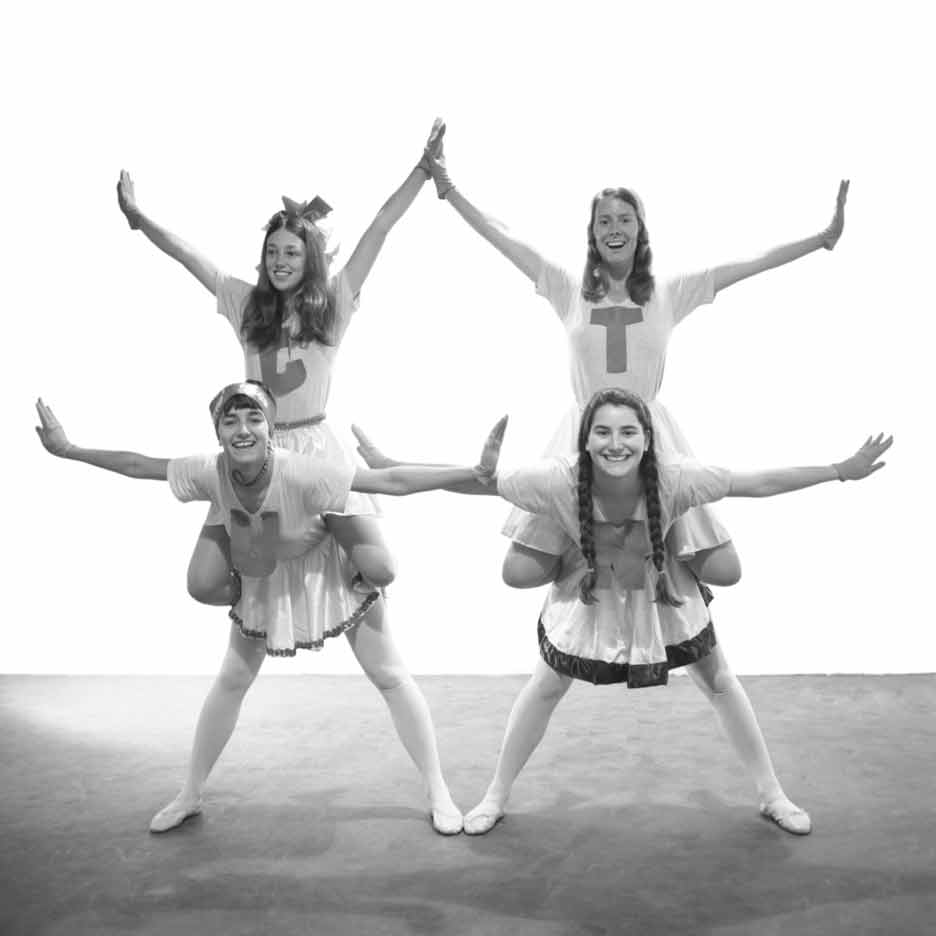
The C*nt Cheerleaders

"Students in the early feminist programs, such as the Cal-Art Feminist Art Program, were taught to say the word cunt until it lost its derogatory nature and female sexuality was revalued, and yet just a few years ago, at the "F-Word" symposium, an event organized to honor their legacy, its organizers were so tentative that they were unable to even spell out the word that defined the movement. (...) At the very end of the symposium, Faith Wilding got up and did the Fresno "cunt cheer". Give me a C... The audience's embarrassment, discomfort, but perhaps also awe could scarcely have been more palpable if she had peed on the floor!"
Schor (2009)


"To contemporary readers the use of the crude slang term cunt will generally be understood in a derogatory way, but this is not necessarily how Rowbotham understood it at the time. Like the reclamation of the negative term queer in the gay and lesbian community and the sitll controversial use of the term nigger by blacks, there was a (now decisively failed) feminist effort made to reclaim the word cunt in positive terms. A great U.S. example of this would be the "cunt cheerleaders," students from Judy Chicago and Miriam Shapiro's Feminist Art Program at Cal Arts, who would turn out at the local airport in cheerleading costumes that spelled out the word cunt to greet feminists visiting the program."
Wilson (2015)


- Schor, M. (2009). A Decade of Negative Thinking. Essays on Art, Politics, and Daily Life. Durham & London. Duke University Press.
- Wilson, S. (2015). Art Labor, Sex Politics. Feminist Effects in 1970s British Art and Performance   Minneapolis: University of Minnesota Press
- photographs via and via and via

Thursday, 14 May 2020

It's nice to a have a girl's head under your foot.

Though she was a tiger lady, our hero didn't have to fire a shot to floor her. After one look at his Mr Leggs slacks, she was ready to have him walk all over her. That noble style sure soothes the savage heart! If you'd like your own doll-to-doll carpeting, hunt up a pair of these he-man Mr. Leggs slacks. Such as our new automatic wash-wear blend of 65% "Dacron" and 35% rayon - incomparably wrinkle-resistant.


A display of affection is great ... but enough is enough. She couldn't keep her hands off him. Always the little hugs, the pats on the cheek. Sly pinches. It could drive a man to the licence bureau. It all began when he wore his first pair of Mr. Leggs Slacks, tailored by Thomson. But he kept his head; now everything's under control. Why don't you try a pair of Mr. Leggs ... and get ready to dig.
FREE! Does your girl have perfect legs? ...


- images via and via, more ads: link and link

Tuesday, 12 May 2020

Being Black in this Pandemic

In England and Wales, Covid-19 patients from black African backgrounds die at more than triple (3.5) rate compared to white people (via), black men are 4.2 times more likely to die than their white counterparts (via) (chances of dying are 1.7 times higher for people of black Caribbean heritage, 2.7 times higher for those with Pakistani heritage). The victims also show the tendency to be younger.


According to a report, ethnic minorities are dying in excess numbers in hospitals, among them a striking number of ethnic minority healthcare workers. This fact that can only be explained considering different factors for different groups. For instance, while black Africans are more likely to be affected because of the key worker roles they are employed in, older Bangladeshi men have health conditions that make them more vulnerable (via).
More than 20% of black African women are employed in health and social care roles while Pakistani men are 90% more likely to work in healthcare roles than their white British counterparts. Similarly, while Indian people make up just 3% of the working population in England and Wales, they account for 14% of doctors, according to the research.
In addition, there are differences when it comes to economic vulnerability:
Bangladeshi men are four times as likely as white British men to have jobs in shutdown industries, with Pakistani men nearly three times as likely," she said. This is partly because of their heavy concentration in the restaurant and taxi sector, she suggested. "Household savings are lower than average among black Africans, black Caribbeans and Bangladeshis," she added. "By contrast, Indians and the largely foreign-born other white group do not seem to be facing disproportionate economic risks.
Lucinda Platt
While only 2% of white British households experienced overcrowding from 2014 to 2017, 30% of Bangladeshi households, 16% of Pakistani households and 12% of black households experienced this, according to a study of the English Housing Survey. (via)
To put it in a nutshell, it is complex:
To try to understand how much of the difference in Covid-19 morbidity was to do purely with ethnicity, the statisticians adjusted for age as well as region, rural and urban classification, area deprivation, household composition, socio-economic position, highest qualification held, household tenure, and health or disability as recorded in the 2011 census. (via)
The fully adjusted results show differences in risk between ethnic groups that are specific to those ethnic groups and are not caused by any of the factors listed on which members of the groups might differ. (via)
In the US, Covid-19 fatalities are extremely high among black Americans:
As of Tuesday, black people made up 33 percent of cases in Michigan and 40 percent of deaths, despite being just 14 percent of the state’s population. In Milwaukee County, Wisconsin, where blacks represent 26 percent of the population, they made up almost half of the county’s 945 cases and 81 percent of its 27 deaths, according to a ProPublica report. In Illinois, black people made up 42 percent of fatalities but make up only 14.6 percent of the state’s population. In Chicago, the data is even graver: Black people represented 68 percent of the city’s fatalities and more than 50 percent of cases but only make up 30 percent of the city’s total population.
In the South, the numbers are also grim. In Louisiana, black people accounted for more than 70 percent of deaths in a state population that is about 33 percent black. About 33 percent of the state’s 512 deaths as of Tuesday morning have occurred in Orleans Parish, where black people make up more than 60 percent of the population and where 29 percent of people live in poverty, according to 2018 census data. (via)
- - - - - -
photograph by the amazing Vivian Maier via

Monday, 11 May 2020

Movie Women's Spaces. Archetypal Settings ... All Leading to Marriage.

"It's interesting how often movie women occupy spaces that might be thought of as masculine (...). These spaces, however, are never remembered as female spaces. This is because movies suggest to us that these are men's spaces that unusual women - remarkable women, wonderful women, movie women - are occupying because of their specialness. They occupy this space inside the frame on behalf of the women in the audience, who will never occupy it in real life."


"The woman is trapped in her limited spaces, and her options for mobility are not presented as horizontal. That is, she can't move easily from job to job across an occupational landscape in the movies. What she can do is more spectacular: she can go up, or she can go down. Thus, one of the most common plot forms of the woman's film is that of the rags-to-riches story (she goes up) or its mirror image, the riches to rags (she goes down).
When a woman goes up, she climbs by marrying or seducing men or by shutting men out of her life. Either way, her mobility is linked to the old problem of men and her relationship to them via her decision about love and romance. When she goes down, it is always because of men. (...)"

"The woman's world on film is a box within a box. The female protagonist has her internal self, desirous of freedom, sex, a job, or a wardrobe, and this is the interior box. The exterior box is the actual setting of the movie, and her private world is contained within it. The easiest way for the movies to tell a story about a woman's world is thus as a personal story about a woman in a specific kind of limited setting with defined parameters.
The way this works can be grasped by considering four typical settings of the woman's film - the prison, the department store, the small town, and the home. They are archetypal: anything else - from the science lab to the nunnery - turns out to be pretty much the same thing. These places are astonishingly alike, on an ascending scale of size. They share one dominant characteristic: clear markers for right and wrong. (...)
The woman starts out on one side or the other. She can begin on the wrong side of the tracks, in the kitchen, down in the stockroom, behidn the perfume counter, or in the prison cell. How does she progress? By using her assets, which are beauty (recognized and commented upon) and brains (concealed and used in covert ways). The rich boy in town marries her and moves her across the tracks. The son of the department-store owner notices her, marries her, and removes her from the working world. The homeowner's son notices her, marries her, and makes her the mistress of the home (shifts her over from the kitchen to the bedroom). The prison doctor notices her, realizes she really isn't a criminal at all, and gets her a pardon or rehabilitates her. He'll marry her later, when it's more socially acceptable. (...)" (Basinger, 1993)

- - - - - - - - - -
- Basinger, J. (1993). A Woman's View. How Hollywood Spoke to Women, 1930-1960. New York: Alfred A. Knopf.
- image ("That Touch of Mink", 1962, Cary Grant and Doris Day) via