Showing posts with label Marilyn Monroe. Show all posts

Thursday, 23 May 2024

The Pink Drink Thesis, the "Classless Woman", and the World's Biggest Female Binge Drinkers

According to an OECD report released in November 2023, the biggest female binge drinkers in the world are ... British women. The OECD (Organisation for Economic Co-operation and Development) compared alcohol consumption across 33 countries.

The Daily Maily spread the Pink Drink Thesis, safely dismissed by the majority of people living and thinking in the 21st century, stating that the infantilised female drinker just cannot help accepting offers. Being the Daily Mail, the tabloid also hypothesised that British women drank to excess because they were "unattractive and classless". 

In the scramble to explain this, the following ideas have been floated, mainly by the Daily Mail: British women are uniquely susceptible to marketing pressures, including but not limited to pink drinks, supermarket offers, bottomless brunches and nice pubs. The 20th-century settlement in drinking culture – that you can have your fill, so long as you’re prepared to do it in a smoky back room with laminated tables and carpets that smelt like the urinals – was overturned in the late 1990s, during what we might call the All Bar One revolution (that chain was founded in 1994). Pubs became airier, more chic and inviting, women went into them voluntarily, and it was noted on the profit upswing that, where women went, men went also.

In an article published in The Guardian, Zoe Williams points out the importance to consider generational differences when discussing alcohol consumption:

(...) the sociologists Paul Chatterton and Robert Hollands ascribed the “feminisation of the night-time economy” by 2001 directly to the transformation of the labour market and the increase of female spending power. Arguably, the ladette as cultural artefact – the woman for whom drinking six pints, which by the way is considerably more than six units, was a direct expression of her emancipation – came into being as a way to accommodate this new, independent femininity. If you could slot it into established versions of masculinity, it would be fun and not terrifying. In a trend that has probably been noticed before, where alcohol is concerned, once we started, we didn’t stop. (via)

- - - - - - - - - - - - - -

photograph of Marilyn Monroe drinking champagne via

Wednesday, 13 September 2023

US-Americans and the Death of Home Cooking

According to the Economic Research Service's Adult Eating & Health Module (EHM) study carried out over two three-year periods (2006-2008 and 2014-2016), US-Americans spend less time eating and drinking as a primary activity (decrease by 5%) than they did ten years ago. The amount of time spent eating as a secondary activity, i.e., eating while engaged in another activity, has not changed much. Education - directly or indirectly - has an impact on the amount of time dedicated to eating. Those with more than a bachelor's degree spent 18% more time eating and drinking as a primary activity than those with less education. The data collected also showed an increase in prepared food purchases (via).

After the pandemic, spending at restaurants and food-service providers (excluding grocery stores) returned to what was perceived as normal before. The percentage of US-Americans spending money on eating out vs cooking and eating at home swelled to 53.2. (via)

Based on time-use surveys carried out in France and the US, Maria Pleszz and Fabrice Etilé come to the conclusion that both people in the US and in France spent about 15 to 20 minutes less time cooking and eating at home in 2010 than they did in 1985, however, for different reasons. In France, the decrease was mainly due to a drop in eating time while the time spent cooking had remained relatively stable. According to the authors, the time drop in France was mainly caused by an increase in smaller households. In the US, the drop was explained with people spending less time making meals (via).

For some Americans, going out to dinner is a treat, planned and budgeted for. For others, it’s just another Tuesday night. And Wednesday. And Thursday. 
And that second group of people is becoming the majority. The number of Americans who enjoy cooking is declining, while the prevalence of food delivery startups, and culinary-centric television shows grows. (via)

The importance or non-impartance of food is surely culture-bound. Compared to other nationas, US-Americans only spend a small portion of their household income on food (via) and, again in comparison, spend little time on cooking (via). The early introduction of fast food as an acceptable alternative to real meals, their consumption portrayed in movies, and TV characters throwing away food easily might be further contributors to the message that food is nothing to think about much.

Eddie Yoon gathered data over two decades. In his first survey, he found three groups of US-Americans: 15% saying the love cooking, 50% saying they hate it and 35% being ambivalent about it. 15 years later the percentages had shifted, not necessarily for the better: 10% loved cooking, 45% hated it, 45% were indifferent or liked to sometimes cook, In other words, 90% are not really fond of cooking (via). Grocery shopping and cooking are shifting to a niche activity (via).

(...) our fondness for Food TV has inspired us to watch more Food TV, and to want to eat more, but hasn’t increased our desire to cook. (via)

Monsiavais et al. (2014) carried out a study on time use. The authors stratified the sample into those who a) spent less than an hour a day on food preparation and cleanup, b) one to two hours a day, and c) more than two hours a day. Those who spent the least amount of time on food preparation were working adults with a strong focus on convenience. Time spent on food preparation positively correlated with diet quality (more vegetables, salads, fruits, and fruit juices). Spending less than an hour a day on food preparation meant spending more money on food outside home and using fast food "restaurants" more often: "The per-person expenditure in the lowest time-use group was >$22/week whereas that in the highest group was approximately $15/week". 

Surveys show that the time US-Americans spend on cooking has decreased substantially since the 1960s, i.e., to an average of 33 minutes per day for food preparation and cleanup. Lack of time is mentioned as one reason but surely only explains part of the situation (Monsiavais et al., 2014).

A survey from 2019 found that 41.43% of US-Americans preferred to spend less than 30 minutes cooking a weeknight meal, 50.17% found it acceptable to spend between 30 and 60 minutes, 8.4% were happy to spend more than an hour on it (via).

- Monsivais, P., Aggarwal, A. & Drewnowski, A. (2014). Time Spent on Home Food Preparation and Indicators of Healthy Eating. American Journal of Preventive Medicine, 47(6), 796-802.
- photographs of Marilyn Monroe eating hot dogs with Arthur Miller in New York, 1957, taken by Sam Shaw via 

Monday, 10 October 2022

Global Adult Literacy Rate By Gender

Generally speaking, literacy rates have increased worldwide for both genders. Nevertheless, as of 2020, there is still a gender gap when it comes to literacy with 90% of men and about 83% of women being literate (via).

photograph of Marilyn Monroe via

Sunday, 12 May 2019

"You'd never wholly know you." Marilyn Monroe

“I want to grow old without facelifts... I want to have the courage to be loyal to the face I've made. Sometimes I think it would be easier to avoid old age, to die young, but then you'd never complete your life, would you? You'd never wholly know you.”
Marilyn Monroe


photographs of Marilyn Monroe, Arthur Miller, Simone Signoret, Yves Montand by Bruce Davidson, Beverly Hills Hotel apartment, 1960 via and via and via and via, for more photographs see Magnum Photos: link, (c) Bruce Davidson/Magnum Photos

Monday, 29 October 2018

Female Fashion Photographers - Where are They?

"If you look at the most successful photographers in the world, the top ten are all male, except for maybe [husband-wife team] Inez and Vinoodh. Photography has been a male-dominated business since it began."
Amanda de Cadenet


In 2017, 153 magazine covers from ten of the leading US-American fashion magazines were mainly shot by men, with only 13.7% being shot by women. Some magazines, like e.g. Marie Claire, did not hire a female photographer for the cover shot the whole year. The advertising industry is even more extreme. According to data from major photography publications and awards organisations, male photographers made up between 89 and 96% of those in the advertising categories between 2013 and 2017 (via).
"Over 50 percent of grads coming out of photo school are female, and yet when you look around at the assistants out there, the vast majority are male. Assisting is a physically demanding job, where strength and height are very helpful. I've spoken to countless women who tried to enter the field, but could not get assisting work. Two told me that some agencies outright stated they don't use female assistants. As assisting is the most common path to becoming a photographer, if you shut this door, that can be the end for some."
Cybele Malinowski


"We need to have a say in how we're represented. What I see with women photographing other women is that we find the nuance. We often find different things interesting and beautiful and sexy and charismatic than when men photograph women. I think a lot of it, unfortunately, comes down to sexualizing."
Amanda de Cadenet


photographs of Marilyn Monroe with Milton Hawthorne Greene's (1922-1985) son Joshua via and via and via and via, (c) Joshua Greene, Archive Images

Wednesday, 16 December 2015

Ella & Marilyn

"I owe Marilyn Monroe a real debt…it was because of her that I played the Mocambo, a very popular nightclub in the ’50s. She personally called the owner of the Mocambo, and told him she wanted me booked immediately, and if he would do it, she would take a front table every night. She told him - and it was true, due to Marilyn’s superstar status - that the press would go wild. The owner said yes, and Marilyn was there, front table, every night. The press went overboard. After that, I never had to play a small jazz club again. She was an unusual woman - a little ahead of her times. And she didn’t know it."
Ella Fitzgerald


In 1955, Marilyn Monroe approached Charlie Morrison, the owner of the Mocambo (1941-1958), a nightclub in West Hollywood frequented by celebrities (such as Clark Gable, Humphrey Bogart, Lauren Bacall, Errol Flynn, Charly Chaplin, Elizabeth Taylor, Henry Fonda, Lana Turner, Ava Gardner, Tony Curtis, Natalie Wood, Marlene Dietrich, and many others), when she discovered that Ella Fitzgerald was not allowed to play in her (Monroe's) favourite nightclub. She promised him to attend every performance seated at the front table if he let Fitzgerald play. Morrison agreed, Monroe sat in the front row, and Fitzgerald never again had to play in a small, second-rate jazz club (via).


Marilyn Monroe, however, also seemed to owe something to Ella Fitzgerald. When jazz pianist and composer Hal Schaefer was hired as Monroe's vocal coach he told her to listen to Ella Fitzgerald. She became a fan of hers and the two became friends (via).


“In the very beginning, I told her to buy Ella Fitzgerald’s recording of Gershwin songs. And I ordered her to listen to it a hundred times.” “She wasn’t really into jazz when she came to me. But I told her: ‘Look, I’m going to be your guide. This is where we have to start: listening to the best female singer there is.’ ”
Hal Schaefer


Ella Fitzgerald YouTube Selection:

- It don't mean a thing (1974): WATCH/LISTEN
- This girl in love with you (1969): WATCH/LISTEN
- Hey Jude (1969): WATCH/LISTEN
- Girl from Ipanema (1965): WATCH/LISTEN
- Hard Day's Night (1965): WATCH/LISTEN

- - - - - - - - - - - - - - - - -
photographs via and via and via and via

Monday, 14 December 2015

Quoting Marilyn Monroe

"What I really want to say: That what the world really needs is a real feeling of kinship. Everybody: stars, laborers, N*groes, Jews, Arabs. We are all brothers."
Marilyn Monroe


photograph of Marilyn Monroe in her Cadillac (1954) via

Monday, 13 April 2015

A Woman's Place Is On The Money

“A young girl wrote to ask me why aren’t there any women on our currency, and then she gave me like a long list of possible women to put on our dollar bills and quarters and stuff - which I thought was a pretty good idea.”
Barack Obama


Dear mr president,

I am writing to know why there arent many woman on the Dollars for the United States. I think there should be more women on a Dollars/coins for the united States Becuas if there where no woman there wouldnt Be Men also there are Many woman that could be on Dollars/coins for the united State because of the important things done. Please write Back

Sofia

My list of woman can Be on Dollars/coins for the united States
Anne Hutchinson, Rosa Parks, Abigail Dams, emily Dickinson, Hellen keller, Debran Samspon, Betsy Ross, Michelle oBaMa, Hillary clinton, eleantor roosevelt, Harriet tudman, Ida B. Wells


The White House
Washington

February 11, 2015

Dear Sofia:

This is a belated note to thank you for writing to me with such a good idea last summer. The women you listed and drew make up an impressive group, and I must say you're pretty impressive too.

I'll keep working to make sure you grow up in a country where women have the same opportunities as men, and I hope you'll stay involved in issues that matter to you. If you keep focusing in school and trying to help others whenever you can, there are no limits to what you can accomplish.

Thanks again for the great letter. I expect big things from you.

Sincerely,
Barack Obama


“I was studying Ann Hutchinson, who stood up for women’s rights. Almost everyone who chose a boy, on their poster they had pictures of different dollar bills or coins with their person on it. So I noticed, why don’t women have coins or dollar bills with their faces on it?”
Sofia
“Why is that? Why are no girls on currency? Because women are just as important as men, and I think that it’s important for the women to get recognized in this way.”
Sofia
Sofia, 9 years old, fourth-grader from Massachusetts inspired the Women On 20s campaign. Similarly, a campaign started in the UK in 2013 when the Bank of England announced that Sir Winston Churchill would replace Elizabeth Fry on the 5-pounds note from 2016. Later, the Bank added that Jane Austen would replace Charles Darwin from 2017 (via). But back to Sofia: When studying historical figures at school, she noticed that her classmates who had chosen a man often showed coins and bills. She also noticed that women were underrepresented (few exceptions are Sacagawea and Susan B. Anthony). Sofia went home and told her mother she needed to write a letter to President Obama (via). Not only did she get a reply but also an invitation to the annual White House Easter Egg Roll (via).

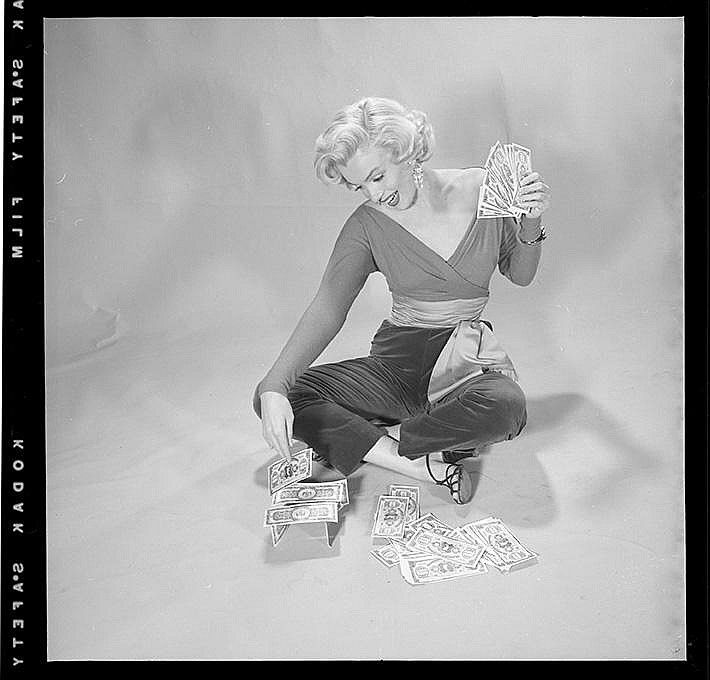
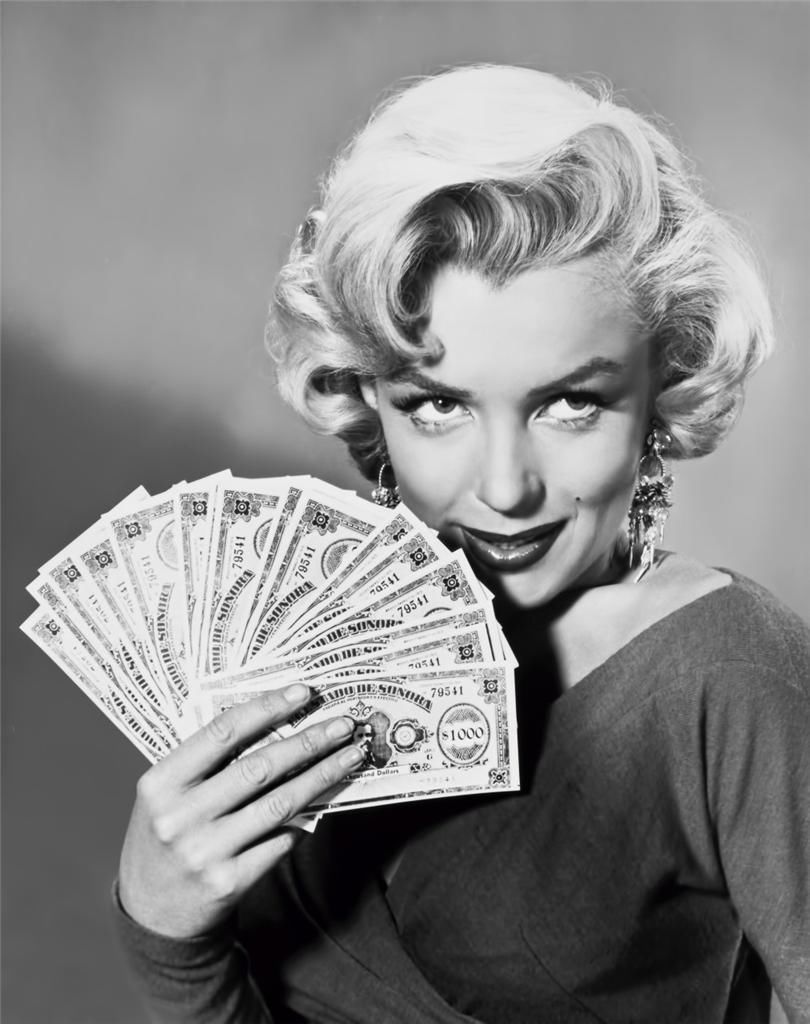
Interesting and curious: From 1946 to 1973, so-called Military Payment Certificates (a form of currency used by the U.S. military personnel in some foreign countries) were printed with more women than man on them. When the war against Vietnam started, the women's portrayals became more modern and resembled celebrities. Rumour has it that one of them looked like Marilyn Monroe. According to a theory, this was no coincidence. Women on the military currency were supposed to motivate the soldiers abroad in a similar way Hollywood stars did with their entertainment programmes when visiting soldiers in combat zones. In 1970, things changed and Military Payment Certificates started having only men on them, such as Benjamin Franklin or George Washington (via).


photographs (1953) of Marilyn Monroe by John "Johnny" Florea (1916-2000) via and via and via and via and via

Saturday, 27 July 2013

Depression in Men?

Marilyn Monroe - if various internet sources are correct - suffered from depression. A typical female disorder? Statistics from the NIH show that women are 70% more likely to experience depression during their lifetime. But...


... according to the gender medicine approach, men seem to suffer from depression as often as women. Men are just less often diagnosed with depression. Statistical differences between men and women are explained by differences in gender roles (e.g. not seeking help), coping styles (e.g. substance abuse) and symptoms leading to an underestimation of the true rates. Men show more anger, aggression and irritability - symptoms that are usually not associated with depression as we are used to focusing on "traditional female symptoms" (see). Once again the behaviour and experience of the dominant group (here women) is seen as normative and those in the nondominant group (here men) are seen as "different". Depression needs to be taken seriously, the relative lack of research on gender and depression raises public health concerns (Addis, 2008).


Addis, M. E. (2008) Gender and Depression in Men. Clinical Psychology: Science and Practice, 15(3), 153-166 (photos via and via)