Showing posts with label numbers. Show all posts

Monday, 1 June 2015

The Tokyo Beatles, Culture, Odd and Even Numbers

While Westerners show a tendency to prefer even numbers, Japanese prefer odd numbers - with few exceptions such as "eight" ("increasing property) and "nine" ("suffering"). In the Seven-Five-Three Festival, for instance, boys and girls at the age of three, boys at the age of five and girls at the age seven celebrate their growth at shrines. According to a custom, festivals are held on odd numbered days in odd-numbered months. At weddings, there is the tradition to give gifts of 10.000, 30.000 or 50.000 yen, never 20.000 or 40.000 yen.


Even numbers, on the other hand, generally do not have positive associations. "Two" means separating, "four" is associated with death and "six" means "good-for-nothing". At funerals, condolence payments are entirely in odd numbers. Hospital sickrooms avoid the number "four" as it sounds like the pronunciation of the word meaning "death".


The clear roles of odd and even numbers can be traced back to the Chinese philosophy of yin and yang (Nishiyama, 2004) - literally meaning dark and bright - which describes the complementary, interconnected and interdependent character of apparently opposite or contrary forces (via).


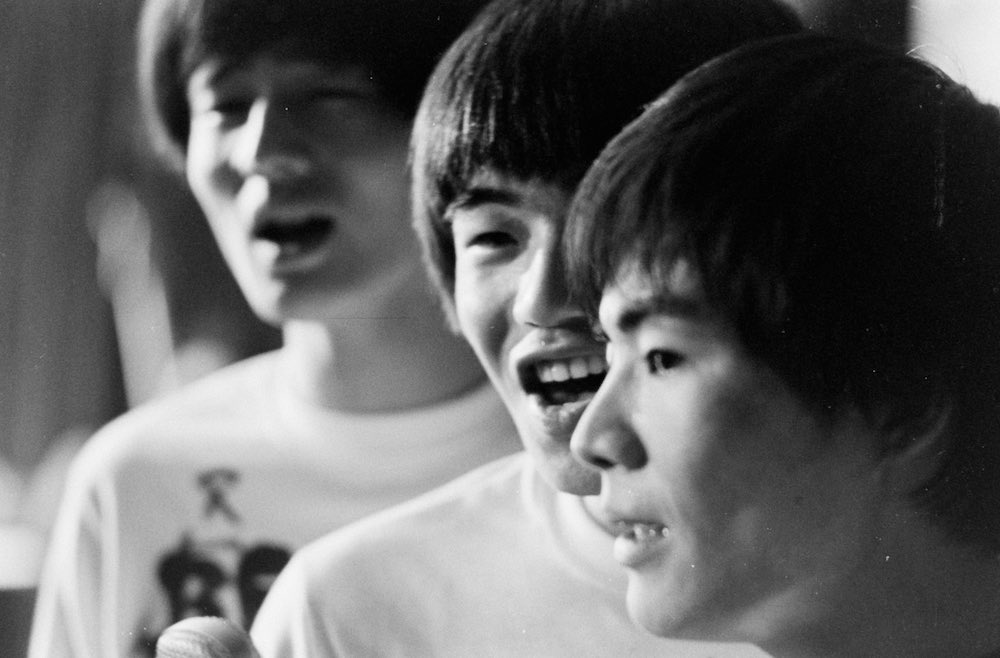
The Tokyo Beatles were a Japanese cover band, "a group of skinny, mop-topped Japanese rock and rollers" that drove their fans wild borrowing their name of "a group of skinny, mop-topped British rock and rollers". The band was most popular for some time and had "highly energized fans" but broke up after seven years in the 1960s "without too many people noticing they were gone" (via).

::: "I want to hold your hand" in Japanese: Dakishimetai 


Michael Rougier (1925-2012) was a LiFE Magazine staff photographer for 24 years (via) and an accomplished sculptor. He was recognised as a "stellar photojournalist" and won the "Magazine Photographer of the Year" award from the National Press Photographers Association in 1954 (via). In 1964, he was on assignment in Japan where he did not only take photographs of the Tokyo Beatles and their fans but "an astonishingly intimate, frequently unsettling portrait of teenagers hurtling willfully toward oblivion" (via).


- Nishiyama, Y. (2004). The Cultural History of Numbers. Studies in Economic History, 8, 146-174.
- photographs by LIFE photographer Michael Rougier (1964) via and via and via and via and via and via and via and via and via and via and via and via and via and via

Friday, 29 May 2015

Gendered Numbers

Both animate and inanimate objects are associated with a gender, products are associated with a gender depending on the question whether more men or women are seen using it more often but also depending on the perceived quality … such as the so-called gentle (hence) feminine product. Gender is also associated with "highly abstract and ostensibly nonsocial concepts", such as numbers.


Historically, numbers have been linked to a gender for a long time and there are examples from ancient Greece and Chinese philosophy. Traditionally, odd numbers used to be seen as masculine, even numbers as feminine. While some may argue that this is just an arbitrary ascription, some scholars say that "representations of abstract concepts must be extrapolated from concrete ones, even when there is little superficial similarity between the two". In other words, there is more to it. And that is where it gets interesting.

In their first study, Wilkie and Bodenhausen investigated gender connotations of "1" and "2". They presented a US-American sample foreign names, i.e. ambiguous stimuli and expected them to be rated more masculine when presented with the number "1" than when paired with the number "2". Results showed that, as predicted, Bulgarian names paired with "1" were rated as more masculine (M = 5.51 vs. M = 5.17). The same was true for Spanish names paired with "1" (M = 4.51 vs. M = 4.29).

In a second study, participants had to evaluate the Bulgarian names paired with three-digit numbers with digits that were either completely even or completely odd. Again there was a tendency to rate names presented with odd numbers as more masculine (M = 5.43 vs. 5.15). In their third study, the stimuli were babies' faces (that are often ambiguous) instead of names, presented with numbers. Here too, babies were more often rated as masculine when presented with the number "1" than with "2" (M = 3.79 vs. M = 3.47). The authors come to the conclusion that "numbers are indeed gendered".

- - - - - - - - - - -

And now for something completely different. Jazz Numbers (1969): WATCH
For more about the "free jazz, Yellow Submarine-style surrealistic animation" see: Open Culture

- - - - - - - - - - -

- Wilkie, J. E. B. & Bodenhausen, G. V. (2011). Are Numbers Gendered? Journal of Experimental Psychology, 1-5
- photograph of Veruschka von Lehndorff, Max Brunell, Carlo Ortiz and a beautiful Fiat Dino (1969) via

This posting originally appeared on Science on Google+ on 15 March 2015.