Monday, 10 July 2017

That Unfinished Oscar Speech, by Marlon Brando (1973)

"Hello. My name is Sacheen Littlefeather. I'm Apache and I am president of the National Native American Affirmative Image Committee. I'm representing Marlon Brando this evening and he has asked me to tell you in a very long speech, which I cannot share with you presently because of time but I will be glad to share with the press afterwards, that he very regretfully cannot accept this very generous award. And the reasons for this being are the treatment of American Indians today by the film industry – excuse me – and on television in movie reruns, and also with recent happenings at Wounded Knee. I beg at this time that I have not intruded upon this evening and that we will in the future, our hearts and our understandings will meet with love and generosity. Thank you on behalf of Marlon Brando."
Sacheen Littlefeather


"Ask most kids about details about Auschwitz or about how the American Indians were assassinated as a people and they don't know anything about it. They don't want to know anything. Most people just want their beer or their soap opera or their lullaby." Marlon Brando
In March 1973, Marlon Brando (1924-2004) declined the Academy Award for Best Actor for his performance in "The Godfather". Instead, he asked Sacheen Littlefeather - actress, activist for Native American civil rights and then-president of the National Native American Affirmative Image Committee - to attend the ceremony in his place (via and via). This was one of the most political and powerful moments in Oscar history (via and via) and not everybody appreciated it (John Wayne, for instance, was not amused). A "tsunami of criticism" followed (via).
One of Marlon Brando's reasons was the way the film industry portrayed Native Americans. At that time, a "high proportion of the Western made up to the 1950s, (...), showed Indians as hostile savages attacking the whites." They were "represented as motiveless and insanely violent" and "merely the backcloth to the inevitable white settlement of the West" (Stokes, 2013).
Apparently, people did not only have a problem with her message but with her being a woman as well:
"Oh, I got threats. They said, 'Why did they send a woman to do a man's job?' [The people backstage] said they’d give me 60 seconds, or they’d arrest me. John Wayne was in the wings, ready to have me taken off stage. He had to be restrained by six security guards. Afterward people questioned my authenticity, they said I wasn’t even Indian."  Sacheen Littlefeather
"They were booing because they thought, 'Well, this moment is sacrosanct and you’re ruining our fantasy with the intrusion of a little reality'". Marlon Brando
"Remember, I was making a profound statement: I did not use my fist, I did not use profanity, I used grace and elegance and quiet strength as my tools." Sacheen Littlefeather
After her brief speech, Littlefeather was escorted away by two security people who protected her. People made "some very stereotypical sounds" and threw tomahawk chops towards her. Her activism brought renewed attention to Wounded Knee but also the end of her career. The actress was not hired again as people within the industry were afraid hiring her would shut down their productions (via).


The following day, the New York Times printed Brando's unfinished Oscar speech:

That Unfinished Oscar Speech

For 200 years we have said to the Indian people who are fighting for their land, their life, their families and their right to be free: ''Lay down your arms, my friends, and then we will remain together. Only if you lay down your arms, my friends, can we then talk of peace and come to an agreement which will be good for you.''

When they laid down their arms, we murdered them. We lied to them. We cheated them out of their lands. We starved them into signing fraudulent agreements that we called treaties which we never kept. We turned them into beggars on a continent that gave life for as long as life can remember. And by any interpretation of history, however twisted, we did not do right. We were not lawful nor were we just in what we did. For them, we do not have to restore these people, we do not have to live up to some agreements, because it is given to us by virtue of our power to attack the rights of others, to take their property, to take their lives when they are trying to defend their land and liberty, and to make their virtues a crime and our own vices virtues.

But there is one thing which is beyond the reach of this perversity and that is the tremendous verdict of history. And history will surely judge us. But do we care? What kind of moral schizophrenia is it that allows us to shout at the top of our national voice for all the world to hear that we live up to our commitment when every page of history and when all the thirsty, starving, humiliating days and nights of the last 100 years in the lives of the American Indian contradict that voice?

It would seem that the respect for principle and the love of one's neighbor have become dysfunctional in this country of ours, and that all we have done, all that we have succeeded in accomplishing with our power is simply annihilating the hopes of the newborn countries in this world, as well as friends and enemies alike, that we're not humane, and that we do not live up to our agreements.

Perhaps at this moment you are saying to yourself what the hell has all this got to do with the Academy Awards? Why is this woman standing up here, ruining our evening, invading our lives with things that don't concern us, and that we don't care about? Wasting our time and money and intruding in our homes.

I think the answer to those unspoken questions is that the motion picture community has been as responsible as any for degrading the Indian and making a mockery of his character, describing his as savage, hostile and evil. It's hard enough for children to grow up in this world. When Indian children watch television, and they watch films, and when they see their race depicted as they are in films, their minds become injured in ways we can never know.

Recently there have been a few faltering steps to correct this situation, but too faltering and too few, so I, as a member in this profession, do not feel that I can as a citizen of the United States accept an award here tonight. I think awards in this country at this time are inappropriate to be received or given until the condition of the American Indian is drastically altered. If we are not our brother's keeper, at least let us not be his executioner.

I would have been here tonight to speak to you directly, but I felt that perhaps I could be of better use if I went to Wounded Knee to help forestall in whatever way I can the establishment of a peace which would be dishonorable as long as the rivers shall run and the grass shall grow.

I would hope that those who are listening would not look upon this as a rude intrusion, but as an earnest effort to focus attention on an issue that might very well determine whether or not this country has the right to say from this point forward we believe in the inalienable rights of all people to remain free and independent on lands that have supported their life beyond living memory.

Thank you for your kindness and your courtesy to Miss Littlefeather. Thank you and good night.

(speech via)

Trivia: Scandals around Brando's Oscar trophy continued. Leonardo DiCaprio, who was given Marlon Brando's Oscar trophy for his performance in "Wolf of Wall Street", gave it back this year because the production company was "skewed up in a billion dollar money-laundering scheme" (via).

- - - - - - - -
- Stokes, M. (2013). American History through Hollywood Film: From the Revolution to the 1960s.
- image via

Saturday, 8 July 2017

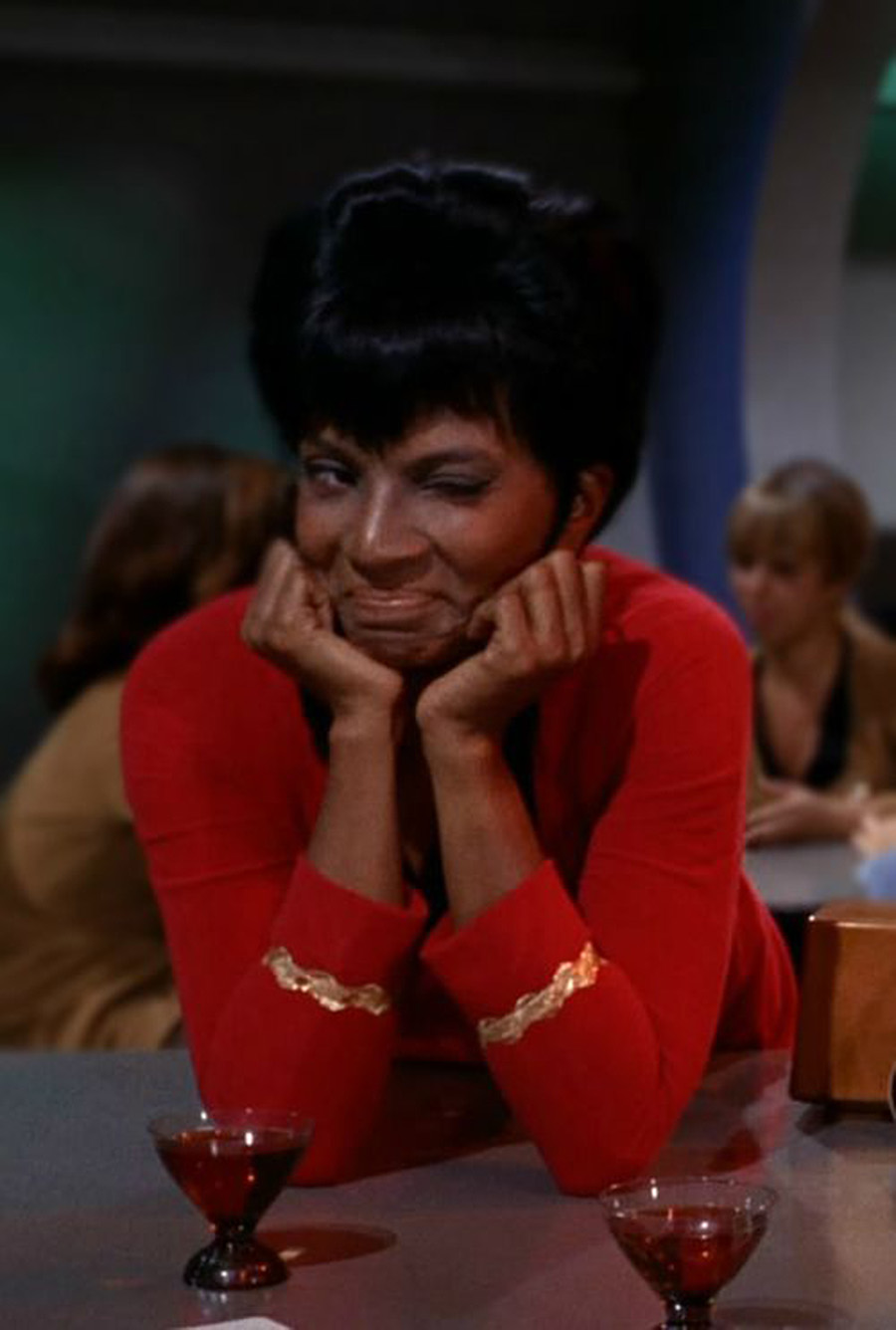
Hoping dream becomes reality, by Nichelle Nichols (1968)

Like most entertainers, TV and cinema personalities. it has been my pleasure to be actively involved with the struggle of my people attempting to extricate themselves from the bonds of discrimination, prejudice, and bigotry that has held us so fast, for so long.


I’ve been more than happy to appear at schools, churches and community affairs in hope that what success I have attained could serve as an inspiration for some black youth who might otherwise give up. The energy and time I have invested in helping the mothers of Watts, VISTA, Head Start, Bootstrap and OIS has been meaningful to me.

Fighting for a race

I know I am not only fighting and working for my people as a race, I’m fighting for myself as an individual as well. As a black person, I am affected by the same unjust elements, simply on a different level.

One of the most enlightening experiences I’ve had was in a poverty area church . . . predominantly black. The minister had asked me to talk to the youth group. His concern was for their future, their ambitions, and discouraging from violence.

What can one say to a 17-year-old black boy who says, “Miss Nichols, before I die in Vietnam for a country that will not acknowledge me as a person, I’d rather die in the streets fighting for my freedom here. And if not my freedom. maybe the next generations to come.”

Perhaps this was the first time I had truly understood the meaning of the Black Movement, for even in spite of their despair I could feel a great sense of pride. Many of the girls and boys now wore their hair in the natural style. Yes, they were black AND proud of it. Poor AND not happy with it. American AND determined to be treated like it. Could I assure him of equality? Could I assure him of his rights?

As the first black woman in a TV series, I had made a small fissure in the wall surrounding a closed wall called “for whites only.” Would I set a precedent to help open the way to greater involvement in the industry? Would I be able to gain greater acceptance and understanding of my people as people?

At that moment, I realized how badly my people need help, and how badly my country needed help.

The best way to help my people and all people is to help the nation wake up. We as a enemy known to man, ourselves. people are facing the greatest As long as we live from riot to riot and from assassination to assassination, this country is in trouble.

- - - - -
The article "She's hoping dream becomes reality" was originally published in The Star Press (Muncie, Indiana) on 26 July 1968, text via Click Americana


images via and via

Thursday, 6 July 2017

Diversity is flawlessly logical. Four years "Diversity is beautiful", Spock and my Vulcan ear.

Four years, 595 postings (24 of them on Star Trek), 5832 subscribers, 6.723.579 views, and thousands of interesting, logical and fascinating comments. Thank you so much and .... live long and prosper!


original image via, creatively modified by Paperwalker

Sunday, 2 July 2017

"As long as I can I'm gonna play. It's just too much fun."

"I was 78 years old when I got my first basketball shoes. So that was a thrill. Growing up we didn’t have sports like the girls do today. We didn’t have the opportunity to play; that was before Title IX."
Grace Larsen (91)


"It keeps me off the streets and out of the bingo parlors -- saves me money."
Nina Duncan (85)

The Senior Women's Basketball Associaten accpets players from all walks of life who are 50 and older. To make the Splash team, however, athletes have to be at least 80 years old (via). Here is a wonderful clip about these impressive women:


images via

Thursday, 29 June 2017

Lucy likes tomato sauce and I have smaller toes than Artie.

"From lettuce love (and hate!) to hard-hitting opinions on ketchup and toe size, these kids know what’s important ― friendship, openness and respecting each other’s differences, a lesson we can all learn from.
Their unscripted and natural responses is just what you would expect and demonstrates that children don’t make assumptions about people and their differences in the way that all too often grown-ups do."

Alice Webb, BBC Children’s Director


This video is part of the BBC campaign "Everyone's Welcome" that celebrates the beauty of diversity. It has reached more than 20 million views on the Facebook pages of CBeebies and BBC Family and Education News Facebook (via).


image via

Tuesday, 27 June 2017

Her Majesty Queen Elizabeth II says...

"My government will make further progress to tackle the gender pay gap and discrimination against people on the basis of their race, faith, gender, disability or sexual orientation."

Excerpt taken from Queen Elizabeth's II's speech in UK Parliament outlining government's agenda, delivered on 21st of June 2017, for the full text see


photograph via

Saturday, 24 June 2017

Racism needs your help to survive

Taika Waititi, Hollywood director and New Zealander of the year, fronts the campaign that was launched to crack down the rising level of racism in New Zealand. According to reports, a third of all human rights complaints concern discrimination based on ethnicity (via).


“How we treat other people will define what kind of country we become and what kind of person a New Zealander is."
Susan Devoy, Race Relations Commissioner

“Today some iconic Kiwis are standing shoulder to shoulder with the Human Rights Commission and asking us all to give nothing to racism, to give it no tolerance, to give it no acceptance and to give it no welcome. They make me incredibly proud to be a New Zealander.”
Susan Devoy

Thursday, 22 June 2017

Belfast (1977)

Got to have a believin'
All the people
'Cause the people are leavin'
When the people believin'
All the children cause the children
Are leavin'


Belfast
Belfast
When the country rings the leaving bell you're lost
Belfast
Belfast

When the hate you have
For one another's past
You can try (You can try)
You can try
To tell the world the reason why
Belfast
Belfast
Belfast
It's the country that's changin'
Oh, it's the country that's changin'
It's the country that's changin'
All the people
'Cause the people are leavin'
It's the world that's deceivin'
All the people
'Cause the people believin' (...)


More Boney M:

::: Gotta go home: WATCH/LISTEN
::: Ma Baker: WATCH/LISTEN
::: Rasputin: WATCH/LISTEN
::: Sunny: WATCH/LISTEN
::: Daddy Cool: WATCH/LISTEN

- - - - - - - - -
- Photograph via
- lyrics via

Tuesday, 20 June 2017

World Refugee Day: Ahmed and Harry

"Every minute 20 people leave everything behind to escape war, persecution or terror."
United Nations


"I’ve met so many who have lost so much. But they never lose their dreams for their children or their desire to better our world. They ask for little in return – only our support in their time of greatest need"
António Guterres, UN Secretary-General

Monday, 19 June 2017

The Aggressive Driver Syndrome, Age, Gender and Type of Car

Aggressive driving (tailgating, rude gestures, passing on the shoulder, pulling into a parking space someone else was waiting for, etc.) is a cultural norm, a socially acquired practice with age and gender differences.
The results of a telephone survey of 1.000 adult drivers conducted in 2000 show that young drivers are more aggressive than older drivers, that men are more aggressive than women when they drive sports cars and light trucks, and women are more aggressive than men when they drive SUVs and luxury cars. The author, in fact, distinguishes between "tough driving cars" (sports, light trucks, SUVs), "soft driving cars" (economy, family), and "special driving cars" (vans, luxury) stating that each of these "psychological categories" has its own aggressive driving syndrome. These are correlations, no causality is discussed.


The author also conducted an online survey in which 72% of female van drivers confessed to swearing and cussing on a regular basis vs. 46% of male drivers of economy cars.
Generally, men described themselves higher on aggressiveness than women (either because they really are or because it is culturally more accepted, or a mix of these reasons). The difference was significant, little in numbers (6 vs. 5.5), and high in effect. When considering the lifetime of one generation of drivers, the author comes to the conclusion that women's lesser aggressiveness would theoretically lead to 120.000 lives saved and 500.000 injuries less. The type of aggressiveness is also related to age and gender. Women, for instance, swear more than men do. So do young drivers compared to older ones. Men, in contrast, speed more than women (so do younger drivers compared to older ones).
"One of the discoveries I made by studying drivers for many years is that they like to underestimate their errors and overestimate their skills. In this sample, people rated themselves as a driver on a 10-point scale, from (1) poor to (10) excellent. Men rate themselves close to 8 while women rate themselves close to 7. This is is significant and substantial, but the interpretation is not entirely clear. It's possible that men are better drivers than women, but not necessarily. It could be that men underestimate their errors, while women are more realistic or honest. What's interesting when you look at the graph, is that this gender difference is replicated across the 10 states for which I had enough respondents to attain reliability."
Interestingly, those who consider themselves near perfect also confess to significantly more aggressiveness.

Although the sample is not representative and one has to be careful when analysing self-assessment, this study has some interesting findings.

- - - - - - - - - - - - - - - - -
- James, L. (2000). Aggressive Driving Analyzed: National Web Based Survey of 1.200 Drivers. The Effect of Age, Gender, and Type of Car Driven Across the States, online
- Photograph via