Showing posts with label India. Show all posts

Friday, 3 May 2024

The Deaf Snow White. By Kanika Agarwal. An Excerpt.

The great king and his queen were married for five years and were still waiting for a child. The mother often prayed for a girl whose skin and heart would be white and pure as snow. In their sixth year, their prayers were answered and they finally got a baby girl. However, the queen died a month after the birth of the child. The king was left to care for their only daughter and put his heart and soul into it. He named her Snow White in remembrance of his wife’s wishes.


As the years passed by, Snow White blossomed into a beautiful girl fair as snow. She had a gentle heart and a soothing voice. She grew up playing in the gardens of their palace, and most of her friends were the plants, bushes and her favourite three little birds – Brownie, Bluie and Ruie. She talked to them endlessly as her father presided over his court. Days turned into months and months turned into years. In the blink of an eye, Snow White was ten years old. It was then that she started losing her hearing. Her father knew that he would not be able to care for Snow White alone now. So, he remarried – primarily to provide care to his deaf daughter. But no one knew what fate had in store for Snow White.

(..) 
Snow White started sensing that her stepmother was using her deafness to fill her father’s ears against her. She observed that her father had become sterner towards her. He once came and sat beside her to talk. She saw his lips moving: “My dear little child, you need to work harder and make sure you treat your mother and your sisters fairly.”

(...) 
Snow White woke up to the pecks of her little birds on her body. “How did you find me?” she asked. They rubbed their beaks against her nose sweetly. Suddenly, Snow White realised that someone was in the house. She peeped out of the bedroom door to find seven little people sipping wine by the fire. She was scared of what awaited her and wanted to run out. So, she tried tiptoeing, only to realise that she was too big to escape the house unnoticed.

She spoke up hesitantly, apologising to them for her intrusion and tried walking away. They moved their lips but they were too tiny for her to read. That is when she had to tell them about her deafness. While many of them did not believe her and accused her of lying, one of them, Sheram, gestured to her to sit and explain her story. Tabish and Sheram listened patiently. By the time she finished her story, her fear had turned into grief and she sobbed inconsolably.


An excerpt taken from Parita Dholakia's version of Rapunzel (via): 
The prince falls in love with Rapunzel and invites her to his palace ...

“I can’t. There is no ramp from the room to the garden.”
“We will find a way. I can carry you down,” says the prince.
“Carry me? I don’t think I would like that. I always go everywhere wheeling my own chair.”

- - - - - - - - - - - - -
- Agarwal, K. (2024). The Deaf Snow White. In: Rising Flames (ed.) And They Lived ... Ever After: Disabled Women Retell Fairy Tales. HarperCollins India.
- More: The Guardian, link
- photograph of Nikki Giovanni (1972) via

Sunday, 27 June 2021

Mädchenland. By Karolin Klüppel.

"In the state of Meghalaya in India, the indigenous people of the Khasi with 1,1 million members form the majority of the population. The Khasi are a matrilineal society. Here, traditionally it is the girls who are of particularly importance and who play an exposed role in the family. The line of succession passes through the youngest daughter. If she marries, her husband is taken into her family‘s house, and the children take their mother‘s name.


A family with just sons is considered unlucky, because only daughters can assure the continuity of a clan. The succession after maternal line guarantees girls and women in Meghalaya a unique economic and social independence compared to general indian conditions.


To disrespect a woman in the Khasi culture means to harm the society.


Between 2013 and 2015 I spent ten months in the khasivillage of Mawlynnong in north-east India, a village of just 95 dwellings. In this series I concentrate on the girls themselves in contextualizing them in their everyday physical environment through a sensitive balance between documentation and composition."
Karolin Klüppel


photographs via

Friday, 26 October 2018

Father's Daughter, Husband's Wife, Son's Mother. Women in India and their Suicide Rate

"Our social norms are very regressive. In the village, a girl is called her father’s daughter, then she is her husband’s wife, and when she has a son, she is her son’s mother."


From 1990 to 2016, India's share of global suicide deaths among women increased from 25.3% to 36.6%. About two in five women who commit suicide worldwide are Indian turning suicide into the leading cause of death among those aged 15 to 39 years. The suicide rate is three times higher than a country with the given socio-economic indicators would have. The main reasons are believed to be early marriage, youth motherhood, low status in society, lack of (financial) independence, and male violence (via and via)

- - - - - - - - - -
- Gender differentials and state variations in suicide deaths in India: the Global Burden of Disease Study 1990-2016, download
- photograph of a contortionist with her puppy Sweety at the Great Raj Kamal Circus in Upleta, India, 1989, taken by Mary Ellen Mark (1940-2015), via

Monday, 13 August 2018

India. No Country for Women.

According to a survey conducted by the Thomson Reuters Foundation in 2018 (the first one was carried out in 2011), India is the most dangerous country in the world for women, followed by Afghanistan, Syria, Somalia, Saudi Arabia, and Pakistan. Between 2007 and 2016, crime against women rose 83% in India alone. In 2016 - again, in India alone - 40.000 rapes were reported. 70% of sexual harassment victims do not report their cases. Girls are molested in school, women raped by taxi drivers, teens trafficked and sold to brothels (via).


The key areas of the poll were healthcare, discrimination, cultural traditions, sexual violence, non-sexual violence and human trafficking. Cultural traditions comprise acid attacks, female genital mutilation, child, marriage, forced marriage, stoning, physical abuse and mutilation to punish, and female infanticide. Discrimination includes job discrimination, inability to make a livelihood, discriminatory land-property-inheritance rights, lack of access to education and to adequate nutrition. (via). At least 20 million women (i.e. the population of London, Paris and New York) have left the workforce for reasons such as sexual harassment. Only 27% work (via).

The full report: Thomson Reuters Foundation

- - - - -
photograph "Woman and a goat" by William Gedney, India, 1970 via

Wednesday, 7 October 2015

Missing Women

"It is often said that women make up a majority of the world’s population. They do not. This mistaken belief is based on generalizing from the contemporary situation in Europe and North America, where the ratio of women to men is typically around 1.05 or 1.06, or higher."
Amartya Sen


The concept of "missing women" was developed by Indian economist, philosopher and Nobel Laureate for Economics Amartya Sen in the early 1990s and refers to the phenomenon that in some parts of the world, such as India and China, "the ratio of women to men is suspiciously low" (Anderson & Ray, 2012).


"To get an idea of the numbers of people involved in the different ratios of women to men, we can estimate the number of “missing women” in a country, say, China or India, by calculating the number of extra women who would have been in China or India if these countries had the same ratio of women to men as obtain in areas of the world in which they receive similar care. If we could expect equal populations of the two sexes, the low ratio of 0.94 women to men in South Asia, West Asia, and China would indicate a 6 percent deficit of women; but since, in countries where men and women receive similar care, the ratio is about 1.05, the real shortfall is about 11 percent. In China alone this amounts to 50 million “missing women,” taking 1.05 as the benchmark ratio. When that number is added to those in South Asia, West Asia, and North Africa, a great many more than 100 million women are “missing.” These numbers tell us, quietly, a terrible story of inequality and neglect leading to the excess mortality of women."
Amartya Sen


"Violence against women must be recognised as a key issue in its own right, as one of the significant causes of death on our planet – comparable in importance only to war, hunger and disease." Winkler (2005)
According to United Nations' estimations, around 200 million women and girls are, euphemistically speaking, missing - a euphemism that "hides one of the most shocking crimes against humanity" (Winkler, 2005).

Gendercide in figures:

- Between 1.5 and 3 million girls and women are killed through gender related violence each year (Winkler, 2005).
- As of 2005, several million foetuses had been aborted in India within the last two decades for the only reason that they had been female (via). In India, there are at least 400.000 sex selective abortions per year (via). Almost half of the 100 million women who were not born because of their gender would have been Indian (43 million of the estimated 100 million) (via).
- Of those girls who are born in India, thousands are abandoned each year (Jha et al., 2011).
- For every 1.000 boys, there are at least about 60 to 70 girls under the age of six years who were killed before or within 6 years after birth (via).
- Indian girls under five years have a 40% higher mortality rate than boys the same age. "Negligent homicide" refers to the practice of letting girls die of malnutrition or starvation, or not taking them to hospital when they fall sick (via).
- Indian girls between one month and five years die of pneumonia or diarrhea at a rate four to five times higher than boys that age. Pneumonia is often induced by wrapping the girl in a wet towel soon after she is born to make sure infanticide is not detected in a police investigation (via).
- In India, girls of one year and younger are 50% more likely to die because of violence than boys at that age. Girls are 21% more likely than boys to die because of violence before their fifth birthday (via).
- According to the United Nations Population fund, around 5.000 women are killed every year in so-called honour crimes. It is estimated that at least three Pakistani women are murdered in "honour killings" every day. In Egypt, 47% of women who had been raped were "honour" killed by a relative afterwards (via).
- About 15.000 widows live and die on the streets of the holy city of Vrindavan, widows who had mostly been sent away by their own families after losing their husbands (via).


- Anderson, S. & Ray, D. (2012). The Age Distribution of Missing Women in India. Economic & Political Weekly, XLVII(47&48), 87-95.
- Jha, P., Kesler, M. A., Kumar, R., Ram, F., Ram, U., Aleksandrowicz, L., Bassani, D. G., Chandra, S. & Banthia, J. K. (2011) Trends in selective abortions of girls in India: analysis of nationally representative birth histories from 1990 to 2005 and census data from 1991 to 2011. The Lancet, 377(9781), 1921-1928
- Winkler, T. H. (2005). Slaughtering Eve. The Hidden Gendercide, 1-3. In: vlachova, M. & Biason, L. (eds.) Women in an Insecure World  via

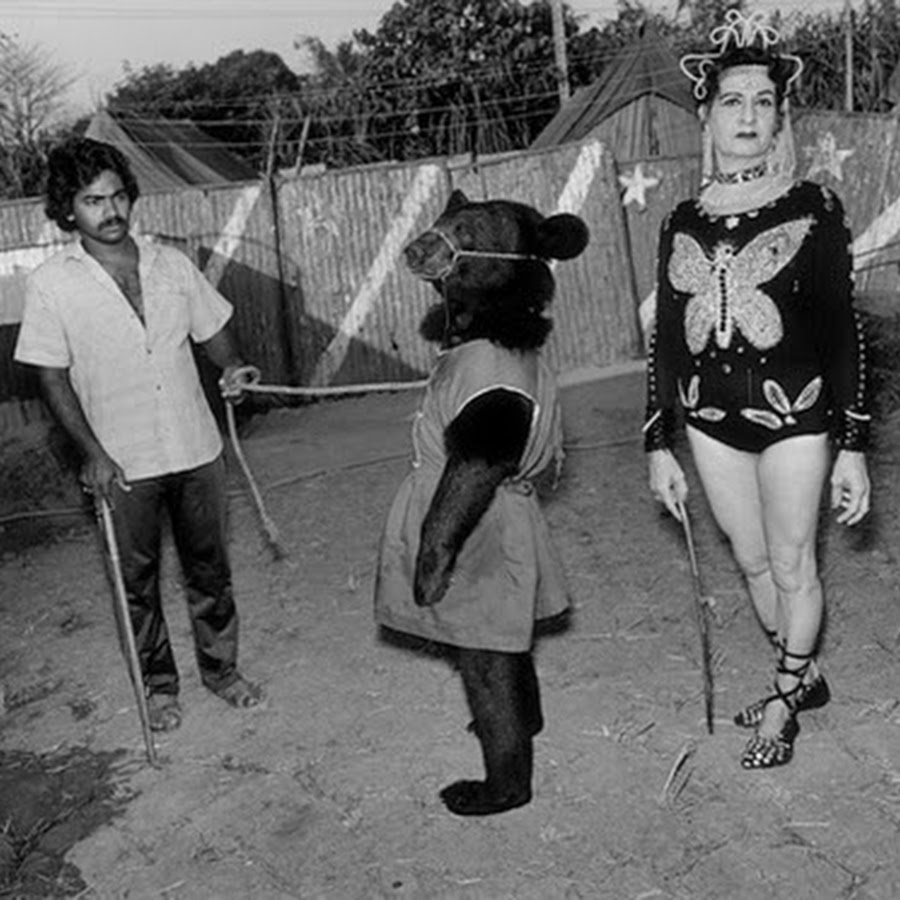
- all photographs by Mary Ellen Mark (1940-2015), "Hippopotamus and Performer. Great Rayman Circus Madras India" (1989) via, "Mira, Shefali and Pushpa of the Great Famous Circus", Calcutta via, Shavannaas Begum with her three years old daughter Par Veen, Great Gemini Circus via, Indian Circus via and via and via and via and via