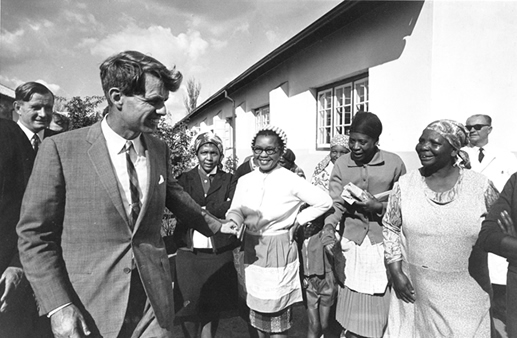
South Africa's dilemma: a bright future weighed down by dark cruelty. Here is a personal report on the land of apartheid, where even the churches are segregated.

AT THE SOUTHERN TIP OF AFRICA, the mountains rise up and then fall sharply to the sea. The beaches are washed in turn by the harsh Atlantic and the warm, slow waters of the Indian Ocean. There, perched on the rocky slopes of the Cape of Good Hope, stands the proud city of Cape Town, a monument to the remarkable fortitude and vigor of the Dutch, British, French, Africans and others who have built one of the richest and most energetic societies in the world.
As our airplane banked over the city, strikingly beautiful in the bright sunlight, all of us smiled and talked, warmed by the shared pleasure of beauty and of pride in human accomplishment.
Then a voice said, "There is Robben Island," and the plane went silent and cold. For Robben Island is home to more than 2,000 political prisoners in South Africa-black and white, college professors and simple farmers, advocates of nonviolence and organizers of revolution, all now bound in the same bleak brotherhood because of one thing: Because they believe in freedom, they dared to lead the struggle against the government's official policy of apartheid.
Apartheid, the Afrikaans word for "apartness," rigidly separates the races of South Africa-three million whites, twelve million blacks, and two million Indian and "colored" (mixed-blood) people. It permits the white minority to dominate and exploit the nonwhite majority completely. If your skin is black in South Africa:
You cannot participate in the political process, and you cannot vote.
You are restricted to jobs for which no whites are available.
Your wages are from 10 to 40 percent of those paid a white man for equivalent work.
You are forbidden to own land except in one small area.
You live with your family only if the government approves.
The government will spend one-tenth as much to educate your child as it spends to educate a white child.
You are, by law, an inferior from birth to death.
You are totally segregated, even at most church services.
During five days this summer, my wife Ethel and I visited South Africa, talking to all kinds of people representing all viewpoints. Wherever we went-Pretoria, Cape Town, Durban, Stellenbosch, Johannesburg-apartheid was at the heart of the discussion and debate.
Our aim was not simply to criticize but to engage in a dialogue to see if, together, we could elevate reason above prejudice and myth. At the University of Natal in Durban, I was told the church to which most of the white population belongs teaches apartheid as a moral necessity. A questioner declared that few churches allow black Africans to pray with the white because the Bible says that is the way it should be, because God created Negroes to serve.
"But suppose God is black," I replied. "What if we go to Heaven and we, all our lives, have treated the Negro as an inferior, and God is there, and we look up and He is not white? What then is our response?"
There was no answer. Only silence.
In Rome a week later, when Ethel and I met with Pope Paul VI, we discussed South Africa-the loss of individual rights, the supremacy of the state, the growing rejection of Christianity by black Africans because, as one of them said, "The Christian God hates the Negroes." Distress and anguish showed in the Pope's face, the tone of his voice, the gestures of his hands.
I told the Pope about our visit to the Roman Catholic church he had dedicated a few years ago in Soweto, the section of Johannesburg set aside for black Africans. He remembered it well. The church is not permitted to own the property on which it is built, and the priests there are under constant government pressure.
As with all black Africans, the lives of the people of Soweto depend upon the symbols written in their individual passbooks. These must be carried at all times, like an automobile registration- but for human beings. To be caught without one, or with one lacking the proper endorsement by an employer, could mean six months in prison or exile to arid, forbidding places designated "native homelands."
Except in one small area, a black African's wife must have a special pass to live with him-unless both happen to find work in the same town. She can visit him for up to 72 hours, but for a stated written purpose, and then she must stand in line to request her pass.
Arrests abound under the passbook law-more than 1,000 every day. To date, there have been five million convictions among the nonwhite population of fourteen million.
Occasionally, the tortured cry out eloquently, as one did when convicted of inciting a strike (illegal for black Africans).
"Can it be any wonder to anybody that such conditions make a man an outlaw of society?" he asked. "Can it be wondered that such a man, having been outlawed by the government, should be prepared to lead the life of an outlaw?"
That man was now below, on Robben Island, sentenced to lifeimprisonment. And as we turned back to the bright bustle of Cape Town, I pondered the dilemma of South Africa: a land of enormous promise and potential, aspiration and achievement-yet a land also of repression and sadness, darkness and cruelty. It has produced great writers, but the greatest, Alan Paton, who wrote Too Late the Phalarope and Cry, the Beloved Country, can travel abroad only if he is prepared never to return. It has a Nobel Peace Prize winner, Chief Albert Luthuli of the Zulus, but he is restricted to a small, remote farm, his countrymen forbidden under pain of prison to quote his words. It has some of the finest students I have seen anywhere in the world-intelligent, aware, committed to democracy and human dignity-but many are constantly harassed and persecuted by the government.
Some of these young people, members of the 20,000-strong National Union of South African Students, crowded Cape Town's Malan Airport as we landed. The NUSAS - through its president, a courageous senior at the University of Cape Town named Ian Robertson-had invited me to make the 1966 Day of Affirmation address. The annual Day, June 6 this year, formally affirms the 42-year-old organization's commitment to democracy and freedom, regardless of language, race or religion. Robertson was not at the airport. Nor would he be at the university that night. At the moment of our arrival, he sat in his apartment in Cape Town, forbidden to be in a room with more than one person at a time, to be quoted in the press in any way, to take part in political or social life-prohibited, although he is studying to be a lawyer, to enter any court except as a witness under subpoena.
He was thus "banned" for five years by the minister of justice, who alleged that, in some unspecified way, he was furthering the aims of communism. But it was generally accepted that young Robertson's only offense was to invite me to speak.
That afternoon, I visited my host at his apartment. I presented him with a copy of President Kennedy's book, Profiles in Courage, inscribed to him "with admiration" by Mrs. Jacqueline Kennedy.
I recalled my dinner, shortly after arrival the day before, in Pretoria with politicians, editors and businessmen, all genuinely puzzled that the Western world found fault with South Africa when South Africa was so staunchly anti-Communist.
"But what does it mean to be against communism," I asked, "if one's own system denies the value of the individual and gives all power to the government-just as the Communists do?"
They said South Africa's "unique problems" were internal.
"Cruelty and hatred anywhere can affect men everywhere," I said. "And South Africa could too easily throw a continent, even the world, into turmoil.
"But you don't understand," they said. "We are beleaguered."
I could understand that feeling. The Afrikaners, people of Dutch stock who make up 60 percent of the white population, struggled against foreign rule from 1806 until 1961. The Voortrekkers (literally, fore-pullers) opened up vast new areas in ox-drawn caravans during the last century, and their descendants fought the Boer War.
Yet, who was actually beleaguered? My dinner companions, talking easily over cigars and brandy and baked Alaska? Or Robertson and Paton and Luthuli? And the Indian population being evicted from District 6, an area of Cape Town, after living there for decades -its leadership "banned" for five years for protesting?
For the minister of justice can deprive a person of his job, his income, his freedom and-if he is black-his family. The minister's word alone can jail any person for up to six months as a "material witness," unspecified as to what. The prisoner has no right to consult a lawyer or his family. Without government permission, it is a criminal offense even to tell anyone he is being detained. He simply disappears, and he may be in solitary confinement for the entire six months. No court can hear his case or order his release. And-a final touch-he may be taken into custody again immediately after release. Many people held under this law and its predecessor committed suicide.
The capstone to this structure of repressive power is the "ban." On his own authority, the minister of justice can ban people from public life, from leaving their villages or even their homes. His victims are prohibited from contesting the order in court. Once a person is banned, it is illegal to publish anything he says. A factory worker may be prohibited from entering any factory, or a union official from entering any building where there is a union office. A political party can be destroyed by banning its leaders-which is exactly what happened to Alan Paton's Liberal party. They cannot legally communicate with each other, and the police watch them constantly.
And all this power is in the hands of Balthazar J. Vorster, the minister of justice, who, incidentally,was interned in South Africa during World War II because of his activities in a Nazi-like terrorist force that harassed the British allies.
These things were on my mind as I walked through 18,000 students at the University of Cape Town that evening. In the speech, I acknowledged the United States, like other countries, still had far to go to keep the promises of our Constitution. What was important, I said, was that we were trying. And I asked if South Africa, especially its young people, would join in the struggle:
"There is discrimination in New York, the racial inequality of apartheid in South Africa and serfdom in the mountains of Peru. People starve in the streets of India, a former prime minister is summarily executed in the Congo, intellectuals go to jail in Russia, thousands are slaughtered in Indonesia, wealth is lavished on armaments everywhere. These are differing evils-but they are the common works of man. They reflect the imperfections of human justice, the inadequacy of human compassion, the defectiveness of our sensibility toward the sufferings of our fellows.... And therefore they call upon common qualities of conscience and of indignation, a shared determination to wipe away the unnecessary sufferings of our fellow human beings…."
In a response afterward, John Daniel, vice president of NUSAS, was eloquent and courageous: "You have given us a hope for the future. You have renewed our determination not to relax until liberty is restored, not only to our universities but to our land."
The next day, I spoke at the University of Stellenbosch, which has produced all but one of South Africa's prime ministers. Nestled in a green and pleasant valley, the first center of Afrikaner independence, it is the fountainhead of Afrikaner intellectual-ism today. Everyone expected a cool, if not hostile, reception. But we were greeted in the dining hall by the rolling sound of thunder-the pounding of soup spoons on tables, the students' customary applause. It was clear that, although many differed with me, they were ready to exchange views.
At the question session, they defended apartheid, saying it eventually would produce two nations, one black and one white. Had not India been divided into Hindus and Moslems?
But, I asked, did the black people have a choice? Why weren't they or the "colored" people consulted? The black Africans are 70 percent of the population, but they would receive only 12 percent of the land, with no seaport or major city. How would they live in areas whose soil was already exhausted and which had no industry ?
And they are not being prepared educationally. Black children are not taught in English or Afrikaans, but in tribal tongues, thus cutting them off from modern knowledge. Education is compulsory for whites but not for nonwhites; thus, one of every 14 white students reaches the university, while only one in every 762 blacks makes it. Indeed, one in three gets no schooling at all, and of those who do, only one in 26 enters secondary school.
And what about the two million "colored" people, neither white nor black? They are in limbo, somewhat better off than the blacks, but far worse than the whites. There is no plan to give them land of their own-no future except more subjection and humiliation.
Earlier, I had asked a group of pro-government newspaper editors to define "colored." They considered and said, "a bastard." I asked if a child born out of wedlock to a white man and white woman would be colored. They said the whole area was difficult. Then one of them said it was simply a person who was neither white nor black. A South American, yes; an Indian, yes; a Chinese, yes-but a Japanese, no. Why not a Japanese? Because there are so few, was the answer. It developed, however, that South Africa trades heavily with the Japanese, and perhaps it was more profitable to call them white.
Afterward, at the University of Natal, the audience of 10,000 included, for the first time, a large number of adults. I talked about the importance of recognizing that a black person is as good, innately as a white person: "Maybe there is a black man outside this room who is brighter than anyone in this room-the chances are that there are many." Their applause signaled agreement.
A questioner raised a point made over and over: that black Africa is too primitive for self-government, that violence and chaos are the fabric of African character. I deplored such massacres as those that had taken place in the Congo. But I reminded them that no race or people are without fault or cruelty:
"Was Stalin black? Was Hitler black? Who killed 40 million people just 25 years ago? It wasn't black people, it was white."
The following day, we spent three hours in the black ghetto of Soweto. We walked through great masses of people, and I found myself making speeches from the steps of a church, from the roof of a car and standing on a chair in the middle of a school playground.
Many of the homes there are pleasant, far more attractive than those in Harlem or South Side Chicago. But Soweto is a dreary concentration camp, with a curfew, limited recreation, no home ownersllip and a long list of regulations whose violation could cause eviction.
For five years, until our visit, the half-million people of Soweto had no direct word from their leader, the banned Albert Luthuli. My wife and I had helicoptered down the Valley of a Thousand Hills at dawn to see him at Groutville, about 44 miles inland from Durban.
He is a most impressive man, with a marvelously lined face, strong yet kind. My eyes first went to the white goatee, so familiar in his pictures, but then, quickly, the smile took over, illuminating his whole presence, eyes dancing and sparkling. At mention of apartheid, however, his eyes went hurt and hard. To talk privately, we walked out under the trees and through the fields. "What are they doing to my country, to my countrymen," he sighed. "Can't they see that men of all races can work together-and that the alternative is a terrible disaster for us all?"
I gave him a portable record player and some records of excerpts of President Kennedy's speeches. He played President Kennedy's civil-rights speech of June 11, 1963, and we all listened in silence- Chief Luthuli, his daughter, two government agents accompanying us, my wife and I. At the end, Chief Luthuli, deeply moved, shook his head. The government men stared fixedly at the floor.
As I left the old chief, I thought of the lines from Shakespeare: "His life was gentle, and the elements/So mix'd in him that Nature might stand up/And say to all the world, 'This was a man!'"
That night, in the final address, I spoke to 7,000 at the University of Witwatersrand on the battle for justice. I was thinking of James Meredith, the courageous "freedom walker" who had just been shot on a Mississippi highway, when I said:
"Let no man think he fights this battle for others. He fights for himself, and so do we all. The golden rule is not sentimentality but the deepest practical wisdom. For the teaching of our time is that cruelty is contagious, and its disease knows no bounds of race or nation."
I stressed that it was up to South Africa to solve its racial problems, that all any outsider could do was to urge a common effort in our own countries and around the world and show that progress is possible.
"My own grandfather had a very difficult time," I said, "and my father finally left Boston, Massachusetts, because of the signs on the wall that said, 'No Irish Need Apply.'
"Everthing that is now said about the Negro was said about the Irish Catholics. They were useless, they were worthless, they couldn't learn anything. Why did they have to settle here ? Why don't we see if we can't get boats and send them back to Ireland? They obviously aren't equipped for education, and they certainly can never rule…."
They laughed, and I could not resist adding:
"I suppose there are still some who might agree with that."
But the final question was the most difficult: How can there be genuine dialogue, and therefore a hope of solution, when your adversary also makes the rules and acts as referee with the power to destroy you at will? I said I recognized the terrible problem they faced, but there were basically only two alternatives: to make an effort-or to yield, to admit defeat, to surrender.
In my judgment, the spirit of decency and courage in South Africa will not surrender. With all of the difficulties and the suffering I had seen, still I left tremendously moved by the intelligence, the determination, the cool courage of the young people and their allies scattered through the land. I think particularly of the gay and gallant student, about to speak at Durban, who said to the Special Police there: "Please don't listen to me too closely, but, if you do, you'll find this is a real swinger." And I think of Martin Shule*, another student, who spoke after me at Witwatersrand and said: "We must now cast off all self-protective timidity, and we must now willfully and deliberately descend into the arena of danger to preserve the independence of thought and conscience and action which is our civilized heritage. We must now set ourselves against an unjustifiable social order and strive energetically and selflessly for its reform."
They are not in power now, but they are the kind of people who make a nation, who may one day make South Africa a land of light and freedom and allow it to take its full place in the world. Theirs is the spirit of which Tennyson wrote in Ullysses:
One equal temper of heroic hearts,
Made weak by time and fate,
but strong in will
To strive, to seek, to find, and not to yield.
* Correct name is Merton Shill
::: Related posting:
"A Ripple of Hope": Robert F. Kennedy's Speech in Cape Town, 1966
- - - - - - - - - - - -
text
via, photograph
via