Showing posts with label ethnocentrism. Show all posts

Wednesday, 7 October 2020

Homogenising the Way the World Goes Mad

To travel internationally is to become increasingly unnverved by the way American culture pervades the world. We cringe at the new indoor Mlimani shopping mall in Dar es Salaam, Tanzania. We shake our heads at the sight of a McDonald's on Tiananmen Square or a Nike factory in Malaysia. The visual landscape of the world has become depressingly familiar. For Americans the old joke has become bizarrely true: wherever we go, there we are.
We have the uneasy feeling that our influence over the rest of the world is coming at a great cost, loss of the world's diversity and complexity. For all our self-incrimination, however, we have yet to face our most disturbing effect on the rest of the world. Our golden arches do not represent our most troubling impact on other cultures, rather, it is how we are flattening the landscape of the human psyche itself. We are engaged in the grand project of Americanizing the world's understanding of the human mind. 

(...) Particularly telling are the changing manifestations of mental illnesses around the world. In the past two decades, for instance, eating disorders have risen in Hong Kong and are now spreading to inland China. (...) In addition, a particularly Americanized version of depression is on the rise in countries across the world.

(...) Over the past thirty years, we Americans have been industriously exporting our ideas about mental illness. Our definitions and treatments have become the international standards. Although this has often been done with the best of intentions, we've failed to foresee the full impact of these efforts. It turns out that how a people in a culture think about mental illnesses - how they categorize and prioritize the symptoms, attempt to heal them, and set expectations for their course and outcome - influences the diseases themselves. In teaching the rest of the world to think like us, we have been, for better and worse, homogenizing the way the world goes mad. (excerpts)

- - - - - - -
- Watters, E. (2010). Crazy Like Us. The Globalization of the American Psyche. New York, London, Toronto & Sydney: Free Press.
- photograph (America Seen Through Stars and Stripes, New York City, 1976, by Ming Smith) via

Monday, 2 July 2018

Anthropology and the Abnormal, by Ruth Benedict (1934)

"(...) Normality, in short, within a very wide range, is culturally defined. It is primarily a term for the socially elaborated segment of human behavior in any culture; and abnormality, a term for the segment that that particular civilization does not use. The very eyes with which we see the problem are conditioned by the long traditional habits of our own society.


It is a point that has been made more often in relation to ethics than in relation to psychiatry. We do not any longer make the mistake of deriving the morality of our own locality and decade directly from the inevitable constitution of human nature. We recognize that morality differs in every society, and is a convenient term for socially approved habits. Mankind has always preferred to say 'It is morally good' rather than 'It is habitual,' and the fact of this preference is matter enough for a critical science of ethics. But historically the two phrases are synonymous."


"The problem of understanding abnormal human behavior in any absolute sense independent of cultural factors is still far in the future. The categories of borderline behavior which we derive from the study of the neuroses and psychoses of our civilization are categories of prevailing local types of instability. They give much information about the stresses and strains of Western civilization, but no final picture of inevitable human behavior. Any conclusions about such behavior must await the collection by trained observers of psychiatric data from other cultures. Since no adequate work of the kind has been done at the present time, it is impossible to say what core or definition of abnormality may be found valid from the comparative material. It is as it is in ethics: all our local conventions of moral behavior and of immoral are without absolute validity, and yet it is quite possible that a modicum of what is considered right and what wrong could be disentangled that is shared by the whole human race."


- Benedict, R. (1934). Anthropology and the Abnormal via
- photographs by Leon Levinstein via and via and via

Saturday, 11 November 2017

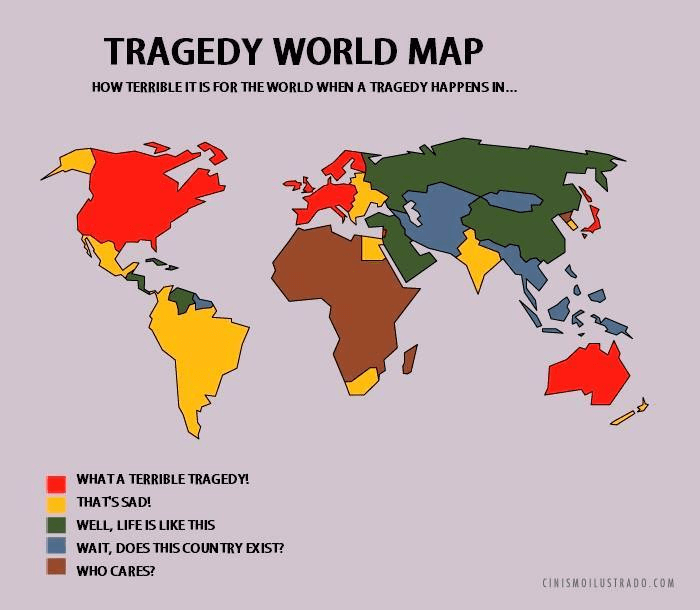
Ethnocentrism and the Tragedy World Map

"Cultural proximity, or how relatable an event is due to audience’s identifying with the protagonists, has been noted in influencing viewer preferences (Straubhaar, 1991) and has been shown to be an important variable in how the media select and frame stories (Galtung & Ruge, 1965; Moeller, 2006; Cottle, 2013). Summed rather crudely by a Sky US correspondent, cultural proximity means that, in terms of media value, “one British person equals however many Bangladeshi etcetera” (in Cottle, 2013: 235). The 2004 East Asia tsunami provides the exemplary instance of this in action, with the CARMA report finding 40 percent of all the media’s coverage focused on westerners affected by the disaster, who made up less than one percent of the victims (Franks, 2006)."
Callum Martin, 2015


"The international news calculus is always the same. First, is there a local person in the disaster or on board a plane that has crashed? If so, the local victims get intense focus that simplifies [the] international crisis or conflict for readers. … Overall, there is this concept of ‘worthy’ and ‘unworthy’ victims in the media."
Jack Lule, Lehigh University


- Flooding in 2017, some headlines and excerpts:

"As Storm Harvey threatens Louisiana and leaves heavy floods across parts of Texas, thousands of people affected by disasters in Asia and Africa have also been tweeting and sharing pictures of their experiences.
But news outlets have focussed headlines and bulletins largely on the disaster in the US, prompting accusations from social media users of giving disproportionate attention to stories about wealthier countries."
BBC, August 2017

"Harvey has gathered headlines as the most powerful storm to hit Texas in half a century, but floods have killed many more people in Africa and Asia this year amid extreme weather worldwide."
VOA News, August 2017

"More than 1,200 people have died across India, Bangladesh and Nepal as a result of flooding, with 40 million affected by the devastation."
The Guardian, August 2017

"Houston animals are lost, cold and suffering too"
Newsweek, August 2017

"27 cats, 8 dogs rescued from Houston flooding arrive at MaxFund Denver"
The Denver Post, September 2017


- Ebola

"How the world ignored Africa’s Ebola tragedy
Had the deadly virus started in the West, the response would have been vastly different"
The Daily Telegraph, October 2014

"(...) despite taking thousands of lives in Africa, Ebola did not capture the global spotlight until the first Americans became infected and arrived back in the United States for treatment."
Forbes, February 2016

- Some more examples

"When Nepal was struck with an earthquake, nearly a quarter of all global coverage in the first 24 hours was about the foreign tourists trapped on Mount Everest."
Forbes, February 2016

"(...) the November 2015 Paris attacks garnered more than nine times the global media attention as the April 2015 Kenyan attack, despite the Garissa attack involving the targeted killing of children at school."
Forbes, February 2016

"In the case of Zika, Google Trends shows that interest in the virus did not really begin until this past December and accelerated in January as the first American infection was confirmed and concerns rose over the potential of the Summer Olympics to create a global epidemic."
Forbes, February 2016

"Guatemala experienced one of the worst earthquakes in this century in the Western hemisphere,” with the official death toll later put at 4,000. “Yet, proportionate to the number of victims, it received one-third of the coverage given the Italian earthquake” that killed nearly 1,000 people that year."
William C. Adams, George Washington University

"As media coverage focused on the Paris terror attacks last week [leaving 17 dead], more than 2000 Nigerians were reported to have been killed by Islamist militants. What makes one massacre more newsworthy than another?"
The Guardian, January 2015

- Finally:

"The majority of what we know about the latest on the Syrian civil war, or reconstruction in Haiti or the spread of the Zika virus is determined by editorial decisions of what is “important” or “relevant” for us to know. As computer algorithms begin to play an ever-growing role in making these decisions for us, we are fast reaching a world where “likes” will become the new arbitrator of what is important in the world and where, in spite of more and more information, we will know less and less."
Forbes, February 2016

- - - - - - - - - -
images via and via and via

Friday, 2 May 2014

The -ism Series (12): Ethnocentrism

In 1906, Sumner coined the term "ethnocentrism" describing cultural narrowness, rigidness and provincialism leading individuals to accept only those that are culturally alike (Ögretir & Özcelik, n.d.). Ethnocentrism, "a nearly universal syndrome of discriminatory attitudes and behaviors" means seeing one’s own group as superior, one’s own values as universal. Ethnocentrism is also defined as in-group favouritism while xenophobia refers to out-group hostility (Hammon & Axelrod, 2006). Patriotism is another construct related to it (Chen, 2010).


Freud's focus is slightly different. According to him, ethnocentrism is "the narcissism of minor differences" that facilitates the displacement of aggression from in-group to out-group. Quoting Freud (from Ögretir & Özcelik, n.d.):
"Every time two families become connected by a marriage, each of them thinks itself superior to or of better birth than the other. Of two neighboring towns each is the other’s most jealous rival; every little canton looks down upon the others with contempt. Closely related races keep one another at arm’s length: the South German cannot endure the North German, the Englishman casts every kind of aspersion upon the Scot, the Spaniard despises the Portuguese."


At its core, ethnocentrism means using one’s own group as the centre of viewing things (Chen, 2010), scaling and rating others with reference to one‘ s own group (Ögretir & Özcelik, n.d.). It is the perspective one takes. In other words, one’s own culture is the standard, "the rest" is "the deviating other". And "the other" is rarely judged neutrally.

Link to Neuliep and McCroskey's questionnaire to measure one's tendency to ethnocentrism: click


- Chen, G.-M. (2010) The Impact of Intercultural Sensitivity on Ethnocentrism and Intercultural Communication Apprehension. Intercultural Communication Studies XIX(1), 1-9
- Hammon, R. A. & Axelrod, R. (2006) The Evolution of Ethnocentrism. Journal of Conflict Resolution, 50(6), 926-936
- Ögretir, A. D. & Özcelik, S. (n.y.) The Study of Ethnocentrism, Stereotype and Prejudice: Psycho-Analytical and Psycho-Dynamic Theories. Journal of Qafqaz University, 236-244
- first and last photographs by Aleksandr Malin via and via, Mick Jagger's photograph by Cecil Beaton via

Wednesday, 2 October 2013

Food as a Cultural Marker

Eating is not just a biological practice (Claxton). It is a cultural practice and as such reflects our personal and social identity (Cornejo Happel, 2012). Food plays a central role in the construction of both identities and stereotypes. In fact, stereotypes based on food are effective ways of disparaging others (Leizaola, 2006) as for instance ethnic slurs based on food illustrate: kraut, spaghettis, macaroni eaters, eskimo, frogs, roast-beefs, hamburgers, baguette-heads, the watermelon stereotype...


Positive food stereotypes are sometimes actively reinforced in order to meet e.g. tourists' expectations (Leizaola, 2006). Negative views are often expressed through food taboos: Those who respect the taboos are better than the others - better than the "Barbarians".
In other words, food demonstrates ethnicity and ethnocentrism through emotions ranging from contempt to disgust (De Garine, 2001). Food can be a highly emotive issue, indeed. Dog eating, for instance, is mainly criticised by Western societies, some calling for a total ban. This criticism provokes reactions as food is seen as part of culture and the criticism is regarded as one referring to a cultural practice. In South Korea, one of the few countries where dog eating is practiced, many people seem to be against banning dog meat (the study/survey referred to the dog species that was bred for this purpose only and not to any other practices). At the same time, many South Koreans do not seem to approve dog eating either and only eat dog meat twice or three times a year. Defending food seems to be defending identity (Podberscek, 2009).

- - - - - - - - -
- Claxton, M. (n.y.) Culture, Food, and Identity.via
- Cornejo Happel, C. A. (2012) You are what you eat: Food as expression of social identity and intergroup relations in the colonial Andes, Cincinnati Romance Review, 33, 175-193
- De Graine, I. (2001) Views about food prejudice and stereotypes. Anthropology of food. Social Science Information, 40(3), 487-507
- Leizaola, A. (2006) Matching national stereotypes? Eating and drinking in the Basque borderland. Anthropological Notebooks 12(1), 79-94
- Podbersczek, A. L. (2009) Good to Pet and Eat: The Keeping and Consuming of Dogs and Cats in South Korea. Journal of Social Issues, 65(3), 615-632
- photograp by Elliott Erwitt via 

Wednesday, 31 July 2013

Barbie & Ethnic Marketing

Toys as a form of material culture are regarded as one source of cultural data. They are said to encode the cultural values of their creators. In the case of Barbie, there is the reproach that ethnicity is defined by other than white, that blonde Barbie sets the standard from which "the other" comes. While "ethnic Barbies" are qualified by their language, foods, native clothes etc.,"Standard Barbie" can do without these ethnic symbols (Schwarz, 2005). Mexico Barbie, for instance, wears traditional clothes, carries a Chihuahua and a passport; her creation caused some controversy.


By developing dolls that allowed identification by "ethnic others", Mattel intended to capture the growing ethnic markets (Goldman, 2011). However, there is more to it than just increasing sales. Dolls invite children to imagine themselves in the doll's image (Schwarz, 2005) ... and one "standard image" is simply not enough.


For more subversive photographs of Barbie see Mariel Clayton


Goldman, K. (2011) La Princesa Plastica. Hegemonic and Oppositional Representations of Latinidad in Hispanic Barbie. In Dines, G. & Humez, J. M. (eds.) Gender, Race and Class in Media. A Critical Reader. Thousand Oaks: Sage, 375-382
Schwarz, M. T. (2005) Native American Barbie: The Marketing of Euro-American Desires. American Studies, 46(3/4), 295-326;  photos via and via

Friday, 19 July 2013

The Centre of the World

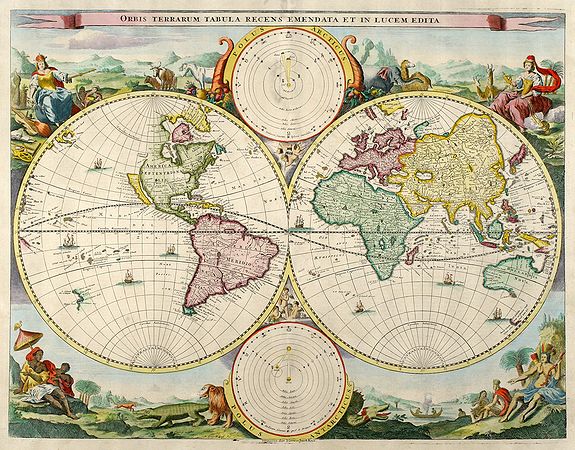
World maps do have a long and controversial history as they depict political and socio-economic interests. The size of different countries did not only depend on geographic data but also on aspirations to present one's own nation as larger, as superior. An often cited example is the Mercator projection that distorts size making the Northern Hemisphere appear much larger than it actually is. The "Greenland Problem" refers to the fact that Greenland seems to be the same size as Africa although Africa is fourteen times larger. (image via)


Being European, I grew up with a Eurocentric map, with Europe in the middle. And being centred in the middle, I clearly knew what was East and West. Or thought so. When I used to study Japanese my professor once told us that when she moved to Austria it took her a while to understand what we meant when we spoke of Japan as a country in "the Far East". Japan was not in the East, it was in the centre. She had grown up with a world map showing Asia in the middle. Isn't it fascinating how relative things are?... (images via)

Eurocentric view:


Asiacentric view:


Americacentric view: