Showing posts with label marathon. Show all posts

Monday, 1 February 2016

Adidas: Designed just for Women

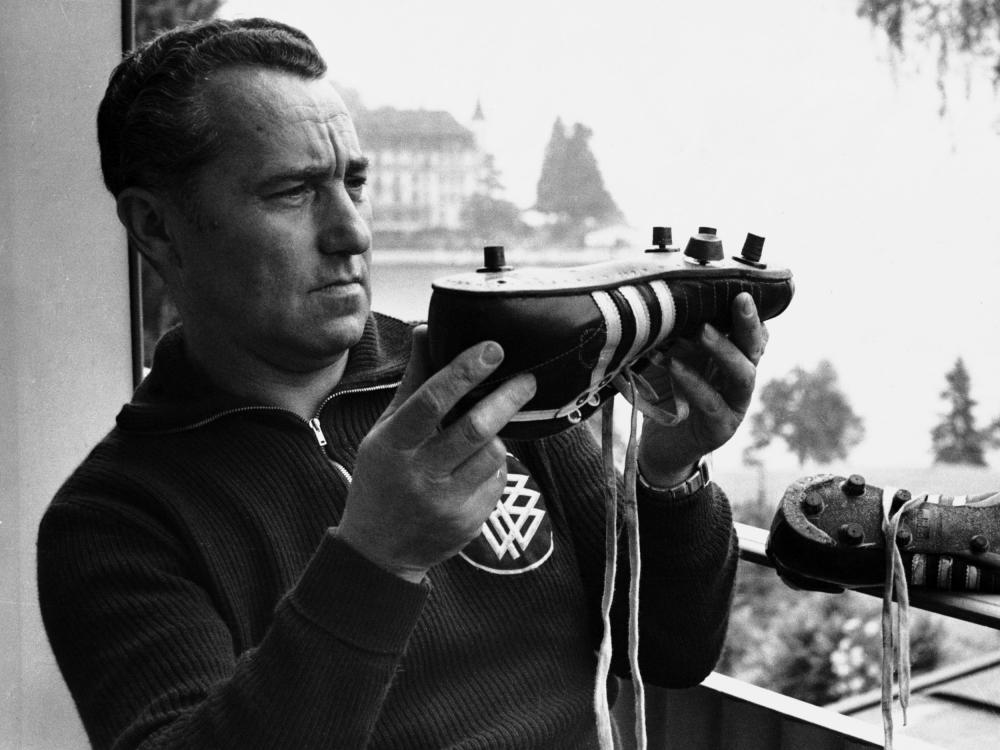
"Most athletic footwear designed for women is adapted from athletic footwear designed for men" ... although the anatomy of women's feet differs from that of men's feet. Anatomy and the fact that more and more women are running marathons and hence are "attractive customers" (in the U.K., for instance, women's participation in marathon races increased by 12% while men's participation decreased by 13%) are the reasons why - after three years of development and 100 prototypes - Adidas has now introduced the "PureBoost X", a running shoe designed and developed for women.


Research on differences between men's and women's feet started about twenty years ago. Improving women's athletic gears, however, is still a research field that is neglected - particularly in comparison to research on men's equipment.
"It’s only lately [in sportswear development] that if you have 200 subjects, that you have 100 female and 100 male. Typically you have 200 males." Benno Nigg, professor emeritus of kinesiology
Women's feet tend to have narrower heels and higher arches than men's feet. According to motion-capture research carried out by Adidas, they also experience more expansion in the forefoot and midfoot as there is more movement in the Achilles area around the heel. The running shoe developed with women in mind has a sock-like mesh upper that is not entirely attached to the sole to make sure there is more open space around the woman's arch (via, viavia).


photographs via and via

Friday, 22 August 2014

Marathon Woman

"The reason there are no intercollegiate sports for women at big universities, no scholarships, prize money, or any races longer than 800 meters is because women don’t have the opportunities to prove they want those things. If they could just take part, they’d feel the power and accomplishment and the situation would change. After what happened today, I felt responsible to create those opportunities. I felt elated, like I’d made a great discovery. In fact, I had." 
Kathrine Switzer


At university, Kathrine Switzer unofficially trained with the men's cross-country team as there was no women's running team. One night in 1966, she had an argument with her coach Arnie Briggs. Switzer: "Oh, let's quit talking about the Boston Marathon and run the damn thing." Briggs: "No woman can run the Boston Marathon."


"If any woman could do it, you could, but you would have to prove it to me. If you ran the distance in practice, I'd be the first to take you to Boston." Briggs and Switzer ran a 31-mile trial, checked the rule book and entry form, did not find anything about gender and Switzer registered as "K.V. Switzer". Her boyfriend, Big Tom Miller, decided to run the marathon too because: "If a girl can run the marathon, I can run a marathon."


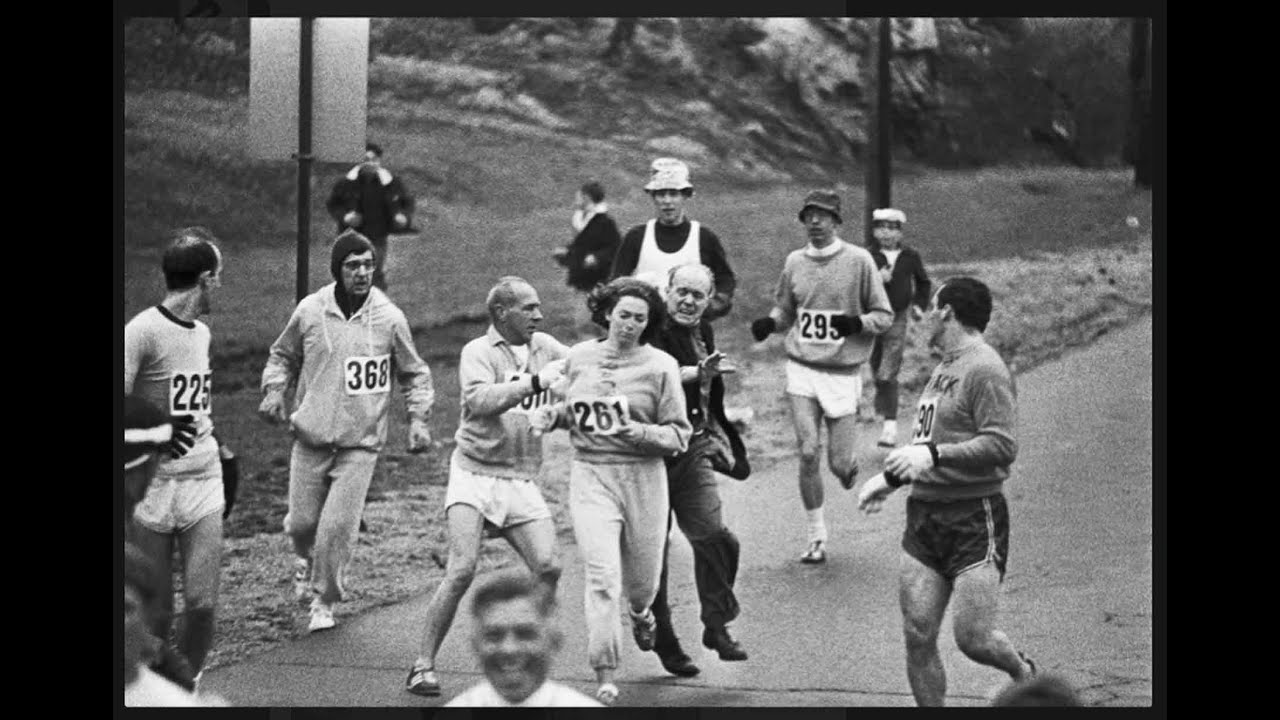
In Boston, Switzer felt welcome, other runners were pleased to have a woman in their presence: "Gosh, it's great to see a girl here!" As she was running, she saw a man from the Boston Athletic Association in the middle of the road shaking his finger at her and saying something. Shortly later, race manager Jock Semple grabbed her shoulder and screamed: "Get the hell out of my race and give me those numbers!" He tried to rip off her bib number, her coach tried to push him away, Kathrine Switzer tried to run (away) and her boyfriend finally hit him. Nevertheless, they continued running - feeling confused, helpless, terrified. Journalists changed the tone of their questions: "What are you trying to prove?"


 "(...) I wondered if I should step off the course. I did not want to mess up this prestigious race. But the thought was only a flicker. I knew if I quit, nobody would ever believe that women had the capability to run 26-plus miles. If I quit, everybody would say it was a publicity stunt. If I quit, it would set women’s sports back, way back, instead of forward. If I quit, I’d never run Boston. If I quit, Jock Semple and all those like him would win. My fear and humiliation turned to anger." (via)


Women were not unwelcome in the 1960s if they only ran alongside the competitors for a while taking the role of enthusiastic spectators. As long as they were not official entrants and the "finishing line was not recorded, the woman runner posed not threat and encountered few problems." (Cooper, 1999). In 1966, Roberta Louise Gibb became the first woman to run the entire Boston Marathon - without a number and without an official time. In 1967, Kathrine Switzer ran with a number and finished the marathon despite the incidents. The Boston Marathon was established in 1897. Officially, women were not allowed to enter the Boston Marathon until 1972. In 1996, all unoffical women's leaders from 1966 to 1971 (when women were still believed to be physiologically unable to run marathon distances) were retroactively recognised. In 2011, 43% of the entrants were female and offical participants (via).


"I think it's time to change the rules. They are archaic. Women can run, and they can still be women and look like women. I think the AAU will begin to realize this and put in longer races for women ... I'm glad I ran - you know, equal rights and all."
Kathrine Switzer, 23 April 1967 (in Cooper, 1999)

- Cooper, P. (1999) The American Marathon. Syracuse University Press
- Interview with Kathrine Switzer: watch
- photos via and via and via and via and via and via
related postings: Merry Lepper & Bobbi Gibb

Wednesday, 20 August 2014

"Hub Bride First Gal to Run Marathon"

“If I can show that a woman can run 26 miles, and run it well -- stride for stride with the men -- that is going to throw all the rest of the prejudices and all the misconceptions and all of the so-called reasons for keeping women down that have existed for the past how many centuries? Centuries of this stuff! And so I sort of chuckled to myself and thought, ‘Oh, this is going to be fun! I'm going to turn the whole thing on its head.’ ” 
Bobbi Gibb


Roberta Louise "Bobbi" Gibb applied for the Boston Marathon in February 1966. She received a reply from the race director Will Cloney who informed her about the "fact" that women were not physiologically capable of running twenty-six miles and apart from that were not allowed to (Heminsley, 2013). “And that's what everyone thought. I mean, this was a universal truth. Women can't be doctors, it's too much stress. Women can't be lawyers, it's too much stress. Women can't be in the government.... women can't run long distance. Women can't do anything except stay home and clean the house. It was like being in a cage. It was horrible.... It was just everywhere. It was ubiquitous.” During her training she waited to see what would happen to her physically as the "conventional wisdom" was that running more than a mile could be deadly to women (via).


Her running turned from a personal challenge into a question of principle. "I was running to change the way people think ... If women could do this that was thought impossible, what else could women do? What else can people do that is thought impossible?" The only problem was that Gibb was not allowed to participate and hence could not show what was possible (Heminsley, 2013). She borrowed old shorts from her brother, put on a swimsuit and a blue hooded sweater and hid in the bushes. When the gun went off she jumped into the crowd of runners. After a while, the men who were running behind her realised that she was a woman and reacted positively. Despite the temperatures she was afraid of removing her hoody, of revealing that she was a woman and being thrown out. "We won't let them throw you out. It's a free road.", the men behind her said.
"That was another item on my agenda, to end this stupid war of the sexes. Why do we have to be fighting a war of the sexes? We're on the same side in this! Men can have feelings. Women can have physical bodies that are strong.... you can be who you are.” 
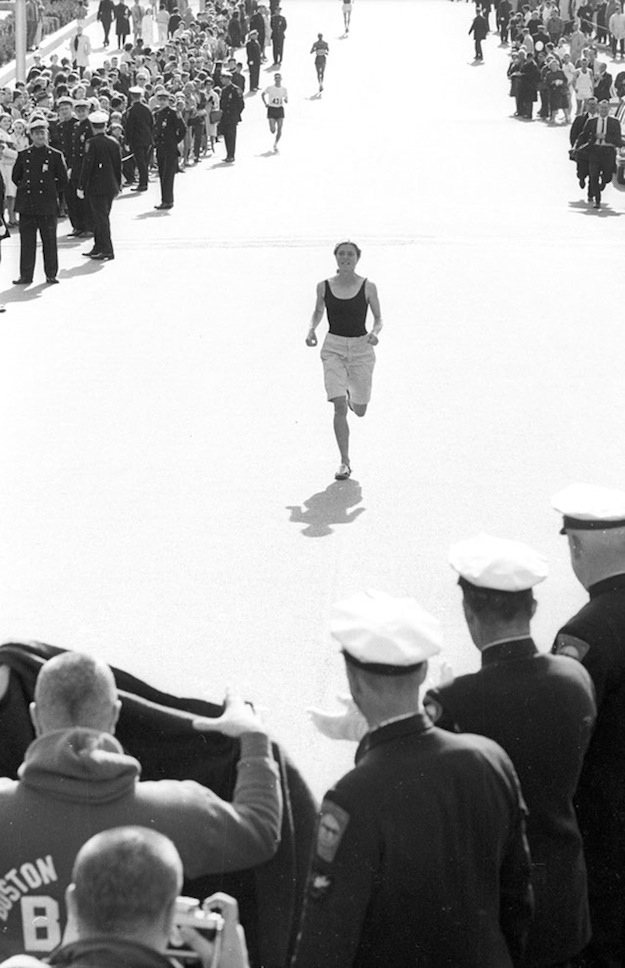
She took the hoody off, the crowd went wild (via) and cheered. "One woman standing near, with several children, yelled 'Ave Maria'. She was crying. I felt as though I was setting them free. Tears pressed behind my own eyes." (Hemnisley, 2013)


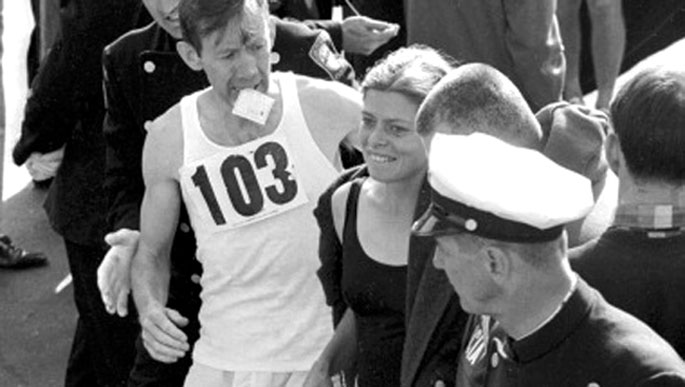
Bobbi Gibb made headlines ("Hub Bride First Gal to Run Marathon") and contributed to changing the way people think about men and women. Her time (3 hours, 21 minutes), however, was not officially recorded; "the record books did not take note of her achievement, no matter how many newspapers did." (Heminsley, 2013).


- Heminsley, A. (2013). Running like a girl. London: Hutchinson
- photos via and via and via and via
related postings: Merry LepperKathrine Switzer

Monday, 18 August 2014

3:37:07

“Now therefore, the City Council of the City of Culver City, Calif. hereby congratulates and commends Merry Lepper, a shining example of how one person can overcome tremendous hurdles to fulfill a dream and, in the process, pave the way for generations to come.” 
Jeffrey Cooper, Mayor of Culver City (via)

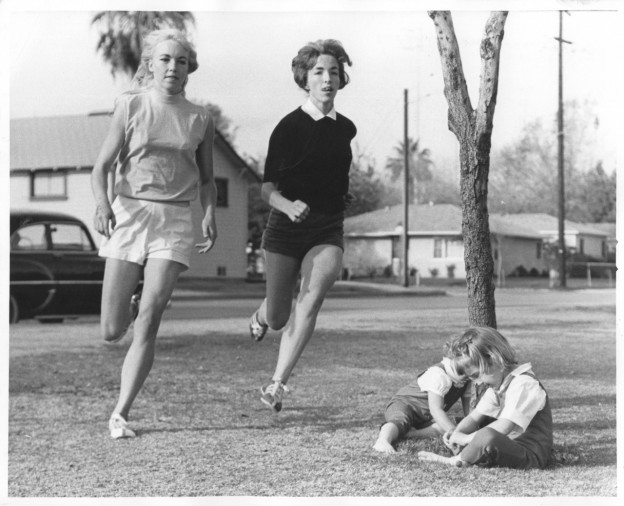
Merry Lepper, in 1963 a student at San Bernardino Valley College (via), is often referred to as the first woman who completed a marathon race (Culver City Marathon in December 1963 finished in 3:37:07). At that time, women were not allowed to run more than 880 meters, for their own good, since running longer distances "would hurt their ovaries". Her training partner Lyn Carman was warned that she would never have babies again. Lepper comments: "I really had to laugh about that because I was hearing the reason that men gave that women couldn't drive automobiles in Saudi Arabia was that it would hurt their ovaries. Whose ovaries are these?" (via)


20-year old Merry jogging accompanied bei training partner Lyn Carman, watched by two of Lyn's children.

Merry Lepper ran the marathon to show the world that "women can do this without dying or fainting or something." But the world did not pay much attention to her achievement (via). There were no retrospective stories, no tributes (via). Some sarcastically assume the world was still too focused on her ovaries (via). Her achievement, however, was an important one considering the fact that women "could legally vote in presidential elections long before they could officially enter a marathon." (via)

In March 1896, during the Summer Olympics, Stamata Revithi ran from Marathon to Athens, unofficially, since officially she was not allowed to compete (via). According to Baron Pierre de Coubertin, the visionary of the modern Olympic Games, contact with women's athletics was bad for male athletes and a woman's greatest achievement would be "to encourage her sons to be distinguished in sports and to applaud a man's effort." (via). In September 1918, Marie-Louise Ledru completed the Tour de Paris Marathon (via). In October 1926, Violet Stewart Louisa Piercy became the first woman to be officially timed in a marathon. 37 years later Merry Lepper followed into these pioneers' footsteps (via). No matter who gets the credit for being the first woman, each made a great contribution.

- - - - - - - - - - - - -
photo via 
follow up posting: Bobbi Gibb