Nina Simone (1933-2003), one time Grammy Hall of Fame Award winner and fifteen times nominee, became involved in the civil rights movement in the early 1960s. Civil rights messages became an integral part of her songs - the first time with "Mississippi Goddam", a song that was boycotted in some southern states, (via) a song she had written in response to the assassination of the civil rights activist Medgar Evers (1925-1963) and the Birmingham church bombing in 1963 (via).
Recently, her biography - or rather the casting decision for the film "Nina" - caused some controversy. The Afro-Latina actress of Dominican and Puerto Rican descent Zoe Saldana was chosen to play Nina Simone. Some criticised the fact that Saldana would barely resemble Simone (via), that Hollywood would "whitewash and lightwash" and choose what media considers blackness to be. An online petition followed to change the cast and replace Saldana (via). The petition was signed by more than 10.000 people (via). When photos of Zoe Saldana were published wearing an afro wig and darker makeup in order to resemble Simone and to be able to play her role, accusations of blackface and parody followed (via).
Nina Simone's daughter: "My mother was raised at a time when she was told her nose was too wide, her skin was too dark. Appearance-wise this is not the best choice." (via)

Selection of categories
 Age |
 Disability |
 Ethnicity |
 Queer |
 Religion |
 Gender |
 Stereotypes |
 -isms |
 Quotes |
 World days |
 Music |
 Space |
 Sports |
 Health |
 Marketing |
 Urban planning |
 Narrative images |
 Birthday |
 Language |
 Segregation |
 School |
Monday, 20 January 2014

Sunday, 19 January 2014
World Religion Day
Established by the Bahá'i communities in 1950, World Religion Day is to encourage people to talk to and listen to people from different faiths, i.e., different from their own one (via) and at the same time celebrate similarities. It aims to foster interfaith understanding and harmony (via) and is observed with conferences and interfaith activities (via).

Photo of Sophia Loren by Tazio Secchiaroli (1925-1998) via

Photo of Sophia Loren by Tazio Secchiaroli (1925-1998) via

Thursday, 16 January 2014
The -ism Series (5): Classism
"I'm every bourgeois nightmare - a Cockney with intelligence and a million dollars."
Michael Caine

Class is a rather vague term. So are class distinctions in many countries. In some, there is the prevailing myth of a classless society adding to its elusive nature. Although it is called a myth, the construct of class is said to influence virtually everybody. Money is a crucial aspect of class but it is also about power, prestige (Russell, 1996) and access to resources. The concept of power is strongly linked to class since it can predict to what extent one can benefit from a society's resources. It correlates with life experiences and has an impact on what an individual is likely to learn, believe, achieve (Lott, 2012) and think about himself or herself. The experience that one belongs to a disapprobated group can affect self-concept and self-esteem and may lead to an internalisation of classism (Russell, 1996).
Cockney is both a regional dialect and a class dialect. It is connected with London's working class and used to be considered as the most despised non-standard form of English probably because Cockneys lived near London's high society which made the difference to standard English more noticeable. Today, people seem to be comparably more tolerable to Cockney (Koudelkova, 2012). No longer "every bourgeouis nightmare"...
- - - - - - - - - - - - - - -
- Lott, B. (2012) The Social Psychology of Class and Classism, American Psychologist, 650-658
- Koudelkova, L. (2012) Cockney and Estuary English. Diploma Thesis via
- Richardson, L. (2005) Sticks and Stones: An Exploration of the Embodiment of Social Classism. Qualitative Inquiry, 11(4), 485-491
- Russell, G. M. (1996) Internalized Classism: The Role of Class in the Development of Self. 59-71
- Photograph of Michael Caine (by Brian Duffy) via
Michael Caine

Class is a rather vague term. So are class distinctions in many countries. In some, there is the prevailing myth of a classless society adding to its elusive nature. Although it is called a myth, the construct of class is said to influence virtually everybody. Money is a crucial aspect of class but it is also about power, prestige (Russell, 1996) and access to resources. The concept of power is strongly linked to class since it can predict to what extent one can benefit from a society's resources. It correlates with life experiences and has an impact on what an individual is likely to learn, believe, achieve (Lott, 2012) and think about himself or herself. The experience that one belongs to a disapprobated group can affect self-concept and self-esteem and may lead to an internalisation of classism (Russell, 1996).
Cockney is both a regional dialect and a class dialect. It is connected with London's working class and used to be considered as the most despised non-standard form of English probably because Cockneys lived near London's high society which made the difference to standard English more noticeable. Today, people seem to be comparably more tolerable to Cockney (Koudelkova, 2012). No longer "every bourgeouis nightmare"...
- - - - - - - - - - - - - - -
- Lott, B. (2012) The Social Psychology of Class and Classism, American Psychologist, 650-658
- Koudelkova, L. (2012) Cockney and Estuary English. Diploma Thesis via
- Richardson, L. (2005) Sticks and Stones: An Exploration of the Embodiment of Social Classism. Qualitative Inquiry, 11(4), 485-491
- Russell, G. M. (1996) Internalized Classism: The Role of Class in the Development of Self. 59-71
- Photograph of Michael Caine (by Brian Duffy) via
Monday, 13 January 2014
Blue or Green? Culture, Language and Colours
According to the linguistic relativity hypothesis, culturally shared language experiences lead to shared ways of thinking. In other words, the individual's organisation of language is influenced by the way culture organises language. Much empirical attention has been paid to the question whether language influences encoding and categorisation of experiences such as colour perception (Chiu, 2011).

Languages structure and categorise colours differently which again can affect an individual's perception of colour. Empirically, not all the studies conducted so far support the linguistic relativity hypothesis. The more recent studies, in particular, are in favour of this hypothesis and show that when an individual uses the colour terms in a certain language to describe the colours, his or her memory of the colours may be influenced by the colour terms used in the very description (Chiu, 2011).

In their cross-cultural study, Kay and Kempton asked native speakers of English and speakers of Tarahumara (spoken in northern Mexico) to judge the perceptual distance among eight colour chips of varying shades of greenish blue and blueish green. As the categories "green" and "blue" are not distinguished in the Tarahumaran language - wheras they are in English - the results showed culture-bound differences in the perceived distances between colours: English-speaking participants systematically overestimated the distances between blue and green while the Tarahumara did not. In a second study, Kay and Kempton showed that the distances reported by the English-speaking participants agreed with the Tarahumara-speaking participants once the effects of linguistic encoding had vanished by encoding each colour as "the bluer" and "the greener" one (Chiu, 2011, Kay & Kempton, 1984).

As predicted by the linguistic relativity hypthesis, the linguistic difference between green/blue and siyóname produced a difference in the perceived distance between colours. Colours near the green/blue-boundary were pushed apart by English speakers because of their concept of green and blue (Kay & Kempton, 1984).
For a discussion of the link between language, colour perception and right vs. left hemisphere see e.g. Gilbert et al. or Regier & Kay.

Chiu, C. (2011). Language and Culture. Online Readings in Psychology and Culture, 4(2) via
Kay, P. & Kempton, W. (1984) What Is the Sapir-Whorf Hypothesis? American Anthropologist, New Series, 86(1), 65-79
Regier, T. & Kay, P. (2009) Language, thought, and color: Whorf was half right. Trends in Cognitive Science, 13(19), 439-446
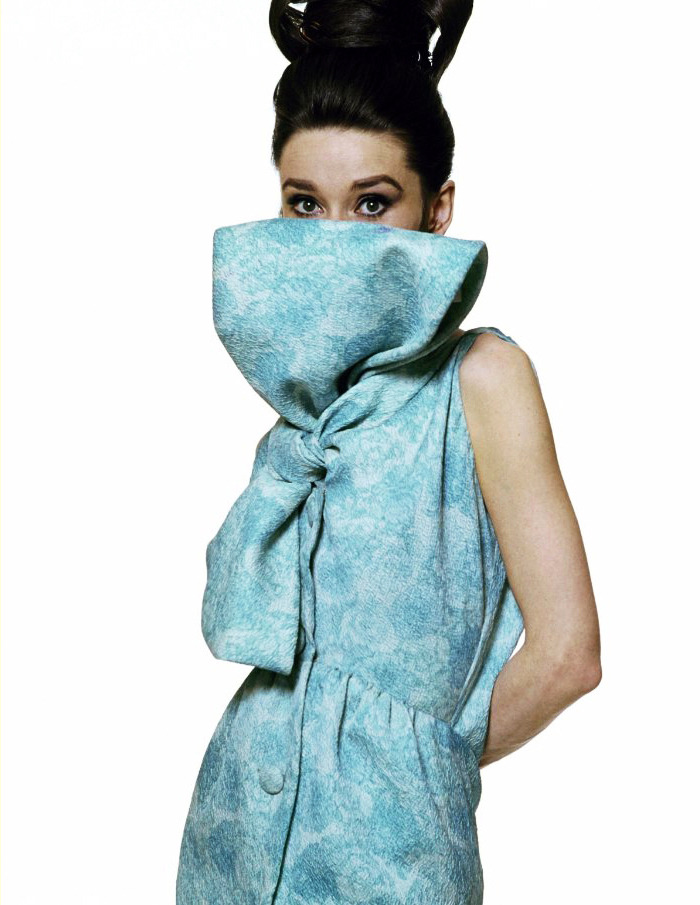
Photo from Clairol ad (around 1966) via, photo of Audrey Hepburn via, photo of mousing fox by Richard Peters (Veolia Environment Wildlife Photographer of the Year 2012) via, photo of Audrey wearing "China blue" dress by Givenchy taken by Bert Stern (1963) via

Languages structure and categorise colours differently which again can affect an individual's perception of colour. Empirically, not all the studies conducted so far support the linguistic relativity hypothesis. The more recent studies, in particular, are in favour of this hypothesis and show that when an individual uses the colour terms in a certain language to describe the colours, his or her memory of the colours may be influenced by the colour terms used in the very description (Chiu, 2011).

In their cross-cultural study, Kay and Kempton asked native speakers of English and speakers of Tarahumara (spoken in northern Mexico) to judge the perceptual distance among eight colour chips of varying shades of greenish blue and blueish green. As the categories "green" and "blue" are not distinguished in the Tarahumaran language - wheras they are in English - the results showed culture-bound differences in the perceived distances between colours: English-speaking participants systematically overestimated the distances between blue and green while the Tarahumara did not. In a second study, Kay and Kempton showed that the distances reported by the English-speaking participants agreed with the Tarahumara-speaking participants once the effects of linguistic encoding had vanished by encoding each colour as "the bluer" and "the greener" one (Chiu, 2011, Kay & Kempton, 1984).

As predicted by the linguistic relativity hypthesis, the linguistic difference between green/blue and siyóname produced a difference in the perceived distance between colours. Colours near the green/blue-boundary were pushed apart by English speakers because of their concept of green and blue (Kay & Kempton, 1984).
For a discussion of the link between language, colour perception and right vs. left hemisphere see e.g. Gilbert et al. or Regier & Kay.

Chiu, C. (2011). Language and Culture. Online Readings in Psychology and Culture, 4(2) via
Kay, P. & Kempton, W. (1984) What Is the Sapir-Whorf Hypothesis? American Anthropologist, New Series, 86(1), 65-79
Regier, T. & Kay, P. (2009) Language, thought, and color: Whorf was half right. Trends in Cognitive Science, 13(19), 439-446
Photo from Clairol ad (around 1966) via, photo of Audrey Hepburn via, photo of mousing fox by Richard Peters (Veolia Environment Wildlife Photographer of the Year 2012) via, photo of Audrey wearing "China blue" dress by Givenchy taken by Bert Stern (1963) via



Thursday, 9 January 2014
Urban Planning and Active Ageing
Statistics showing the two trends that in general a) society is getting older and b) the number of older people is increasing are not new and more or less well known. The need to adapt is a notion that seems to be comparatively less widely spread. In the field of urban planning that means that older people need to be involved as they often feel a stronger sense of isolation in cities than other age groups. One possible explanation is that older people are among the last to be included when it comes to decisions concerning urban development (via).
Philip Johnson wearing a model of his 1984 Pittsburgh landmark via

In 2011, the Dublin Declaration on Age-Friendly Cities and Communities was signed by more than forty cities, inspired by the World Health Organization's definition of active ageing as "the process of optimising opportunities for health, participation and security in order to enhance quality of life as people age, allowing people to realise their potential for physical, social and mental well-being throughout their lives and to participate in society according to their needs, desires and capabilities, while providing them with adequate protection, security and care when they require assistance" (via).

In the UK, Manchester is the first Age Friendly City. The projects comprise e.g. housing support, neighbourhood regeneration, cultural programmes, road safety, public health (e.g. free swimming and physical activity), local work, age-friendly design, and civic representation (via).

Beth Johnson Foundation & Manchester City Council Creating (2011) Age-friendly Places. A guide for cities, boroughs, towns or counties, councils, partners and communities (via)
Photos of Philip Johnson (1906-2005) via and via
Philip Johnson wearing a model of his 1984 Pittsburgh landmark via

In 2011, the Dublin Declaration on Age-Friendly Cities and Communities was signed by more than forty cities, inspired by the World Health Organization's definition of active ageing as "the process of optimising opportunities for health, participation and security in order to enhance quality of life as people age, allowing people to realise their potential for physical, social and mental well-being throughout their lives and to participate in society according to their needs, desires and capabilities, while providing them with adequate protection, security and care when they require assistance" (via).

In the UK, Manchester is the first Age Friendly City. The projects comprise e.g. housing support, neighbourhood regeneration, cultural programmes, road safety, public health (e.g. free swimming and physical activity), local work, age-friendly design, and civic representation (via).

Beth Johnson Foundation & Manchester City Council Creating (2011) Age-friendly Places. A guide for cities, boroughs, towns or counties, councils, partners and communities (via)
Photos of Philip Johnson (1906-2005) via and via


Tuesday, 7 January 2014
The -ism Series (4): Racism
According to the social constructionist view, the concept of race is a "pseudo-biological concept that has been used to justify and rationalize the unequal treatment of groups of people by others". Its classification is based on skin colour, hair style and other characteristics that are (mis)used as biological markers which are to identify "biological groups". As there is more genetic variability within "racial" groups than between them, social constructivists see race as nonexistent, as instable, as something that is constantly transformed by political struggle (Machery & Faucher, 2005).

The absurdity of the alleged biologically determined inferiority of certain "racial" groups and superiority of others is best expressed by the interdisciplinary consensus among scientists that there is no discrete, measururable and scientifically meaningful definition of "racial groups". Race as biology is fiction. Racism is real (Smedley & Smedley, 2005).

Gordon Roger Alexander Buchanan Parks (1912-2006) was a photographer, musician, writer, film director ("Shaft") and civil rights activist. His photograph "American Gothic, Washington D.C.", a photo of a black woman standing in front of the American flag with a broom in one hand became one of his best-known ones. Parks was the first African American who worked at Life magazine and the first who wrote, directed, and scored a Hollywood film (via).

"A radically prosaic approach to civil rights images": Parks' segregation photographs focus on everyday activities, on "normal" life in an environment of restriction and intimidation (via).

Below: Untitled, Shady Grove, Alabama, 1956, (c) The Gordon Parks Foundation, courtesy of Jenkins Johnson Gallery via

Machery, E. & Faucher, L. (2005) Social Construction and the Concept of Race. Philosophy of Science, 72, 1208-1219.
Smedley, A. & Smedley, B. D. (2005) Race as Biology is Fiction, Racism as a Social Problem is Real. Anthropological and Historical Perspectives on the Social Construction of Race. American Psychologist, 60(1), 16-26; photos by Gordon Parks via and via and via

The absurdity of the alleged biologically determined inferiority of certain "racial" groups and superiority of others is best expressed by the interdisciplinary consensus among scientists that there is no discrete, measururable and scientifically meaningful definition of "racial groups". Race as biology is fiction. Racism is real (Smedley & Smedley, 2005).

Gordon Roger Alexander Buchanan Parks (1912-2006) was a photographer, musician, writer, film director ("Shaft") and civil rights activist. His photograph "American Gothic, Washington D.C.", a photo of a black woman standing in front of the American flag with a broom in one hand became one of his best-known ones. Parks was the first African American who worked at Life magazine and the first who wrote, directed, and scored a Hollywood film (via).

"A radically prosaic approach to civil rights images": Parks' segregation photographs focus on everyday activities, on "normal" life in an environment of restriction and intimidation (via).

Below: Untitled, Shady Grove, Alabama, 1956, (c) The Gordon Parks Foundation, courtesy of Jenkins Johnson Gallery via

Machery, E. & Faucher, L. (2005) Social Construction and the Concept of Race. Philosophy of Science, 72, 1208-1219.
Smedley, A. & Smedley, B. D. (2005) Race as Biology is Fiction, Racism as a Social Problem is Real. Anthropological and Historical Perspectives on the Social Construction of Race. American Psychologist, 60(1), 16-26; photos by Gordon Parks via and via and via

Sunday, 5 January 2014
Quoting Quincy Jones
"The climate in the '50s and '60s for black performers or black people in the entertainment business was atrocious. It was atrocious."
Quincy Jones

The Italian Job (1969) Opening "On Days Like These", music by Quincy Jones
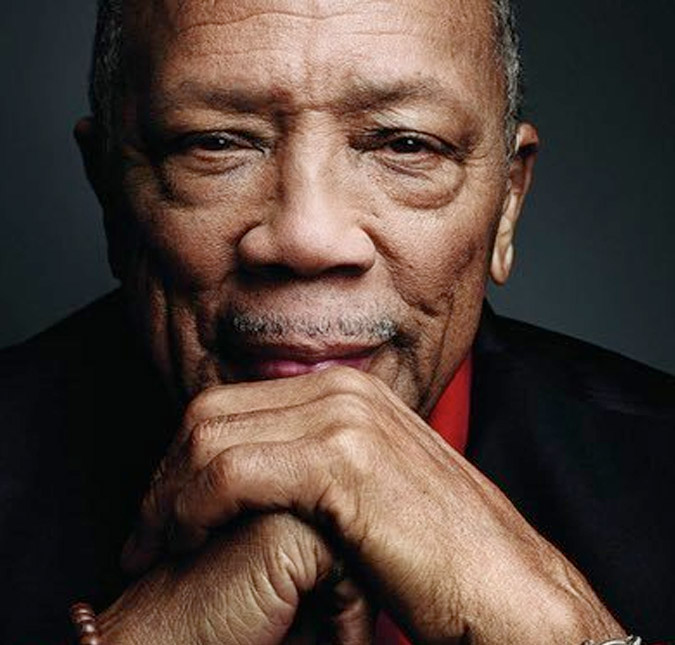
Quincy Delight Jones, Jr. is the first African-American to be nominated twice in one year for an Academy Award for Best Original Score, the first African-American to be named musical director of the Academy Awards ceremony, the first African-American to receive the Academy's Jean Hersholt Humanitarian Award, and one of the first African-Americans to be nominated for an Academy Award for Best Original Song.
Jones started supporting Martin Luther King in the 1960s. He is one of the founders of the Institute of Black American Music and of the Black Arts Festival in Chicago. He formed the Quincy Jones Workshops, founded the Quincy Jones Listen Up Foundation and supports a great many more charities (via).
- - - - - -
This posting was slightly modified in August 2017 (photograph added).
Quincy Jones

The Italian Job (1969) Opening "On Days Like These", music by Quincy Jones
Quincy Delight Jones, Jr. is the first African-American to be nominated twice in one year for an Academy Award for Best Original Score, the first African-American to be named musical director of the Academy Awards ceremony, the first African-American to receive the Academy's Jean Hersholt Humanitarian Award, and one of the first African-Americans to be nominated for an Academy Award for Best Original Song.
Jones started supporting Martin Luther King in the 1960s. He is one of the founders of the Institute of Black American Music and of the Black Arts Festival in Chicago. He formed the Quincy Jones Workshops, founded the Quincy Jones Listen Up Foundation and supports a great many more charities (via).
- - - - - -
This posting was slightly modified in August 2017 (photograph added).
Saturday, 4 January 2014
World Braille Day
The 4th of January commemorates the birthday of Louis Braille (1809-1852) who invented "Braille" in 1821. Braille was blinded in an accident when he was three years old. By the age of fifteen he had developed the Braille system of reading and writing (via). The Braille code is one means to ensure inclusion and equal opportunities for a great many people worldwide (via).
Rubik's Cube Braille Version via

Braille Stamps by Dutch Design Award winner René Put via

Braille Graffiti via

According to the World Health Organization, about 285 million people are visually impaired, 39 million are blind and 246 million people have low vision. 90% of people of the world's visually impaired live in developing countries, 80% of all visual impairment can be avoided or cured (via).
Rubik's Cube Braille Version via


Braille Stamps by Dutch Design Award winner René Put via

Braille Graffiti via

According to the World Health Organization, about 285 million people are visually impaired, 39 million are blind and 246 million people have low vision. 90% of people of the world's visually impaired live in developing countries, 80% of all visual impairment can be avoided or cured (via).
Tuesday, 31 December 2013
Year of the Horse
"This" year, Chinese New Day will arrive on 31 January and the Year of the (Wood) Horse will start. While Chinese New Year falls on different dates in the Gregorian calendar, in the lunisolar Chinese calendar, Chinese New Year usually falls on the second new moon after the winter solstice (via). Calendars differ, the Gregorian 2014, for instance, is the year 2964 in the Berber calendar, 4347 in the Korean calendar, 1376 in the Burmese calendar, 6764 in the Assyrian calendar, and 2558 in the Buddhist calendar (via).
Apart from the horse, 2014 is dedicated to the brain. The European Year of the Brain aims to raise awareness and educate since this most complex structure has a huge impact on both individuals and society (via).

Again, best wishes to all of you - no matter what year you celebrate and when.
- - - - - - - - - - -
Photograph by Norman Parkinson via
Apart from the horse, 2014 is dedicated to the brain. The European Year of the Brain aims to raise awareness and educate since this most complex structure has a huge impact on both individuals and society (via).

Again, best wishes to all of you - no matter what year you celebrate and when.
- - - - - - - - - - -
Photograph by Norman Parkinson via
Friday, 27 December 2013
The -ism Series (3): Sexism
Sexism has different faces. The two most well-known ones are hostile and benevolent sexism - both convey information about the position of men and women in society and the division of their power. Both share assumptions about women's inferiority but differ in some aspects.
Hostile sexism communicates openly an iron hand approach, an "antagonistic attitude to women" and is therefore rather easily identified.
Benevolent sexism, however, is sometimes more difficult to grasp and therefore more difficult to challenge. It refers to a more positive attitude to the fragile woman that needs to be protected and provided by men. As benevolent sexism with its velvet glove approach makes women feel better about their disadvantaged situation it is said to have "a paliative, system-justifying function" (Calegoro & Jost, 2010).

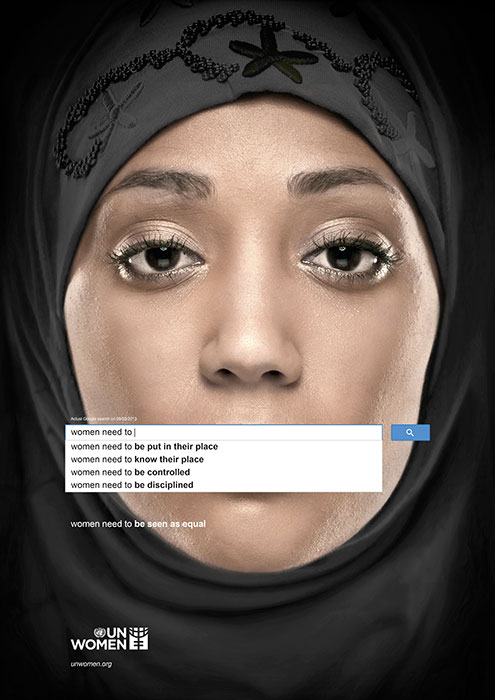
In a campaign created for United Nations Women, Google autocomplete suggestions were used to raise awareness for sexism.The autocomplete feature is based on the search terms other people have used before.
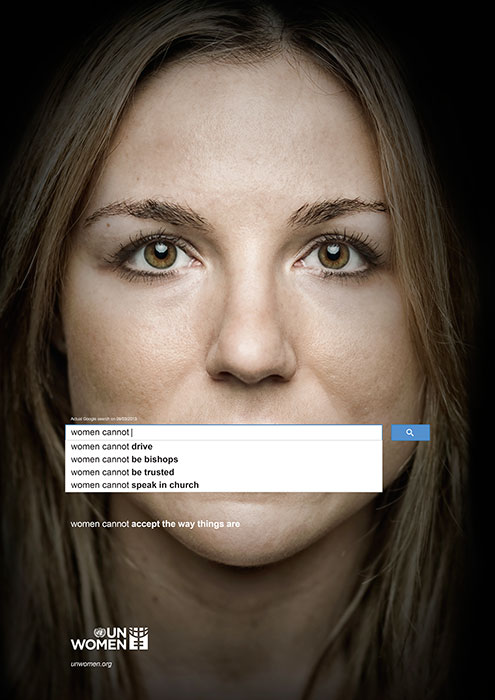
The campaign used autocomplete searches from 9 March 2013. It was launched in October and inspired a series of spin-off advertisements.
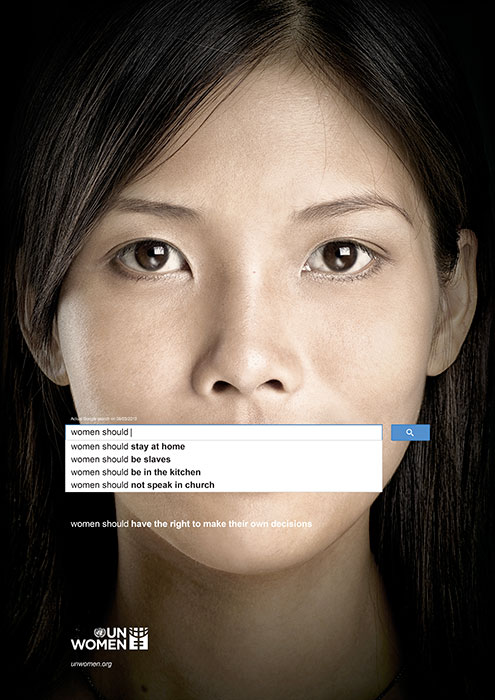
An article in The Guardian says: "Google has become something of a secular equivalent of a confessional box. Within the confines of a search bar you can ask questions or express opinions you would never admit to in public. Our most popular searches are, to some degree, an uncensored chronicle of what, as a society, we're thinking but not necessarily saying. What makes the UN Women campaign so powerful is that it pulls back the curtain of publicly acceptable rhetoric and lays bare just how widespread gender prejudices still are."
The following clip is part of the campaign:
Calegoro, R. M. & Jost, J. T. (2010) Self-Subjugation Among Women: Exposure to Sexist Ideology, Self-Objectification, and the Protective Function of the Need to Avoid Closure. Journal of Personality and Social Psychology, 100(2), 211-228; photos via

In a campaign created for United Nations Women, Google autocomplete suggestions were used to raise awareness for sexism.The autocomplete feature is based on the search terms other people have used before.

The campaign used autocomplete searches from 9 March 2013. It was launched in October and inspired a series of spin-off advertisements.

An article in The Guardian says: "Google has become something of a secular equivalent of a confessional box. Within the confines of a search bar you can ask questions or express opinions you would never admit to in public. Our most popular searches are, to some degree, an uncensored chronicle of what, as a society, we're thinking but not necessarily saying. What makes the UN Women campaign so powerful is that it pulls back the curtain of publicly acceptable rhetoric and lays bare just how widespread gender prejudices still are."

The following clip is part of the campaign:
Calegoro, R. M. & Jost, J. T. (2010) Self-Subjugation Among Women: Exposure to Sexist Ideology, Self-Objectification, and the Protective Function of the Need to Avoid Closure. Journal of Personality and Social Psychology, 100(2), 211-228; photos via
Subscribe to:
Posts (Atom)