Monday, 20 September 2021

Design Justice

Abstract: Design is key to our collective liberation, but most design processes today reproduce inequalities structured by what Black feminist scholars call the matrix of domination. Intersecting inequalities are manifest at all levels of the design process. (...) Design justice is a field of theory and practice that is concerned with how the design of objects and systems influences the distribution of risks, harms, and benefits among various groups of people.


Design justice focuses on the ways that design reproduces, is reproduced by, and/or challenges the matrix of domination (white supremacy, heteropatriarchy, capitalism, and settler colonialism). Design justice is also a growing social movement that aims to ensure a more equitable distribution of design’s benefits and burdens; fair and meaningful participation in design decisions; and recognition of community-based design traditions, knowledge, and practices (Costanza-Chock, 2018).


- Costanza-Chock, S. (2018). Design Justice: Towards an Intersectional Feminist Framework for Design Theory and Practice; link
- photographs (©Haus-Rucker-Co) via and via

Sunday, 19 September 2021

Music Theory. So White.

According to the Society for Music Theory's 2018 report, 84.2% of its membership is white, 90.4% of all full-time employees in music theory are white, and 93.9% of professors in music theory are white. Apart from that, composers chosen to represent music and music theorists on top of the discipline are white. In the 1990s, the Committee on Diversity was launched aiming to increase the ethnic diversity of the society's membership. The number of black and Hispanic members grew from 2% in 1996 to 2.9% in 2018.

Ewell criticises music theories being theories of white persons and representing either the best or the only framework for music theory with the those from German-speaking countries of the 18th, 19th or 20th century on top. He also criticises the notion that institutions and structures of music theory need not be examined.

An example he mentions is Heinrich Schenker's influence on American music theory, an "exemplar of a music theorist" but also an ardent racist and German nationalist. The author speculates that his "racist views infected his music theoretical arguments". For Schenker, blacks were incapable of producing good music.

Schenker himself obviously believed that his political fulminations and his musical ideas belonged together, that both were armaments, as it were, in a cultural struggle that would eventually lead to a regeneration both of music and of the society at large in the German-speaking world. (Schachter cited in Ewell, 2020).

Schenker's theory of music is not a theory of music but of genius which implies a biological category with the genius being "an innately superior being" ... and never black. 

- - - - - - -
- Ewell, P. A. (2020). Music Theory and the White Racial Frame. A Journal of the Society for Music Theory, link
- photographs of Miles Davis and John Coltrane, NYC 1959 © by Don Hunstein via. All rights reserved.

Thursday, 16 September 2021

Disabled or Not, We Are All Interdependent.

“Another myth that is firmly upheld is that disabled people are dependent and non-disabled people are independent. No one is actually independent. This is a myth perpetuated by disablism and driven by capitalism - we are all actually interdependent


Chances are, disabled or not, you don’t grow all of your food. Chances are, you didn’t build the car, bike, wheelchair, subway, shoes, or bus that transports you. Chances are you didn’t construct your home. Chances are you didn’t sew your clothing (or make the fabric and thread used to sew it). The difference between the needs that many disabled people have and the needs of people who are not labelled as disabled is that non-disabled people have had their dependencies normalized. The world has been built to accommodate certain needs and call the people who need those things independent, while other needs are considered exceptional. Each of us relies on others every day. We all rely on one another for support, resources, and to meet our needs. We are all interdependent. This interdependence is not weakness; rather, it is a part of our humanity.”
- - - - - - - - -
photograph by Diane Arbus (flower girl at a wedding, 1964) via

Tuesday, 14 September 2021

Making Our Society Just and Humane

"The convergence and interaction of liberating forces at work in society against racism, sexism, ageism and economic imperialism are all oppressive 'isms' and built-in responses of a society that considers certain groups inferior. All are rooted in the social-economic structures of society. All deprive certain groups of status, the right to control their own lives and destinies with the end result of powerlessness. All have resulted in economic and social discrimination. All rob (American) society of the energies and involvement of creative persons who are needed to make our society just and humane. All have brought on individual alienation, despair, hostility, and anomie."
Walton (1979)

photograph by Lee Friedlander via

Monday, 13 September 2021

Stereotype Threat and Female Football Players

In their study, Grabow and Kühl (2019) tested whether stereotype threat, i.e., poorer performance because of the fear of fulfilling a negative stereotype, affected female football players' performance Stereotypically, women are regarded as unable to play football, women's football is considered to be less interesting ... and this has an effect on their performance.

Female football players (n = 80) were randomly assigned to either a threat (reading a text that reminded of the stereotype) or no-threat condition. Those who were reminded of the stereotype, in fact, scored significantly less hits than those not reminded of it. 

The threatened group read:

Although men and women do not directly compete playing football, one can state on a scientific basis that men outperform women in motor tasks concerning force and velocity (Knisel, Opitz, Wossmann, and Ketelhut, 2009). Research supposes that there are hardly differences between men and women concerning the capability characteristics concentration, aplomb, and precision. During this study, the shooting precision of women shall be video-recorded and analysed in order to advance research.

The text for the non-threatened group:

In the realm of football one can state on a scientific basis that there are individual differences in motor performance concerning force and velocity (Knisel, Opitz, Wossmann, and Ketelhut, 2009). In how far there are individual differences concerning the capability characteristic shooting precision has not yet sufficiently been researched. During this study, the shooting precision shall be video-recorded and analysed in order to advance research.

- Grabow, H. & Kühl, M. (2019). You Don't Bend It Like Beckham if You're Female and Reminded of It: Stereotype Threat Among Female Football Players. Frontiers in Psychology link
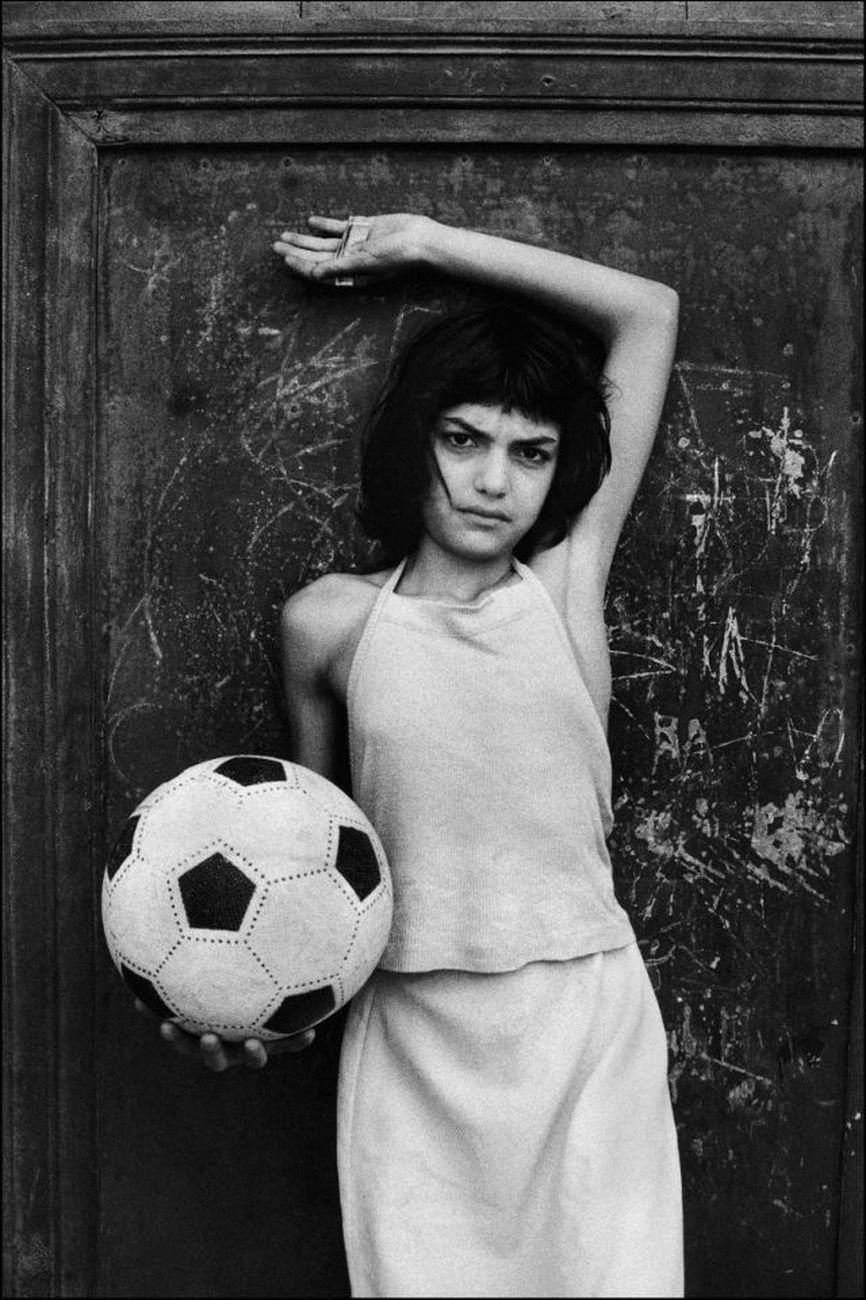
- photographs by Letizia Battaglia (1980) via and via and via

Sunday, 12 September 2021

Skin Tone and Humiliation at the Airport

"I live in Berlin and every time I go back home to Nottingham I get singled out at East Midlands airport – which is pretty small – often by a plainclothes policeman who takes me aside (after standard passport control) and questions me about why I’m in Nottingham and where I’m from and who I work for and what I do etc. It’s extremely humiliating because no one else gets taken aside and I’m always singled out. I have tried various different non-terroristy outfits to no avail.


When I tell the border police this is my home and I’m visiting my mum they usually need a lot of convincing, and also talk to me really slowly as if I’m an idiot, though they are fully aware that I’m a British citizen. To be honest, I don’t really get it: I booked the flights a long time in advance and I do the trip regularly, I don’t understand why I have to be regularly humiliated in this way every time I go home." Belal, 27

"Flying back from Belfast to Manchester after visiting my then girlfriend in Northern Ireland – I was selected “randomly” as I left the flight for further questioning (I was the only non-white passenger). I was questioned as to why I was travelling to Northern Ireland and asked whether I was employed. I was allowed to leave with a timid apology after declaring that I was in fact the parliamentary researcher to the shadow secretary of state for business innovation and skills, and that I could call John Denham MP to confirm if they’d like. 

Initially I was a little embarrassed, as I was taken aside when I got off the plane while all the other passengers walked past me – so it was all in full view and, being the only ethnic minority on the flight, I could only imagine what other passengers were thinking. 

I’ve known a few other ethnic minority people who’ve had similar. One of my friends was profiled and she works for the Department of Education, and my other friend was stopped in New York when trying to attend New York Fashion Week with his job with Victoria Beckham. It was particularly telling when I was an adolescent because my father is quite obviously Indian, whereas my mother is of Irish/Parsi descent and therefore very fair, and there was a difference in how they were treated by security until they realised they were together." Uzair, 26 

"I’m mixed-race (African-British) born and raised in Britain, with a British passport and without any criminal record or anything that might legitimately flag me up for extra security concerns. But despite this, I tend to get extra pat downs every time I go through security. I’ve also been called to one side when about to board flights, and when at the check-in desks and passport desks as well.

The worst case of this was flying Manchester to London and then on to New York, where I got an extra search at each security checkpoint. I was also pulled to one side each time we boarded a flight (after they’d checked my documents and seen my name), and then on arriving at New York, the passport checkpoint carted me off to sit in an extra security section along with people who regularly travel to Cuba and Colombia.

After a couple of hours waiting around there, they searched my suitcase and found some sheet music (I play music as a hobby). We then had a very strange conversation where the security agent was seriously asking me if the sheet music was some form of code. They also asked me a bunch of questions about how long I planned to stay in the US, what work I do, whether I knew anyone there. It was pretty nerve-wracking, particularly as I really started to feel like they might not let me enter the country because the wait to be processed took so long.

When I’m travelling with white people with Anglo-Saxon-sounding names, they never get the extra security checks but I do. I half expect it now because that’s the world we live in. I don’t think the people carrying out the checks are genuinely racist on the whole (maybe some are), but most are just following orders as best they know how.

The problem is when the orders aren’t clear or the staff are under pressure to perform and do not want to miss someone they go overboard trying to do their job partly because cognitive bias and stereotypes are inherent to how we function. We’d all probably benefit from their getting training or support to overcome that. 

I automatically budget in extra time to go through security because I expect to get some form of extra hassle every time I fly. It’s telling that I’m pleasantly surprised on the rare occasions when I don’t get extra attention." Katie, 32 (The Guardian)

- - - - - - -
photographs by Garry Winogrand via and via and via

Friday, 10 September 2021

The Tiger Mum

The most prevailing stereotype of Chinese parenting in the United States is the Tiger Mum described as being strict, harsh, severe and very controlling. The Tiger Mum forces her child to parentally-defined success instead of persuing the child's dreams leading to unhappiness in children.

Chinese parents, however, beg to differ and define their parenting styles neither as tiger mum parenting, nor are they convinced that this model would create the most successful children. Their styles, in fact, cover a wide range of beliefs and approaches.

The concept of the tiger mom as Americans perceive it represents an attempt to use American cultural beliefs of parenting as a baseline from which to make sense of Chinese parenting. The “Tiger mom” has become the go-to phrase for Americans when referring to traditional Chinese parenting styles. This attempt to categorize cultural differences into discrete boxes fails to capture the complex nature of Chinese parenting.

Most of the research carried out to study Chinese parenting styles are based on a culturally-biased theory that was derived from White middle classe samples, a theory that most likely does not capture differences in cultural  beliefs. 

Studies that focus on exploring Chinese parenting beliefs often focus on the cultural notion of training, Chiaoshun, which is rooted in the teachings of Confucius (Chao, 1994, 2001). The most important emphasis in Confucius’s school of thought is respect for the social order, including relationships between individuals as well as relationships between an individual and society (Bond & Hwang, 1986). Based on this idea of consideration for social order, the notion of “training” in Chinese culture encourages parents to teach their children the quality of respect in all of their relationships. As a result, Chinese parents subscribing to this practice reinforce harsh and strict discipline, and hope that their children will learn from their instruction. Thus, parenting practices that appear harsh and strict to others are often simply a culturally-based attempt to train children to act in a socially acceptable manner (Chan et al., 2009). Moreover, when adopting harsh language and strict discipline, Chinese parents assume the children will understand the connotation behind the harsh language. Rather than ruthless punishment, the harsh language and discipline indicates parental trust and high expectations of children’s performances (Chan, Bowes, & Wyver, 2009; Chao, 1994, 2001; Chen & Luster, 2002; Cheung & McBride-Chang, 2008).

The parenting style is not about strictness but about instilling Confucian qualities in children. The priority is that the child becomes "a good person", academic achievement is a close second. Since US-Americans do not know this base and only focus on what they see or believe to see, i.e., harsh practices. Chinese immigrant families combine both, US-American and Chinese approaches creating a cohesive parenting style (via).

- - - - - - -
- Wang, S. (n.d.). The "Tiger Mom": Stereotypes of Chinese Parenting in the United States, link
- photograph by Wang Fuchun via

Thursday, 9 September 2021

The first object of the coloniser...

 "...is to plant deep in the minds of the native population the idea that before the advent of colonialism their history was one which was dominated by barbarism."
Frantz Fanon

photograph via

Wednesday, 8 September 2021

Eve Arnold (III): No Woman in Inverted Commas

"I was green and awed by the male founder members. I hated the 'there-there little girl' pat on the head attitude of a few of my colleagues." When, a great many years later, she was asked what it had been like to be a woman in a man's world, she replied: "It's man in a woman's world!" In fact, she felt that being a woman was an advantage, "a marvelous plus to photographing".

At the time she arrived, photo-journalism was dominated by men. She helped opening the door for women and beacme "a role model for the legion of women phtographers who came after her" (de Giovanni, 2015)-

Twenty-five years ago, when I became a photojournalist, I was looked on as someone apart—a “career lady,” a “woman photographer.” My colleagues were not spoken of in inverted commas; they were not “career men” or “men photographers”. I was not happy about it, but realized as have women before me that it was a fundamental part of female survival to play the assigned role. I could not fight against those attitudes. I needed to know more about other women to try to understand what made me acquiesce in this situation.

It was then that I started my project, photographing and talking to women. I became both observer and participant. I photographed girl children and women; the rich and the poor; the migratory potato picker on Long Island and the Queen of England; the nomad bride in the Hindu Kush waiting for a husband she had never seen, and the Hollywood Queen Bee whose life was devoted to a regimen of beauty care. There were the Zulu woman whose child was dying of hunger and women mourning their dead in Hoboken, New Jersey. I filmed in harems in Abu Dhabi, in bars in Cuba, and in the Vatican in Rome. There was birth in London and betrothal in the Caucasus, divorce in Moscow and protest marches of black women in Virginia. There were the known and the unknown—and always those marvelous faces.

I am not a radical feminist, because I don’t believe that siege mentality works. But I know something of the problems and the inequities of being a woman, and over the years the women I photographed talked to me about themselves and their lives. Each had her own story to tell- uniquely female but also uniquely human.

Themes recur again and again in my work. I have been poor and I wanted to document poverty; I had lost a child and I was obsessed with birth; I was interested in politics and I wanted to know how it affected our lives; I am a woman and I wanted to know about women.

I realize now that through my work these past twenty-five years I have been searching for myself, my time, and the world I live in. Eve Arnold

- - - - - - - -
- de Giovanni, J. (2015). Eve Arnold. Magnum Legacy. Prestel.
- photograph (Havana, 1954) via

Tuesday, 7 September 2021

Eve Arnold (II): Photographing Black Bourgeoisie and Apartheid

In the 1950s, in segregated New York, Eve Arnold ventured to Harlem to capture the world of shows where she hardly went unnoticed. The audiences were all-black and reacted with surprise to her, mostly smiling. Her approach was new, instead of fashion per se she documented skin whitening and hair straightening, recorded social history, as she said. But what was even more new was showing black models.

In 1961, she photographed Malcolm X for the first time; the two developed a strong friendship. When she followed him to rallies and meetings, people spat at her and shouted: "Kill the white bitch". She was escorted from her hotel every day to stay unharmed, every morning started with a phone call from someone with a Southern accent telling her to get "the hell out of town before it was too late". But she stayed two weeks during which she also photographed a rally organised by the American Nazi Party. The moment she raised her camera to shoot George Lincoln Rockwell, the founder of the party, one Nazi said: "I'll make a bar of soap out of you." Arnold answered: "As long as it isn't a lampshade". She continued taking photographs.

In 1964, she documented the life of privileged black US-Americans "The Black Bourgeoisie", a segment that had been hardly explored.

"I spent the last weekend in Philadelphia doing my negro story, and am just beginning to see dayllight and focus - those who made it in spite of the fact that they are negro, and those who are making it now because they are negro - the whole climate has changed in this country, and now they are accepted because of the spending power (20 billions (sic)) - as great as that of Canada - and it is a hell of an interesting story. I am getting a huge charge out of it."

In 1973, the editor of the Sunday Times asked her if she could capture the "tragic and explosive" situation in South Africa and illustrate what it was like to be black in the apartheid system. Eve Arnold anticipated resistance and when applying for a visa told the consul at the embassy that she wanted to photograph animals and people. It took her only two days to get the visa. In South Africa she had to apply for permission to enter the "homelands" of the blacks segregated from where whites were living. It was certainly one way to discourage photographers and journalists. Arnold, however, waited it out and travelled the country waiting for the permission. Once in the homelands, she had to check in with the police every day, or rather, was supposed to do so. Arnold worked outside police hours and by doing so could take photographs that would not have been possible under their surveillance: starving children, malnourished pregnant women receiving very limited and primitive medical care. She witnessed systematic cruelty she had never seen before, families that were split apart, men sent away thousands of miles to work in mines getting a salary of 46 cents a month and the possibility to return home to see their families only once a year. Men worked in terrible conditions, women were often unskilled and illiterate, both doomed to poverty. Her plan was to document the life of a black family living under apartheid. Due to the distances and bureaucratic barriers, documenting one family's life was not possible. Instead, she made two stories, one about men working in a gold mine and one about women and children in a homeland. After three months she returned home (de Giovanni, 2015).

- - - - - -
- de Giovanni, J. (2015). Eve Arnold. Magnum Legacy. Prestel.
- photograph (South Africa) via